

Emergency shelter options for earthquake safety in BC
Posted by Karl Lundgren on
TL;DR:
- Many BC residents mistakenly believe government emergency shelters will be available immediately after a major earthquake, which can lead to inadequate personal preparedness.
- The provincial system provides short-term ESS support for evacuees, lasting approximately 72 hours, but does not serve as a long-term or universal shelter option, especially during large-scale disasters.
Many BC residents assume that when a major earthquake strikes, government emergency shelters will be ready and waiting for their families. This assumption, while understandable, can lead to dangerous gaps in your personal preparedness plan. The term “emergency shelter” carries very different meanings depending on the context, and confusing disaster evacuation support with homelessness or extreme-weather programmes could leave your family unprepared when it matters most. This article clarifies exactly what types of emergency shelter exist in BC, how the provincial system works after a seismic event, and what your family needs to do right now to stay safe.
Table of Contents
- How emergency shelter is defined in BC emergencies
- How emergency support services (ESS) shelters work during disasters
- Staying home: Is it possible after an earthquake?
- Comparing emergency shelter types in BC
- Preparing your family: What you need for sheltering safely
- What most guides miss about emergency shelters and earthquake prep
- Equip your family for sheltering safely in any emergency
- Frequently asked questions
Key Takeaways
| Point | Details |
|---|---|
| ESS shelters are temporary | They provide support for up to 72 hours after a disaster before you must make longer-term arrangements. |
| Sheltering at home is best | If your home is undamaged, staying put with supplies gives the most comfort and control after a quake. |
| Prepare your own supplies | Having an emergency kit ready ensures your family’s well-being whether you shelter at home or at a reception centre. |
| Shelter types have clear roles | Disaster evacuation shelters are distinct from those for homelessness or extreme weather and serve different populations. |
How emergency shelter is defined in BC emergencies
The phrase “emergency shelter” gets used loosely in public conversation, and that lack of precision creates real confusion. In BC, there are two fundamentally different systems that both use this language, and they serve entirely different populations under entirely different circumstances.
The first system is the Emergency Support Services (ESS) programme, administered by the Province of British Columbia and delivered through local governments and registered volunteers. ESS is designed specifically for people who have been displaced by a disaster, whether that is an earthquake, wildfire, flood, or another sudden emergency. ESS includes shelter, food, and support for evacuees for approximately 72 hours after an emergency, and it operates through designated Reception Centres set up in schools, community centres, or other large public buildings.
The second system is the network of homelessness and extreme-weather shelters run by municipalities, non-profits, and social service agencies. These facilities respond to social needs, such as a lack of permanent housing or dangerous cold weather, and they operate on an ongoing or seasonal basis. Homelessness and extreme-weather shelters are distinct from ESS reception centres and are not designed to receive earthquake evacuees.
| Feature | ESS reception centres | Homelessness/extreme-weather shelters |
|---|---|---|
| Purpose | Disaster evacuation support | Social housing needs |
| Trigger | Declared emergency/evacuation order | Ongoing need or extreme weather |
| Duration | Typically 72 hours | Ongoing or seasonal |
| Eligibility | Evacuees displaced by disaster | People experiencing housing insecurity |
| Administration | Province and local government via ESS | Municipalities and non-profits |
Understanding this distinction is not a bureaucratic detail. It is a foundational part of how you plan to protect your family. The role of emergency supplies in your home becomes far more critical once you recognise that ESS support is time-limited, conditional, and not automatically available everywhere.
“ESS is not a long-term housing solution. It is a bridge for the first critical hours after a disaster, designed to stabilise evacuees while longer-term options are arranged.” — BC Emergency Support Services Programme Guide
How emergency support services (ESS) shelters work during disasters
ESS is not a system that turns on automatically when an earthquake occurs. It must be activated by a local authority, usually an Emergency Operations Centre (EOC), in response to the scale and nature of the event. Understanding how this works in sequence helps families set realistic expectations.
When a significant earthquake strikes, here is the general process that unfolds:
- Local EOC activation: The municipal or regional district activates its EOC and assesses damage reports.
- Evacuation orders issued: Affected residents receive evacuation orders or alerts depending on the severity of structural and safety risks.
- Reception centre designated: Local ESS coordinators identify and open a reception centre, typically in a pre-identified facility such as a recreation centre or school.
- Evacuee registration: Arrivals register with ESS volunteers and receive an intake assessment to identify their immediate needs.
- Support provided: ESS workers connect evacuees with temporary lodging, food, emotional support, first aid referrals, and information about the disaster.
- 72-hour review: After roughly 72 hours, the local authority reviews the situation to decide if ESS support can be extended.
Reception centres are designated places to register and access ESS supports for evacuees, and not every community will have one open at the same time. Reception centre locations are determined based on the size of the emergency, the number of people displaced, and available resources.
The following table outlines the core services typically provided at a reception centre:
| Service type | What is provided |
|---|---|
| Shelter | Referrals to hotels, family hosts, or temporary accommodations |
| Food | Meals or vouchers for the immediate period |
| Clothing | Vouchers or donated items if clothing was lost |
| Emotional support | Referrals to mental health workers or counsellors |
| Information | Updates on the emergency and available resources |
ESS is typically available for about 72 hours and may be extended only in exceptional circumstances with provincial approval. This is a short window, and families who arrive at a reception centre expecting weeks of support will find the reality quite different.
Pro Tip: Anyone displaced by a disaster-related evacuation order is eligible for ESS, regardless of income or citizenship status. Bring government-issued identification, any medical prescriptions, and a list of your household members to speed up the registration process. If you have pets, check in advance whether your local reception centre has pet-friendly arrangements, as many do not.
Planning your earthquake preparedness supplies with the 72-hour ESS limit in mind is essential. The system is designed as a bridge, not a destination.
Staying home: Is it possible after an earthquake?
For most BC families, the safest place to be after an earthquake is their own home, provided the structure has not been compromised. Public shelter space at ESS reception centres is finite. After a major Cascadia Subduction Zone event, the number of displaced people would likely overwhelm even a well-organised ESS response.
PreparedBC advises staying home if your housing is undamaged and recommends having emergency supplies on hand for three to fourteen days. This guidance reflects the reality that infrastructure, including roads, water systems, and power, may be disrupted for an extended period after a major seismic event.
Sheltering at home effectively requires having the right supplies ready before disaster strikes. Key essentials include:
- Water: At least four litres per person per day, stored for a minimum of 72 hours and ideally for two weeks.
- Food: Non-perishable items that do not require cooking, such as canned goods, energy bars, and dried fruit.
- Light and power: Battery-powered or hand-crank flashlights, lanterns, and a weather radio.
- Medications: A two-week supply of any prescription medications stored in a waterproof container.
- First aid supplies: A well-stocked kit that includes bandages, antiseptic, and any specific items your family needs.
- Sanitation: A portable toilet or large bucket with heavy-duty bags, toilet paper, and hygiene supplies if water service is disrupted.
- Comfort items: Blankets, warm clothing, and important documents stored in a waterproof bag.
- Communication tools: A battery-operated or hand-crank radio to receive emergency broadcasts.
Pro Tip: Before assuming your home is safe to shelter in, conduct a quick structural check after the shaking stops. Look for cracks in load-bearing walls, damage to your foundation, gas leaks (smell or hissing sounds), and any shifting or tilting of the structure. If you are uncertain, leave and contact a structural engineer or your municipality before re-entering. Your local emergency management office will have posted inspection notices in severely damaged areas.
Knowing how to organise your earthquake kit at home is equally important. Supplies stored in a disorganised way or in multiple locations may be inaccessible after significant structural movement.
Comparing emergency shelter types in BC
To bring full clarity to this topic, it helps to look at all the shelter types available in BC side by side. Each exists for a specific purpose, and understanding which applies to your situation prevents you from arriving at the wrong door during a crisis.
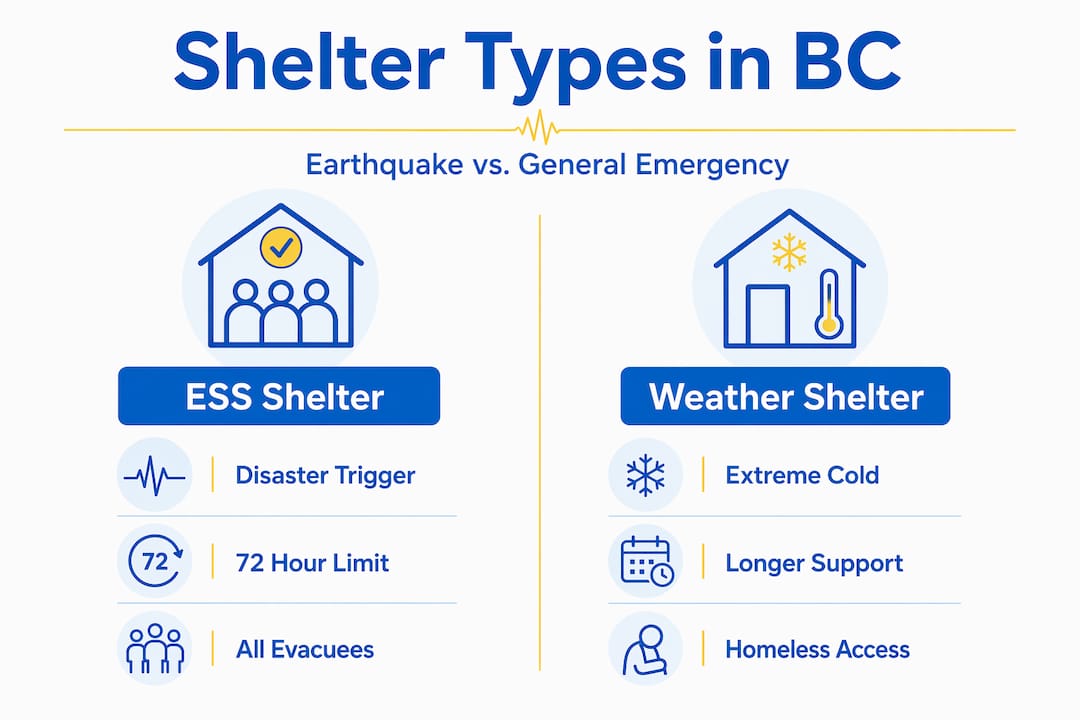
| Shelter type | Trigger | Duration | Who can access |
|---|---|---|---|
| ESS reception centre | Disaster evacuation order | Up to 72 hours (extendable rarely) | Evacuees displaced by disaster |
| Municipal homelessness shelter | Ongoing social need | Ongoing or seasonal | Individuals experiencing homelessness |
| Extreme-weather shelter | Dangerously cold or severe weather | Duration of weather event | People without adequate housing |
| Private hotel or motel (ESS referral) | Disaster evacuation | Short-term per booking | Evacuees referred through ESS |
| Home shelter-in-place | No trigger needed | Unlimited | Any household with supplies |
ESS shelters are for evacuees due to disaster, while homelessness and extreme-weather shelters respond to social needs. These systems simply do not overlap, and the people who run them are not interchangeable.
Knowing which shelter to use means:
- Go to an ESS reception centre if you have received an evacuation order due to an earthquake, fire, flood, or similar disaster.
- Contact municipal social services if you are experiencing housing instability unrelated to a sudden disaster.
- Shelter in place at home if your structure is sound and you have sufficient emergency earthquake supply planning in place.
- Check your local emergency management website for real-time reception centre locations, as these change with every event.
Preparing your family: What you need for sheltering safely
Preparedness is not a single action. It is a series of deliberate decisions made before any emergency occurs. Whether your family shelters at home or must use a public ESS facility, the steps below will put you in a far stronger position.
- Stock your home supply kit. Build a supply cache that supports your entire household for at least 72 hours and ideally up to two weeks. Include water, food, medication, first aid supplies, a flashlight, extra batteries, and a battery-operated radio.
- Prepare a go bag. A go bag is a backpack or duffel bag kept near your front door that contains essentials you can grab within minutes if you receive an evacuation order. It should include water, snacks, medications, identification, cash, a phone charger, and a change of clothes.
- Identify your meeting point. Choose a location outside your home and one outside your neighbourhood where family members will gather if separated.
- Know your evacuation route. Map out two exits from your neighbourhood and identify which roads are most likely to remain passable after an earthquake.
- Store important documents. Keep copies of identification, insurance policies, and medical records in a waterproof folder in your go bag.
- Check on vulnerable family members. Know in advance who in your household or extended family will need extra assistance, including children, elderly relatives, and people with disabilities.
ESS provides short-term shelter, but you should plan for up to two weeks on your own. This is a key planning threshold that often surprises families who have not thought through the full scope of post-earthquake disruption.
Pro Tip: A personal earthquake kit is designed to cover the essentials for one person over the critical first 72 hours. Complement it with a household supply cache that covers the extended period PreparedBC recommends. Having a kit that meets or exceeds the Government of BC’s earthquake kit recommendations ensures you are not relying on a supply system that may be unavailable after the Big One.

What most guides miss about emergency shelters and earthquake prep
Here is an uncomfortable reality that most earthquake preparedness articles gloss over: the ESS system, as well-designed as it is, was never built to handle a Cascadia Subduction Zone megathrust earthquake. A full-scale rupture along the Cascadia fault could displace hundreds of thousands of BC residents simultaneously. Reception centres have limited capacity. ESS volunteers are also community members who may themselves be displaced or dealing with their own families.
This does not mean the system is useless. It means that treating government shelter as your primary plan is genuinely risky. The families who fare best after major disasters are those who have invested in their own resilience first and treat public support as a welcome bonus, not a given.
There is a second issue that rarely gets discussed: reception centre activation is not guaranteed in every community or for every type of earthquake event. A moderate but damaging earthquake might not trigger a formal evacuation order, which means ESS may never activate at all. Families in that situation are entirely on their own without public shelter options, yet their homes may still be unsafe to occupy.
The real goal of earthquake preparedness is not to find your nearest reception centre. It is to reduce your dependence on that system entirely. Storing adequate water, food, medication, and light sources puts the power of resilience back in your hands. Understanding the emergency supply priorities that genuinely matter versus the ones that sound good on a checklist is a skill every BC family should develop now, before the shaking starts.
Self-sufficiency is not pessimism. It is the most practical expression of care for the people you love.
Equip your family for sheltering safely in any emergency
After learning how the ESS system actually works and what its real limitations are, the next step is to take action that puts your family ahead of the uncertainty. A quality earthquake kit is the single most reliable investment you can make in your household’s safety.
EarthquakeKit.ca offers Government of BC earthquake kits that are built to meet provincial recommendations, covering water, food, first aid, light, and communication essentials. For workplaces, community groups, or multi-family households, group earthquake kits provide expanded coverage with everything organised and ready to deploy. Whether you are sheltering at home or navigating a public reception centre for the first time, having your own supplies removes the uncertainty that makes disasters more dangerous. Start your family’s preparedness plan today.
Frequently asked questions
How long do ESS emergency shelters provide support after an earthquake in BC?
ESS support is designed to last 72 hours, and extensions beyond that window are rare and require provincial-level approval. Families should not plan beyond this timeframe when relying on public shelter.
Can anyone access a reception centre during a disaster?
Reception centres open based on emergency scale, evacuee numbers, and available resources, and are designated specifically for people who have received evacuation orders, not for general public use.
Should I plan to use a public shelter or stay home after an earthquake?
If your home is structurally sound, PreparedBC recommends sheltering in place with your own supplies rather than relying on public facilities, which have limited capacity and short support windows.
What is the difference between ESS shelter and homelessness or extreme-weather shelter?
ESS and homelessness shelters serve entirely different needs: ESS is for disaster evacuees displaced by an emergency, while homelessness and extreme-weather shelters respond to ongoing or seasonal social housing needs.
What should I pack if I need to go to an ESS shelter?
Pack at minimum three days of medications, government-issued identification, water, snacks, a phone charger, hygiene supplies, and any comfort items for children or elderly family members. Keep these items in a prepared go bag so you can leave quickly when an evacuation order is issued.
Recommended
Share this post
- 0 comment
- Tags: en, what is emergency shelter