

How to prepare school emergency kits for BC parents
Posted by Karl Lundgren on
TL;DR:
- Preparing school emergency kits with essential supplies can significantly improve a child’s safety during a Cascadia megathrust earthquake. It is crucial to include items like water, non-perishable food, first aid supplies, and comfort items, while ensuring the bag is lightweight and well-organized. Regular maintenance, understanding school protocols, and including region-specific gear enhance overall preparedness for BC’s unique earthquake hazards.
British Columbia sits directly above the Cascadia Subduction Zone, a fault capable of producing a megathrust earthquake powerful enough to reshape coastal communities in minutes. For parents, that risk is never more unsettling than when your child is at school. Knowing how to prepare school emergency kits gives you a concrete way to act on that concern, and this guide covers exactly what to pack, how to pack it, and how to keep it ready, so your child has what they need if the ground ever shifts without warning.
Table of Contents
- Essential items to include in a school emergency kit
- Selecting and packing the right bag
- Maintenance and regular updates for school emergency kits
- Ensuring effective communication and family reunification after an earthquake
- Special considerations for earthquake-specific hazards in BC
- Rethinking school emergency kits: going beyond the basics in BC
- Where to find reliable earthquake kits for your child’s school safety
- Frequently asked questions
Key Takeaways
| Point | Details |
|---|---|
| Include key essentials | Water, food, first aid, and sanitation supplies form the foundation of every school emergency kit. |
| Choose the right bag | Use sturdy, waterproof backpacks that weigh less than a quarter of your child’s body weight for easy carrying. |
| Maintain regularly | Check and refresh kit contents at least every six months to ensure all items are current and usable. |
| Plan communication | Add contact lists and signalling tools like whistles to help family reunite after an emergency. |
| Tailor to BC hazards | Include dust masks, goggles, and mylar blankets to protect against earthquake-related risks unique to BC. |
Essential items to include in a school emergency kit
Having introduced the importance of preparedness, let’s explore the critical supplies your child’s emergency kit needs to contain.
The foundation of any school safety kit preparation starts with water. Plan for at least one gallon (roughly four litres) per person per day. Most guidance recommends a minimum three-day supply, but BC preparedness experts strongly encourage parents to build kits capable of sustaining a child for up to two weeks, given that post-earthquake disruptions frequently exceed the standard 72-hour window.
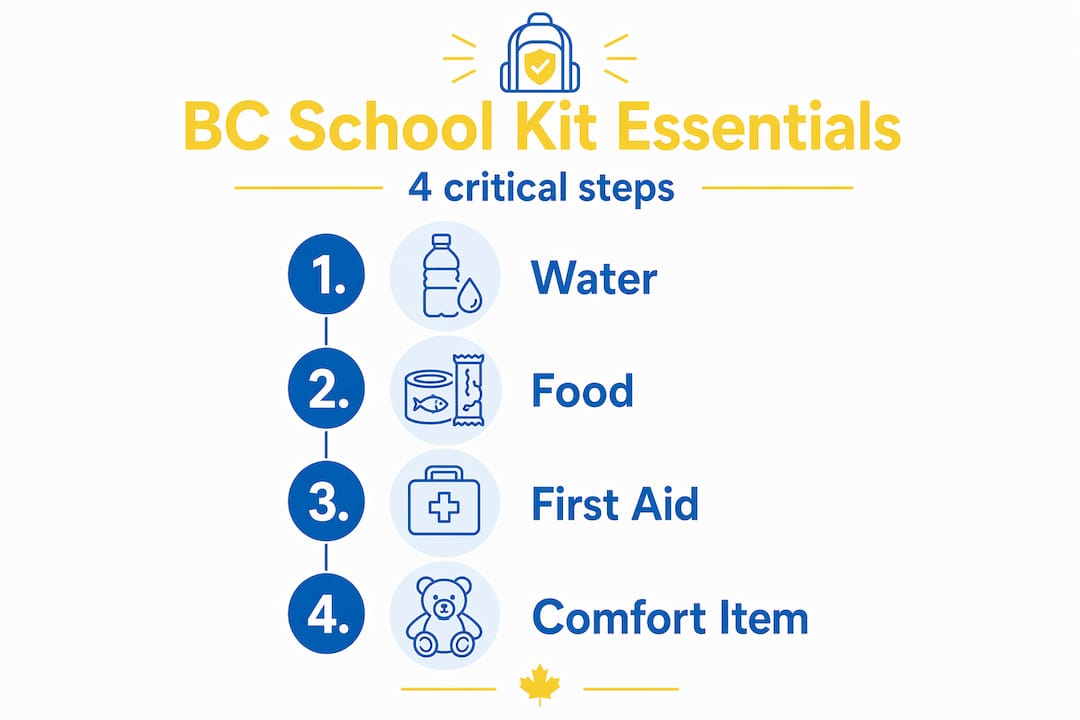
Food is equally non-negotiable. Choose non-perishable items your child will actually eat, such as granola bars, dried fruit, nut butter packets, and crackers. This is not the place for unfamiliar foods; a stressed child is far more likely to eat something recognisable and comforting.
According to Ready.gov’s kit standards, a complete school emergency kit should include the following core supplies for emergency kits:
- At least a three-day water supply (working toward two weeks)
- Non-perishable food for three to fourteen days
- A first aid kit with bandages, antiseptic wipes, and pain reliever
- A flashlight with extra batteries
- A whistle for signalling
- Dust mask (N95 rated if possible)
- Plastic sheeting and duct tape for shelter-in-place situations
- Moist towelettes and garbage bags for sanitation
- A wrench or pliers to turn off utilities
- A manual can opener
- Local maps (printed, not digital)
- A family photo and handwritten contact list
Beyond the basics, child-friendly emergency kit packing guides recommend including small comfort items. A familiar photo, a piece of chocolate, or a folded note from a parent can meaningfully reduce a child’s anxiety during a prolonged wait. These details are small in weight but large in impact.
Pro Tip: Review what makes earthquake kits essential for BC schools before you finalise your list. School protocols vary by district, and some schools have specific requirements for what kits must or cannot contain.
| Item | Minimum quantity | Notes |
|---|---|---|
| Water | 4L per day per child | Sealed pouches recommended for backpacks |
| Non-perishable food | 3-day minimum | Choose familiar foods your child prefers |
| First aid kit | 1 complete kit | Pre-assembled kits save space |
| Flashlight | 1 with backup batteries | LED lasts longer |
| N95 dust mask | 2 or more | Critical for post-quake air quality |
| Whistle | 1 | Louder and more reliable than shouting |
| Mylar blanket | 1 | Compact and essential for BC’s cool climate |
Selecting and packing the right bag
Now that you know what to pack, let’s cover how to select the right bag and pack your child’s school emergency kit efficiently.
The bag itself matters as much as its contents. A well-assembled school emergency bag is useless if it is too heavy for your child to carry, or falls apart when it gets wet. BC emergency preparedness guidelines specify that a backpack for a child’s emergency kit should weigh no more than one-quarter of the child’s body weight and should be both sturdy and waterproof.
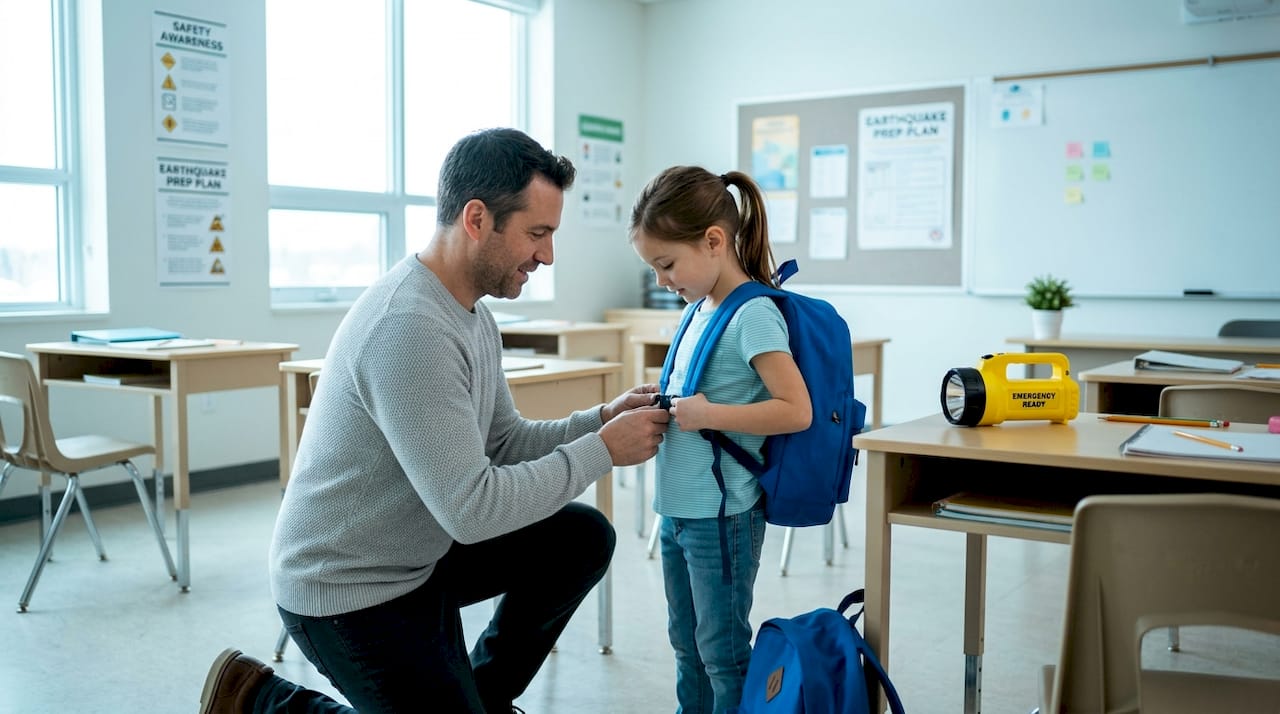
For a child who weighs 40 kilograms, that means the fully packed bag should not exceed 10 kilograms. For younger or smaller children, this weight limit requires careful prioritisation of what goes in and what stays home.
When packing, follow these practical principles:
- Use the main compartment for heavier items like water pouches and food, placed closest to the child’s back for balance
- Store first aid supplies and the flashlight in outer, easily accessed pockets
- Place moisture-sensitive items, including the contact list, batteries, and any medication, inside sealed zip-lock bags or small waterproof pouches
- Label the bag clearly on the outside with your child’s name, school, and your contact number
- Avoid decorative or novelty bags; a plain, dark-coloured sturdy backpack designed for emergency use holds up far better under real conditions
One packing detail many parents overlook: place the whistle on the exterior of the bag, attached to a clip or zipper pull. In a post-earthquake scenario where your child may be under debris or in reduced visibility, reaching into a bag for a whistle is not realistic. External attachment makes it instantly accessible.
Pro Tip: Pack the bag once with your child present. Walk them through each item and explain its purpose. A child who knows what is in their kit and why is far more likely to use it correctly under stress.
Maintenance and regular updates for school emergency kits
Having packed the kit, it is vital to maintain its readiness through regular updates and checks.
An emergency kit that has not been reviewed in eighteen months may have expired food, dead batteries, and clothing that no longer fits. BC regional guidelines recommend checking kits every six months to replace expired items and update contents for seasonal changes.
A structured maintenance routine is straightforward when you break it into steps:
- Set a calendar reminder for every six months, ideally aligned with the twice-yearly time changes in November and March. These are easy anchors that most BC families already recognise.
- Check all expiry dates on food, water pouches, medications, and first aid supplies. Replace anything within three months of its expiry.
- Test the flashlight and replace batteries even if they appear functional. Cold temperatures reduce battery performance significantly in BC winters.
- Update clothing in the kit to reflect the current season. A light jacket packed in July is not adequate for November in Metro Vancouver, let alone in the Fraser Valley or the Interior.
- Review the contact list for accuracy. Phone numbers change, and family circumstances shift. A list that was current two years ago may lead to dead ends when it matters most.
Tape a printed emergency kit checklist for schools to the inside lid or top flap of the bag. This way, whoever does the inspection has an immediate reference without needing to recall the full list from memory.
Pro Tip: Involve your child in the maintenance review. Children who participate in checking their kits understand preparedness as a routine, not a frightening event, which reduces anxiety about earthquakes overall.
Ensuring effective communication and family reunification after an earthquake
Beyond packing supplies, effective communication plays a crucial role in reuniting families after a quake.
When a major earthquake strikes, cell networks overload within minutes. Texts often get through when voice calls cannot, but neither method is guaranteed. Post-earthquake contact strategies developed by insurance and emergency management experts show that the families who reunite most reliably are those who planned specific meeting points and communication methods in advance.
Every student safety kit should include:
- A laminated card with at least three phone numbers (home, both parents’ mobiles, and an out-of-province contact)
- A small notebook and pencil so your child can leave notes at known locations
- A whistle for immediate signalling in the aftermath of shaking
- A portable battery charger (kept charged) for older children with mobile phones
- Clear, written instructions about where to go if school is evacuated and parents cannot be reached immediately
“Whistles and written contact lists are among the most reliable tools for post-earthquake family reunification, because they function even when communication networks are completely overloaded.” — Insurance Bureau of Canada
Teach your child the “Drop, Cover, and Hold On” protocol, but go further. Discuss your family’s specific reunification plan. Which adult picks them up? Where do they wait if that person cannot arrive? What is the backup location? Children as young as seven can understand and remember a two-step plan when it is practised ahead of time. For more guidance, see communication tools in school emergency kits.
Special considerations for earthquake-specific hazards in BC
To enhance safety, it is important to tailor kits to BC’s unique earthquake hazards and climate conditions.
British Columbia’s coastal geography creates conditions that are distinct from other earthquake-prone regions. Post-quake dust clouds from collapsed masonry and drywall are a documented hazard, as are the damp, cool temperatures that persist year-round in Metro Vancouver, Victoria, and along the coast. A BC earthquake preparedness resource specifically highlights the importance of dust masks, goggles, and mylar blankets in school kits to address these regional risks.
| Hazard | Recommended item | Why it matters in BC |
|---|---|---|
| Airborne dust and debris | N95 dust mask and safety goggles | Collapsed buildings generate toxic dust plumes |
| Hypothermia risk | Mylar (emergency) blanket | Coastal BC is damp and cool, especially in autumn and winter |
| Sanitation disruption | Toilet bags and moist towelettes | Sewage lines rupture in earthquakes; washrooms may be unusable |
| Rain and wet conditions | Waterproof bag and rain poncho | BC precipitation makes dry shelter critical |
| Extended shelter-in-place | Extra food and hygiene supplies | Schools may shelter students for many hours post-quake |
Additional items worth including based on BC-specific earthquake kit guidance:
- Safety goggles (not just glasses) that seal against debris
- A compact rain poncho stored in an outer pocket
- Hand sanitiser and a small supply of toilet tissue
- Any prescribed medication your child requires, with dosage instructions written in plain language for a teacher or first responder
These are not extras. In BC’s coastal climate, the gap between a child who is cold, wet, and unable to breathe safely and one who is protected can come down to three items that weigh less than 200 grams combined.
Rethinking school emergency kits: going beyond the basics in BC
Here is an uncomfortable reality most preparedness articles will not say directly: the standard 72-hour kit minimum is almost certainly not enough for a Cascadia megathrust event.
The Cascadia Subduction Zone can produce a magnitude 9.0 or greater earthquake. The infrastructure damage from such an event would be extensive, with bridges, water systems, and roads potentially out of service for days to weeks. Experts and BC preparedness advocates increasingly urge parents to build toward two weeks of supplies, not three days. Three days is a starting point. It is not a finish line.
There is also a practical dimension that goes beyond supply quantity. Emotional resilience matters. A child sitting in a school gymnasium for twelve hours after an earthquake is not just physically in need; they are anxious, possibly in shock, and separated from their family. A small family photo, a handwritten note from a parent, or even a single piece of comfort food can provide meaningful psychological stability. These items weigh almost nothing and cost almost nothing, yet they are absent from the majority of school kits we see.
The second thing conventional guidance tends to understate is the importance of school-specific knowledge. Talk to your child’s school about their emergency plan. What is their reunification protocol? Where will students be held if parents cannot arrive quickly? What supplies does the school already have on hand? Understanding the school’s own plan helps you identify gaps in your child’s personal kit rather than duplicating what is already there.
Finally, treat kit maintenance as a standing appointment, not an occasional reminder. A kit that is checked once and forgotten provides false assurance. The families who are genuinely prepared are those who treat preparedness as an ongoing practise, not a one-time purchase. See why extended emergency kits matter for BC families for further context on preparing beyond the minimum.
Where to find reliable earthquake kits for your child’s school safety
Understanding how to assemble school emergency bags is one thing. Having a trusted, ready-made option available makes acting on that knowledge much simpler.
EarthquakeKit.ca serves BC families and schools with pre-assembled kits built for the specific hazards of coastal and inland British Columbia. Whether you are starting with a basic earthquake kit for a single child or outfitting a classroom with group earthquake kits for schools, the kits are designed to meet and exceed provincial preparedness guidelines. For parents who prefer to build their own kit or supplement an existing one, individual personal earthquake supplies are available to fill specific gaps. Every kit is backed by expert guidance and quality assurance, so you spend less time second-guessing and more time feeling genuinely prepared.
Frequently asked questions
How often should I check and update my child’s school emergency kit?
Check and replace expired items in your child’s kit every six months, including food, water, medications, and batteries, to ensure everything remains usable when it counts.
What is the minimum amount of water to include per person in a school emergency kit?
Plan for at least 4 litres of water per person per day, covering both drinking and hygiene needs, with a minimum three-day supply and ideally working toward two weeks.
Should school emergency kits include items for communication?
Yes. Include contact lists and signalling tools like whistles to help your child and teachers attract attention and share information when phone networks are overloaded after an earthquake.
How can school emergency kits address BC’s unique earthquake hazards?
Dust masks and goggles protect against post-quake debris clouds, while mylar blankets guard against hypothermia in BC’s cool and damp coastal climate during extended shelter-in-place situations.