

Why prepare for the big one: a BC family guide
Posted by Karl Lundgren on
TL;DR:
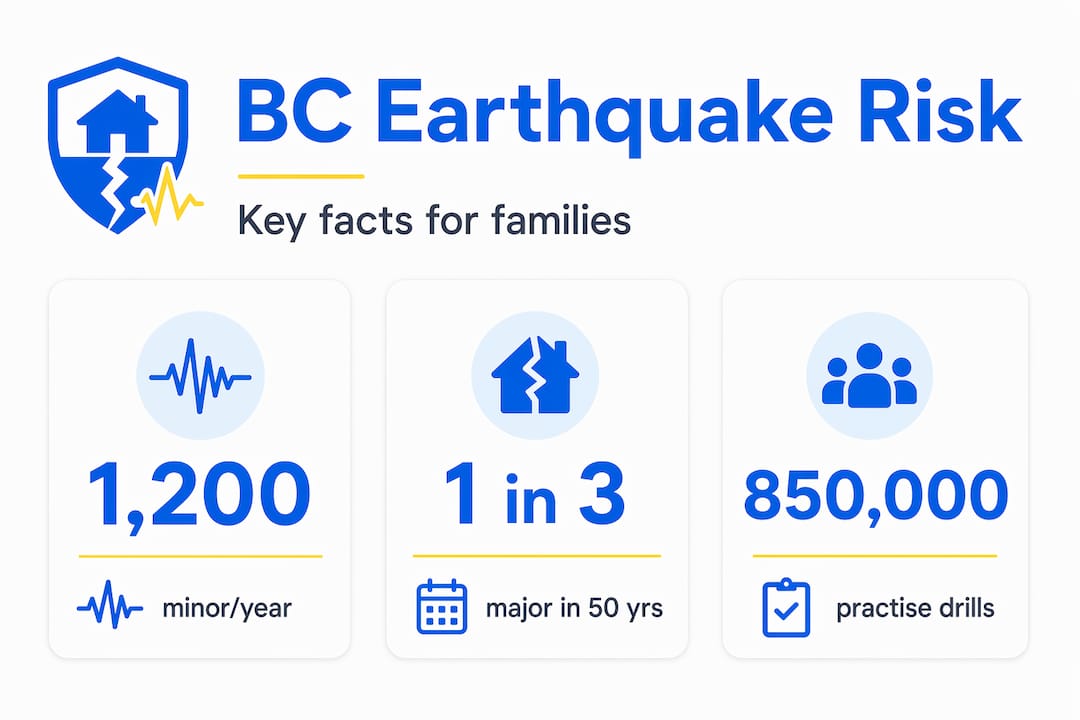
- British Columbia experiences about 1,200 earthquakes annually, with a significant risk of a major quake within 50 years.
- Preparedness involves practicing drop, cover, and hold on, assembling emergency kits, and rehearsing family plans to reduce harm and ensure resilience.
British Columbia averages about 1,200 earthquakes per year, yet most families have done little more than glance at a preparedness brochure. Understanding why prepare for the big one matters is not about living in fear — it is about accepting a geological reality that seismologists have been clear about for decades. The Cascadia Subduction Zone, a fault running offshore from northern Vancouver Island to northern California, is capable of producing a megathrust earthquake of magnitude 9.0 or greater. When it ruptures, it will not send a calendar invite first. This guide explains what the science tells us, what your family should do, and how to act before the ground moves.
Table of Contents
- Earthquake risk and why it matters in British Columbia
- The crucial moment: what to do when the shaking starts
- Being self-sufficient for 72 hours: preparing your emergency kit and plan
- Drills and routines: why practising preparedness changes outcomes
- Summary: why preparation reduces harm and builds resilience
- Rethinking readiness: what most people miss about earthquake preparation
- Find the right earthquake kit to protect your family
- Frequently asked questions
Earthquake risk and why it matters in British Columbia
Many BC residents treat the threat of a major earthquake the way people treat storm warnings: something to acknowledge briefly before moving on. The numbers suggest that attitude carries real risk. An earthquake capable of causing structural damage is expected roughly once every decade in BC, and there is a one in three chance of a major, damaging quake occurring within the next 50 years. That is not a distant hypothetical — it is a statistical certainty playing out over a human lifetime.
The Cascadia Subduction Zone is not the only concern. The region also sits above crustal faults and the Juan de Fuca plate, meaning seismic energy can originate from multiple sources at varying depths. Shallow crustal quakes, in particular, can cause intense localised shaking even at moderate magnitudes. Victoria, Vancouver, and the Fraser Valley sit in areas where soil amplification can multiply ground motion significantly.
“A major, damaging earthquake has a 1 in 3 probability of occurring in British Columbia in the next 50 years.” — Regional District of Nanaimo
Consider what that probability means in practical terms. If you live in BC for 30 to 40 years, you are more likely than not to experience at least one earthquake severe enough to damage buildings, disrupt utilities, and overwhelm emergency services. Reviewing an earthquake preparedness checklist is one of the most direct ways to translate awareness into action.
| Risk factor | Detail |
|---|---|
| Frequency of minor earthquakes | Approximately 1,200 per year in BC |
| Frequency of damaging earthquakes | Approximately once every decade |
| Probability of a major quake in 50 years | 1 in 3 (roughly 33%) |
| Primary fault source | Cascadia Subduction Zone |
| Additional fault sources | Crustal faults, Juan de Fuca plate |
Now that you understand the risk level in BC, let us explore what happens immediately when an earthquake strikes and the critical actions you should take.
The crucial moment: what to do when the shaking starts
When an earthquake begins, you have seconds to make a decision that could determine whether you walk away with minor bruises or serious injuries. Most earthquake injuries occur from falling objects, shattered glass, and people attempting to run outside during shaking. The correct response is “Drop, Cover and Hold On,” and it is the one technique that consistently reduces harm across all scenarios.
Here is what that looks like in practice:
- Drop to your hands and knees immediately, which protects you from being knocked over
- Cover your head and neck under a sturdy table or desk, or against an interior wall away from windows
- Hold on to your shelter and be prepared to move with it until shaking stops
- Stay away from exterior walls, glass, and heavy furniture that could topple
- If you are outdoors, move away from buildings, power lines, and trees
- If driving, pull over safely and stay inside the vehicle until shaking subsides
Over 850,000 people in BC participated in ShakeOut Week, practising this exact protocol to build the instinct needed to react without thinking. That matters more than most people realise. Under sudden stress, the brain defaults to practised behaviour. Families that rehearse “Drop, Cover and Hold On” together react faster and more calmly than those who have only read about it.
Pro Tip: Run a surprise drill at home. Call out “earthquake!” without warning during an ordinary evening and see how each family member responds. The first attempt is usually awkward. That is exactly why you practise.
Understanding the importance of earthquake kits goes hand in hand with knowing how to survive the initial shaking. Both matter equally.
With safety during shaking covered, let us look at how to prepare to sustain yourself after the quake ends.
Being self-sufficient for 72 hours: preparing your emergency kit and plan
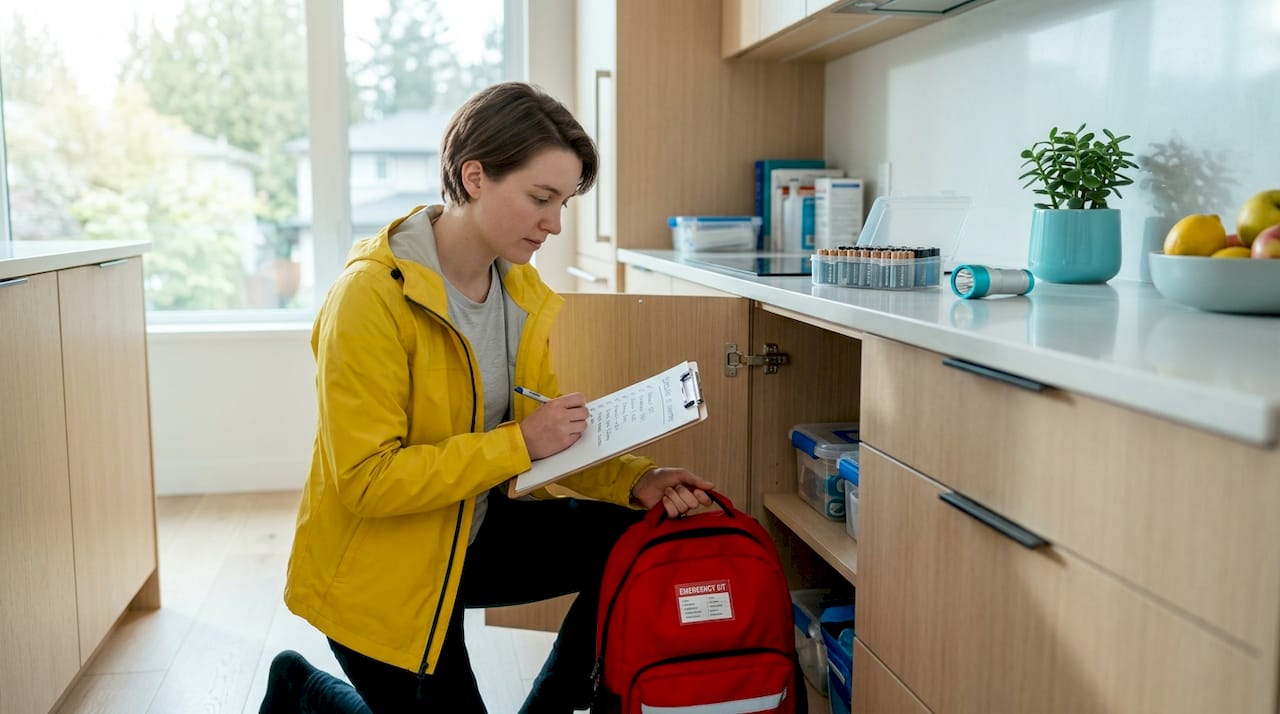
The moment shaking stops, the real challenge begins. Roads may be blocked. Gas mains may be ruptured. Hospitals may be overwhelmed. Emergency responders, no matter how well-trained, cannot reach everyone simultaneously. First responders may take several days to reach affected areas, which means your family’s safety for the first three days rests entirely on what you have prepared in advance.
Here is how to build that foundation:
- Store water — At minimum, four litres per person per day for 72 hours. Include a water purification method as a backup.
- Stock non-perishable food — Aim for three days of meals that require minimal cooking. Include a manual can opener.
- Prepare a first aid kit — Include prescription medications, bandages, antiseptic, and any specific medical supplies your household requires.
- Gather personal documents — Copies of identification, insurance papers, and medical records stored in a waterproof container.
- Add communication tools — A battery-powered or hand-crank radio to receive emergency broadcasts, and a charged external battery pack for phones.
- Include warmth and shelter items — Emergency blankets, a change of clothes, and sturdy footwear for each family member.
- Reduce hazards at home — Strap bookshelves and water heaters to walls, install cabinet latches, and secure heavy items that could fall.
| Kit category | Basic kit | Deluxe kit |
|---|---|---|
| Water supply | Individual bottles | Filtration system included |
| Food supply | 3-day ration bars | 3-day variety meal packs |
| First aid | Standard kit | Extended medical kit |
| Shelter | Emergency blanket | Tent and sleeping bag |
| Communication | Whistle | Hand-crank radio |
| Power | Spare batteries | Solar charger included |
A comprehensive emergency kit guide for BC walks you through each category in greater depth, including specific product recommendations and quantities based on household size.
Pro Tip: Keep a second, smaller kit in your vehicle. If a major earthquake occurs while you are away from home, you need supplies where you are, not where you were planning to be.
Also establish a family communication plan. Agree on an out-of-province contact that all family members can reach, since local phone lines often fail while long-distance calls still connect. Identify two meeting points — one near home and one farther away in case your neighbourhood is inaccessible.
Now that you know what to prepare, let us consider how rehearsing these plans through drills sharpens your readiness.
Drills and routines: why practising preparedness changes outcomes
Owning an emergency kit is not the same as being prepared. A kit sitting in the back of a closet with expired supplies and an outdated contact list offers only the illusion of readiness. What separates households that recover quickly from those that struggle is practised behaviour and regularly reviewed plans.
ShakeOut BC is the province’s annual earthquake drill, and the results show measurable improvements in survival and recovery outcomes for those who participate. Beyond the drill itself, it is an annual reminder to do the work: check your kit, update your contact list, confirm your family communication plan, and review your home for new hazards.
Build preparedness into your household calendar with these habits:
- Rotate food and water supplies every six months to prevent expiry
- Review medications and update prescriptions in your kit annually
- Practice “Drop, Cover and Hold On” with your household at least twice a year
- Walk through your home to identify new hazards after any renovation or furniture change
- Confirm your out-of-province contact is still reachable and aware of their role
“Drills that involve practising protective actions and reviewing plans result in better survival and recovery outcomes for individuals and communities.” — Insurance Bureau of Canada
Using a well-organised kit organisation guide helps ensure nothing is forgotten between reviews. Preparedness is not a one-time task. It is a habit, and habits improve with repetition.
With these practices in mind, let us summarise why preparing for the big one is not just sensible but essential for BC families.
Summary: why preparation reduces harm and builds resilience
Preparation does not make earthquakes less powerful. What it does is change the outcome for your family, your neighbours, and your community. Preparedness reduces impacts on family, property, and community, enabling a faster, more organised recovery after a major event.
Consider the compounding effect of household readiness across a neighbourhood. When families are self-sufficient for 72 hours, emergency responders can concentrate on critical rescues rather than distributing water or providing basic first aid to people who could have been self-reliant. Your preparation is not just personal. It frees up resources for those who genuinely cannot help themselves.
Key reasons to act now:
- Reduced injury risk from practised drop-and-cover behaviour
- Sustained basic needs for your household when utilities and supply chains fail
- Faster personal recovery because you have documents, medications, and a plan
- Lower community burden on emergency services during a large-scale event
- Psychological resilience, because families who have prepared feel calmer and more capable during a crisis
Tips for earthquake readiness do not require a significant investment of money or time. Many of the most effective steps cost nothing at all. Knowing what to do in a major crisis before one occurs is what distinguishes a household that manages from one that is overwhelmed.
Choosing the right emergency kit for your family is a strong starting point, particularly if you are building your preparedness plan from scratch.
Rethinking readiness: what most people miss about earthquake preparation
Here is the uncomfortable truth that most preparedness articles skip past: many BC residents unconsciously believe that if the big one hits, help will arrive soon and the situation will be manageable. That belief is understandable. It is also dangerous.
Emergency management planners have been explicit that a Cascadia megathrust earthquake would be a multi-jurisdictional disaster affecting hundreds of thousands of people simultaneously. Fire stations may be damaged. Bridges may be impassable. The Port of Vancouver, through which most goods enter the region, could be offline for days or weeks. The gap between when the shaking stops and when meaningful external assistance reaches most households is measured in days, not hours.
The second misconception worth addressing is that preparation means predicting or preventing earthquakes. It does not. Seismology cannot tell us when the next major event will occur. What it can tell us, clearly and consistently, is that the risk is real, it is significant, and the gap between prepared and unprepared families will be wide when it materialises.
Preparation is also not about stockpiling supplies out of anxiety. It is an act of responsibility, toward your children, your elderly neighbours, and your community. Families who have reviewed an earthquake preparedness checklist and acted on it do not spend more time worrying about earthquakes. They spend less, because they know what they have and what they would do. That is the real value of readiness: it replaces helplessness with capability.
Find the right earthquake kit to protect your family
Understanding the risk is step one. Having the right supplies is step two. EarthquakeKit.ca offers a range of earthquake kits built specifically for BC households, sized for individuals, couples, and families, and designed to meet the 72-hour self-sufficiency standard that both the Province of BC and the Government of Canada recommend.
Whether you are starting from zero or upgrading an outdated kit, there is an option at every level. Explore our basic earthquake kits for an affordable entry point that covers the essentials, or review our deluxe earthquake kits for expanded supplies including enhanced food, shelter, and communication tools. Families looking for government-endorsed options can browse our government BC earthquake kits, which meet provincial preparedness standards. Every kit is ready to go — no assembly required.
Frequently asked questions
How likely is it that ‘the big one’ will hit British Columbia?
A 1 in 3 probability exists for a major, damaging earthquake in BC within the next 50 years, and damaging earthquakes occur approximately once every decade.
What is the best immediate action during an earthquake?
The recommended response is to “Drop, Cover and Hold On” immediately, getting low, protecting your head and neck, and staying sheltered until the shaking stops completely.
Why should I prepare for 72 hours of self-sufficiency after an earthquake?
Because first responders may need several days to reach affected areas during a large-scale event, having your own food, water, and medical supplies for at least 72 hours is critical for your family’s safety.
How often should I update my emergency kit and plan?
Check your kit every six months to replace expired food and water, update medications, and ensure your communication plan and personal documents are current.
Are earthquake early warning alerts available in British Columbia?
Yes. The Earthquake Early Warning system is now operational in western BC, providing seconds to tens of seconds of advance notice before shaking arrives, giving residents a brief but valuable window to take protective action.
Recommended
- Family earthquake preparedness: Protecting your loved ones in BC – EarthquakeKit.ca
- How to prepare kids for earthquakes: BC family safety guide – EarthquakeKit.ca
- Earthquake safety tips every BC mom needs right now – EarthquakeKit.ca
- Earthquake Kit Organization Guide for BC Families – EarthquakeKit.ca