

Why earthquake kits matter: Be ready, stay safe in BC
Posted by Karl Lundgren on
TL;DR:
- British Columbia faces high seismic risk from the Cascadia Subduction Zone with potential for devastating earthquakes.
- Proper emergency kits should include water, non-perishable food, first aid, tools, and critical documents.
- Preparedness, including multiple tailored kits and regular drills, is essential for safety and community resilience.
British Columbia sits atop one of the most seismically active regions in Canada, and the numbers are sobering. BC faces high seismic risk with the potential for catastrophic losses and a long history of frequent tremors. Yet many households remain without a single emergency supply. An earthquake kit is not a luxury or an overreaction. It is a practical, proven tool that gives you and your family a real chance of staying safe and self-sufficient when the ground shifts beneath you. This guide explains why kits are essential in BC, what yours should contain, how to choose the right type, and how to actually use it when it counts.
Table of Contents
- Why earthquake kits are essential in British Columbia
- What should your earthquake kit include?
- Different types of earthquake kits for various needs
- How to use earthquake kits during and after an emergency
- Common mistakes and how to improve your earthquake preparedness
- A fresh perspective: Why BC’s earthquake reality demands action, not luck
- Take the next step: Equip your home and protect your loved ones
- Frequently asked questions
Key Takeaways
| Point | Details |
|---|---|
| BC faces real earthquake risk | Most residents live in an area exposed to severe shaking and infrastructure threats. |
| Kits mean survival and self-reliance | Prepared kits help you and your loved ones manage after a quake, often before help arrives. |
| Home and grab-and-go kits serve unique roles | Separate kits for home and evacuation are both essential for complete earthquake preparedness. |
| Customise for all household needs | Account for pets, children, special diets, and medications when assembling kits. |
| Preparation beats complacency | Regular updates and community-level planning make the biggest difference when disaster strikes. |
Why earthquake kits are essential in British Columbia
British Columbia’s position along the Cascadia Subduction Zone places it in a category of seismic risk that most Canadians outside the province simply do not face. The Cascadia Subduction Zone is a roughly 1,000-kilometre fault running offshore from northern Vancouver Island down to northern California, where the Juan de Fuca tectonic plate is slowly sliding beneath the North American plate. When that fault ruptures, the result is a megathrust earthquake, one of the most powerful types on Earth.
The odds are not abstract. The Cascadia Subduction Zone carries a 2 to 10 per cent chance of producing a magnitude 9.0 megathrust earthquake in the next 30 years, with the potential for massive casualties and infrastructure loss. That risk sits alongside the day-to-day reality that roughly 4,000 earthquakes are recorded in BC every year, and recent moderate events have repeatedly exposed how unprepared many communities remain.
When a major earthquake strikes, first responders will be overwhelmed. Roads may be impassable, utilities will likely fail, and hospitals will be stretched beyond capacity. The expectation that help will arrive within hours is not realistic after a catastrophic event. This is precisely why how emergency kits help BC residents matters so much. A well-stocked kit gives your household the ability to function independently for days or even weeks.
Consider what self-sufficiency actually means in that context:
- Clean drinking water when taps run dry
- Food that requires no refrigeration or cooking fuel
- First aid supplies before medical help is available
- Warmth, light, and communication tools when power is out
- Critical documents to support insurance claims and identification
“The question is not whether a major earthquake will affect British Columbia. The question is whether you will be ready when it does.”
Exploring BC earthquake kit options tailored to provincial guidelines is a practical first step toward genuine readiness.
What should your earthquake kit include?
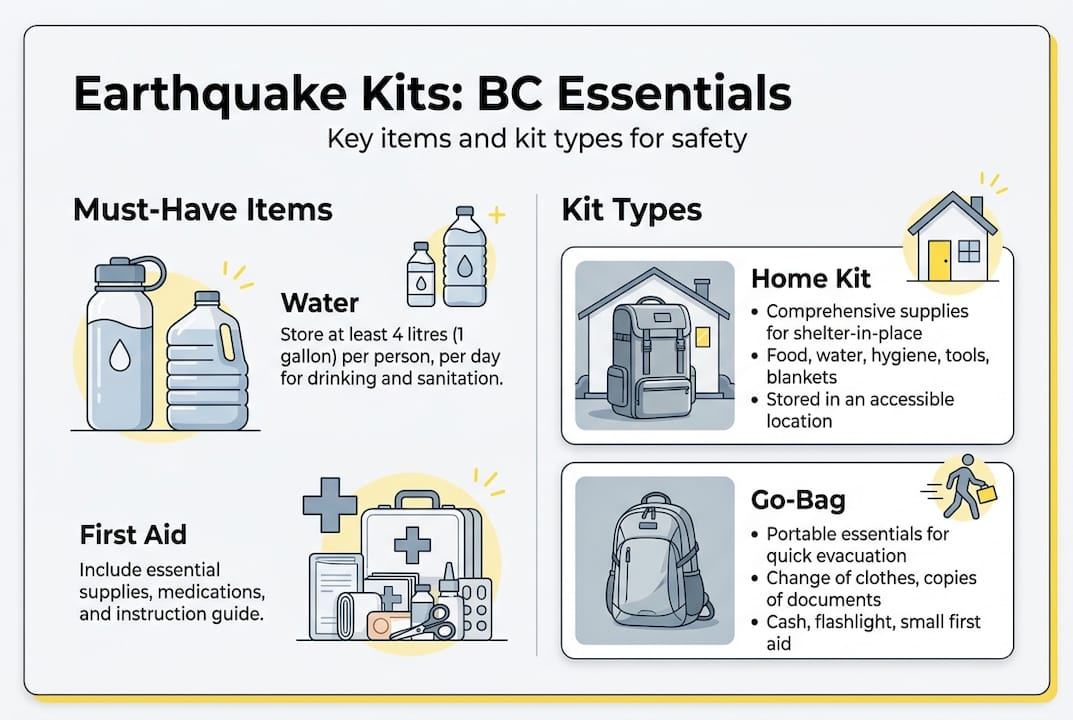
Knowing you need a kit is one thing. Knowing exactly what goes in it is another. The City of Surrey and other BC authorities are clear: a household kit must include 4 litres of water per person per day, with 2 litres for drinking and 2 for hygiene and food preparation. For a family of four, that means storing at least 16 litres per day of emergency.
Here is a numbered breakdown of the core categories every BC household kit should cover:
- Water: Minimum 4 litres per person per day, stored in sealed, food-grade containers
- Food: Non-perishable items such as canned goods, energy bars, dried fruit, and peanut butter
- First aid: A complete kit including bandages, antiseptic, pain relievers, and any prescription medications
- Tools and safety: Flashlight, extra batteries, a hand-crank or battery-powered radio, whistle, and work gloves
- Warmth and shelter: Emergency blankets, a change of clothing, and rain gear
- Documents: Copies of identification, insurance policies, bank information, and emergency contacts in a waterproof pouch
- Communication: A charged portable battery pack and a written list of key phone numbers
| Household member | Special considerations |
|---|---|
| Infants | Formula, nappies, baby food, and a comfort item |
| Elderly residents | Extra medications, mobility aids, and medical alert information |
| Pets | Food, water, carrier, vaccination records, and a leash |
| People with disabilities | Adaptive equipment, extra supplies, and a personal support plan |
Pro Tip: Check expiry dates on food, water, and medications every six months. Many people set a calendar reminder aligned with daylight saving time changes, which makes it easy to remember.
Storage matters too. Keep your main kit in a cool, dry location that is accessible but not blocked by furniture or clutter. Review earthquake kit personal supplies to ensure your household is not missing critical items, and consult an emergency kit guide built specifically for British Columbians.
Different types of earthquake kits for various needs
One kit is a good start. Multiple kits are a complete strategy. The Regional District of Nanaimo and other BC authorities recommend multiple kits for home, car, and work, each with tailored contents and storage approaches suited to where you are when a quake strikes.
Home kit: This is your most comprehensive kit. It should sustain your entire household for one to two weeks, covering water, food, medical needs, and comfort items. Store it in an accessible spot near an exit.
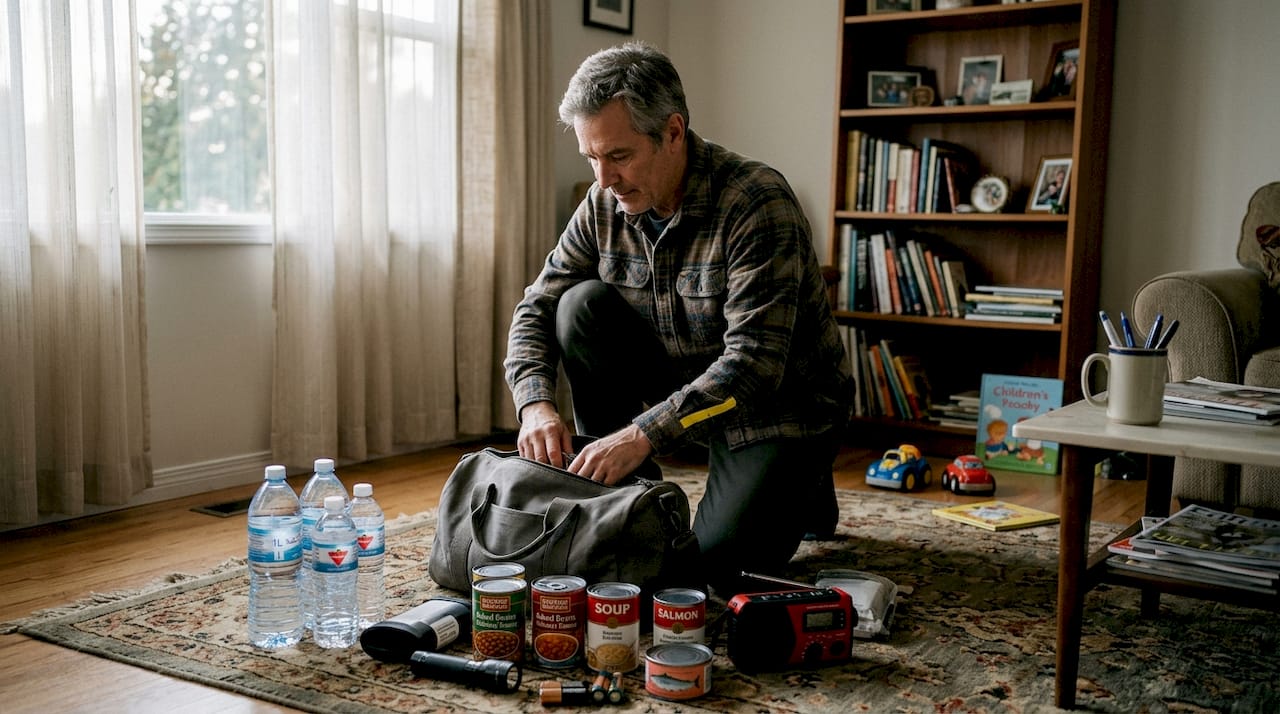
Grab-and-go kit: Also called a go-bag, this is a portable backpack or duffel bag with 72 hours of essentials. It is designed for rapid evacuation when staying home is not safe. Keep it light enough that every adult in the household can carry their own.
Car kit: Earthquakes do not wait until you are home. A car kit should include water, a basic first aid kit, a reflective vest, a small tool kit, emergency blankets, and a copy of your key documents. Store it in the boot of your vehicle.
Work kit: Many British Columbians spend eight or more hours a day at their workplace. A small desk or locker kit with water, snacks, medications, and walking shoes can make a critical difference if you cannot get home immediately after a quake.
| Kit type | Duration | Key contents | Storage location |
|---|---|---|---|
| Home kit | 1 to 2 weeks | Full supplies, documents, tools | Accessible indoor location |
| Grab-and-go | 72 hours | Portable essentials, ID, cash | Near front door or exit |
| Car kit | 24 to 48 hours | Water, first aid, tools, blankets | Vehicle boot |
| Work kit | 24 hours | Water, snacks, medications, shoes | Desk or locker |
Pro Tip: Label each kit clearly and brief every household member on where each one is stored and when to use it. Preparedness only works if everyone knows the plan.
For guidance on matching the right kit to your family’s situation, see choosing the right kit and download an earthquake preparedness checklist for BC residents.
How to use earthquake kits during and after an emergency
Having a kit is only half the equation. Knowing how to use it under pressure is what separates prepared households from vulnerable ones. When shaking begins, the immediate priority is personal safety, not reaching for your kit.
Follow these steps in order:
- Drop, Cover, Hold On. Get low, take cover under a sturdy table or desk, and hold on until the shaking stops. Do not run outside during shaking.
- Avoid doorways. The doorway myth is persistent but wrong. Modern buildings are not designed to make doorways safer than other structural points. A table offers far better protection.
- Once shaking stops, check for injuries. Attend to yourself and others before assessing property damage.
- Check for hazards. Look for gas leaks, fire risks, and structural damage before moving through the building.
- Access your kit. Retrieve water, first aid supplies, and your radio to assess the situation and begin self-care.
- Decide on shelter. If your home is structurally sound, shelter in place. If not, take your grab-and-go kit and evacuate to a designated community gathering point.
“After a quake, check for injuries and hazards, shelter if necessary, and ensure you are prepared for aftershocks and additional hazards using your kit.”
Aftershocks are common and can be nearly as strong as the initial event. Tsunamis are a real secondary risk for coastal BC communities. If you are near the coast and feel strong shaking, move inland and uphill immediately without waiting for an official warning. Your kit should support at least several days of independence while authorities restore services. For practical guidance on organising your kit so it is ready to use quickly, review the organisation guide tailored for BC families.
Common mistakes and how to improve your earthquake preparedness
Even well-intentioned households make preparedness mistakes that leave them vulnerable. Recognising these pitfalls is the first step toward fixing them.
Common mistakes include:
- Assembling a kit once and never reviewing it again
- Storing expired food, water, or medications without realising it
- Building a generic kit that does not account for infants, elderly members, pets, or medical conditions
- Assuming 72 hours of supplies is sufficient when a major quake could disrupt services for far longer
- Relying on a single home kit without a grab-and-go bag or car kit
- Not sharing the plan with all household members
Roughly 92 per cent of BC’s population is exposed to significant earthquake risk, yet preparedness rates remain low. Extending your kit beyond 72 hours and customising it for your household’s specific needs is strongly advised by emergency management professionals across the province.
The consequences of under-preparation are well documented. Case studies show that lack of preparedness leads directly to greater casualties and prolonged hardship in the aftermath of major seismic events.
Pro Tip: Schedule a household preparedness drill twice a year. Walk through where each kit is stored, confirm everyone knows the evacuation plan, and replace any expired items on the spot. It takes less than an hour and could save lives.
For a thorough review of what belongs in your kit and why, visit what is an earthquake kit for a foundational guide built for BC residents.
A fresh perspective: Why BC’s earthquake reality demands action, not luck
Here is the uncomfortable truth that most preparedness articles avoid saying plainly: complacency is the real threat. Not the Cascadia fault. Not the seismic data. The greatest risk to British Columbians is the widespread belief that a catastrophic earthquake is someone else’s problem, or that it will not happen during their lifetime.
That belief is statistically unjustified and morally costly. When you are unprepared, you do not just put yourself at risk. You become a burden on first responders, neighbours, and community resources that are already stretched thin. Preparedness is not a personal lifestyle choice. It is a shared responsibility.
Experts are unambiguous: kits are non-negotiable, and preparedness saves lives. Every household that builds a proper kit reduces the collective strain on emergency services and frees up resources for those who truly cannot help themselves.
The next significant earthquake in BC is not a matter of if. It is a matter of when. Choosing to act now, rather than waiting for a close call to motivate you, is the most rational and responsible decision you can make. Start with choosing kits for families and take the first concrete step today.
Take the next step: Equip your home and protect your loved ones
Building your earthquake kit does not have to be complicated. EarthquakeKit.ca offers trusted, BC-specific options designed to meet provincial and federal preparedness guidelines, so you can get started with confidence.
Browse our basic earthquake kits for a solid foundation, or explore personal supplies kits to fill the gaps in an existing setup. If you are preparing for a workplace, strata building, or community group, our group earthquake kits are built for larger-scale readiness. Every kit we offer is designed with British Columbia’s unique seismic risks in mind. The time to prepare is before the shaking starts.
Frequently asked questions
How much water should each person have in an earthquake kit?
Every person should have at least 4 litres of water per day in their household kit, with 2 litres for drinking and 2 for hygiene and food preparation.
How long should a home earthquake kit last in BC?
A well-prepared kit should sustain each person for one to two weeks at home, since aid may not arrive quickly following a major quake.
What’s the difference between a home kit and a grab-and-go kit?
A home kit provides supplies for several days or weeks in place, while a grab-and-go kit is lighter and portable, designed for 72-hour evacuation scenarios when leaving quickly is necessary.
Why is just 72 hours of supplies not enough in BC?
Large earthquakes can overwhelm emergency services for far longer than three days, which is why experts recommend at least one week of supplies for BC households.