

How BC schools empower families for disaster preparedness
Posted by Karl Lundgren on
TL;DR:
- British Columbia faces an imminent seismic threat from the Cascadia Subduction Zone, prompting widespread earthquake preparedness efforts. Schools follow provincial emergency management plans that emphasize drills, education, and structural safety, but family involvement remains crucial for true resilience. Parents should review school protocols, maintain personal emergency supplies, and practice reunification strategies to bridge existing preparedness gaps effectively.
British Columbia sits directly above the Cascadia Subduction Zone, where a magnitude 9.0 or greater megathrust earthquake is not a question of if, but when. Over 730,000 British Columbians registered for the 10th annual ShakeOut earthquake drill, signalling a province that takes seismic risk seriously. Yet participation in drills and genuine readiness are two different things, and the gap between them matters enormously when your children spend six hours a day at school. Understanding how BC schools prepare, where the vulnerabilities remain, and what families can do alongside these efforts is the most practical thing a parent can do right now.
Table of Contents
- Understanding BC schools’ disaster management framework
- Education and awareness: How schools teach preparedness
- Communication and collaboration: Connecting families and schools
- Equipment and infrastructure: Seismic retrofits and emergency supplies
- Improvement, challenges, and family empowerment
- The uncomfortable truth most families miss about school earthquake readiness
- Next steps for your family’s disaster preparedness
- Frequently asked questions
Key Takeaways
| Point | Details |
|---|---|
| School roles are multifold | BC schools cover planning, education, communication, infrastructure, and evaluation for disaster management. |
| Family-school collaboration is key | Effective preparedness depends on aligned protocols and active parent involvement. |
| Infrastructure upgrades are ongoing | Many BC schools remain earthquake-vulnerable, stressing the importance of advocacy and vigilance. |
| Education empowers action | Drills and curricula foster student awareness, but regular family engagement closes readiness gaps. |
| Emergency kits support resilience | Both school and home kits improve safety and help families face disaster events with confidence. |
Understanding BC schools’ disaster management framework
BC schools do not operate without a plan. Provincial policy requires every school, district, and independent authority to follow structured emergency management guidelines, and those guidelines account for a wide range of hazardous scenarios, with earthquakes receiving particular attention given the province’s seismic profile.
The foundation is the Emergency Management Planning Guide for Schools, Districts and Authorities, which aligns school-level procedures with the provincial catastrophic earthquake response plan. This alignment means that when a major seismic event occurs, school actions are designed to mesh with broader government response rather than operate in isolation. That coordination is significant because a major earthquake will overwhelm any single agency acting alone.
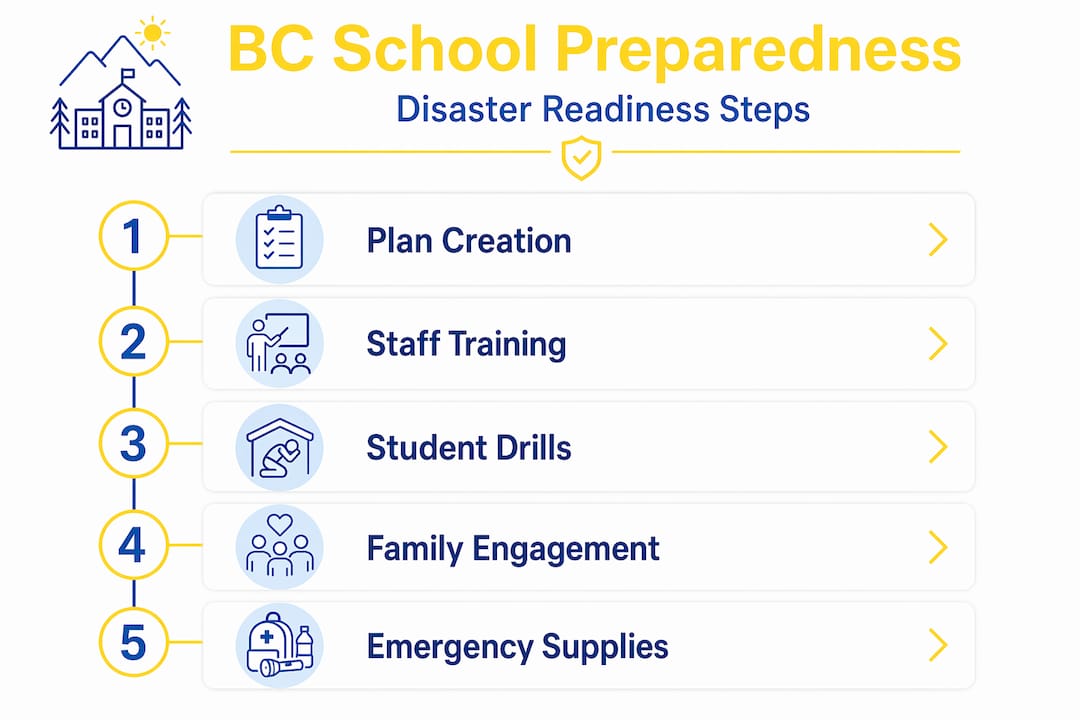
The guide directs schools to adopt an all-hazards planning model, meaning one coherent framework covers multiple types of emergencies rather than separate plans for each scenario. Within that model, earthquake-specific measures are prominent.
Key elements of BC school emergency management include:
- Drop, Cover and Hold On protocols practised regularly with all students and staff
- Evacuation plans with clearly marked assembly areas away from structures that could collapse
- Lockdown procedures for threats requiring students to remain inside
- Student release protocols detailing how children are returned safely to authorised guardians
- School Emergency Response Teams trained to lead immediate response actions
- Annual reviews of plans to account for changes in enrolment, staff, and facility conditions
| Planning element | Purpose | Who leads it |
|---|---|---|
| Emergency Management Planning Guide | Sets province-wide framework | Ministry of Education |
| School Emergency Response Team | Implements site-level response | Principal and trained staff |
| All-hazards plan | Covers evacuation, lockdown, shelter | School district |
| Coordination with province | Aligns school actions with government response | District emergency managers |
This structure provides a solid foundation, but a framework is only as strong as its implementation. That is where education and regular practice become essential.
Education and awareness: How schools teach preparedness
Knowing what to do during an earthquake and being able to actually do it under stress are very different things. Schools in BC address this gap through regular drills, classroom instruction, and take-home programmes that extend preparedness into the family environment.
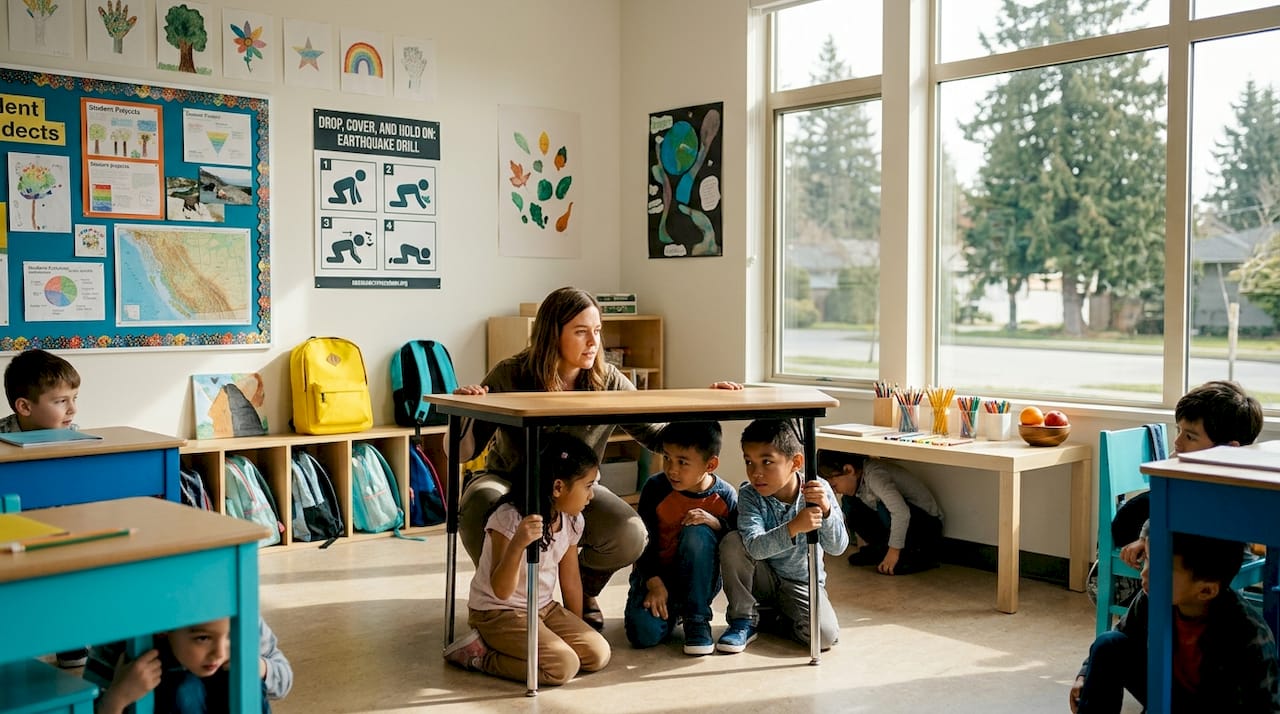
The most visible annual event is the Great BC ShakeOut, a province-wide drill where students and staff practise Drop, Cover and Hold On at a designated time each year. The repetition is intentional. Research in disaster risk education consistently shows that muscle memory developed through repeated practice significantly improves survival behaviour during real events. When shaking begins, people revert to what they have rehearsed.
A systematic review of school roles in disaster risk management identifies education as a core function, alongside response, recovery, and community outreach. Schools are not simply buildings where children wait out a disaster. They are active nodes in a community’s resilience network, responsible for building knowledge and habits that students carry home.
Beyond drills, several approaches are used across BC schools:
- Classroom earthquake science lessons covering why BC faces elevated seismic risk and what happens during a megathrust event
- Student-designed family emergency plans where children become the catalyst for household preparedness conversations
- Take-home programmes such as Master of Disaster, which engage students and parents together in building home emergency plans
- Poster campaigns and school newsletters reinforcing key messages about what to keep in a go-bag and where family meeting points should be
- Cross-curricular integration linking emergency preparedness to science, social studies, and physical education curricula
| Approach | Student age group | Family involvement |
|---|---|---|
| ShakeOut drill | All grades | Indirect: children model behaviour at home |
| Master of Disaster programme | Elementary | Direct: families complete activities together |
| Science-based earthquake units | Grades 4 to 10 | Low to moderate |
| Student-led family planning | All grades | High: students lead household conversations |
Pro Tip: Ask your child’s teacher whether the school uses a take-home programme like Master of Disaster. If not, request that one be considered. Children who teach their parents about earthquake safety are significantly more likely to have prepared households.
The differences between schools in how deeply they engage students in preparedness are real, but the trend across BC is towards more structured, repeated, and curriculum-integrated approaches. Families benefit when they reinforce these efforts rather than treat them as the school’s responsibility alone.
Communication and collaboration: Connecting families and schools
Clear communication between schools and families during a crisis can be the difference between a well-managed emergency and dangerous confusion. BC schools have specific protocols for how they notify parents, manage student release, and coordinate with community emergency services, and parents need to understand these protocols before an event occurs.
“In an emergency, parents should monitor school and district websites for updates, bring photo identification when collecting children, travel by foot if roads are impassable, and expect to find students at a designated off-site assembly area if the school building is unsafe.” — School emergency management and community programmes
This guidance reflects hard-learned lessons from past disasters. Roads near schools may be blocked or dangerous. Phone lines and cell networks often fail in the first hours after a major earthquake. A parent who drives to school expecting a quick pickup may find themselves gridlocked, while a parent who walks in already knowing the assembly area procedure reunites with their child much faster.
What families should understand about school communication protocols:
- School and district websites are the primary information channel after a major event
- Emergency notification systems such as automated calls and texts may be sent but should not be relied upon exclusively
- Student release requires authorised guardian identification at all times, regardless of how well staff know you
- Children are held safely at school or an off-site assembly area until a responsible adult arrives
- Do not call the school during an active emergency as lines must remain open for emergency coordination
Collaboration also extends beyond individual families. Schools work with local emergency managers, fire departments, and community organisations to integrate their response plans. This means that in a major event, school emergency personnel and municipal responders are operating from compatible frameworks rather than working at cross-purposes. For parents, it underscores why staying informed through official municipal and school district channels is far more reliable than relying on social media in the critical hours after a large earthquake.
Equipment and infrastructure: Seismic retrofits and emergency supplies
Physical preparedness comes in two forms: the structural integrity of school buildings and the emergency supplies available when an earthquake strikes. Both matter, and both present a mixed picture across British Columbia.
The BC government’s Seismic Mitigation Program has made meaningful progress, with 58 of 71 high-risk school projects now complete and a target date of 2030 for remaining work. However, over 200 schools across the province remain in a vulnerable condition, meaning they have not yet received structural upgrades that would allow them to withstand major seismic shaking safely. These are not fringe facilities. They are neighbourhood schools that children attend every day.
In Vancouver alone, the provincial government has invested $325 million in seismic upgrades since 2017. That investment reflects both the scale of the problem and the political will to address it, but timelines remain long and funding demands are significant. Not every school district has access to the same resources.
| Category | Current status | Target |
|---|---|---|
| High-risk projects completed | 58 of 71 | All 71 by 2026 |
| Schools still considered vulnerable | Over 200 | Reduced by 2030 |
| Vancouver seismic investment since 2017 | $325 million | Ongoing |
Beyond the buildings themselves, emergency supply kits play a critical role in sustaining students and staff in the hours and potentially days after a major earthquake. Schools typically maintain group emergency kits with water, basic first aid supplies, emergency blankets, and communication tools. Families can review the essential earthquake kits for schools guidance to understand what professional-grade school kits include and how they complement home preparedness.
Pro Tip: Every child should have a personal emergency supply item stored at school, such as a small comfort kit with a snack, a note from home, and a copy of family contact information. Schools cannot always anticipate individual needs, and small personal items can make a significant difference for younger children during a prolonged wait. Ask your school if personal earthquake supplies can be kept in your child’s backpack or locker.
Families should also consider how a basic earthquake kit at home works in concert with school supplies. If parents are delayed in reaching their children due to road damage or structural hazards, students may remain at school for several hours. Having group earthquake kits properly stocked and rotated gives staff the tools they need to keep students safe during that waiting period.
The child-friendly earthquake kit guide offers practical advice on what supplies are most appropriate for school-age children, including considerations that differ from adult preparedness kits.
Improvement, challenges, and family empowerment
Progress is real, but it is uneven. The systematic review on school roles in disaster risk management identifies evaluation and continuous improvement as essential school functions, yet in practice, the pace of seismic retrofits and programme updates varies widely by district. Funding constraints, competing capital priorities, and the sheer volume of work required mean that some communities are significantly better prepared than others.
Reports from earthquake preparedness analysts highlight persistent school vulnerabilities, extended timelines, and gaps in educator training as ongoing concerns. One recurring theme is that institutional preparedness cannot substitute for family involvement. Schools do their part, but the overall outcome depends on what happens at home as well.
Parents can take the following steps to evaluate and advocate for their school’s readiness:
- Request a copy of your school’s emergency management plan from the principal or district office. Most are available on request.
- Attend parent advisory council meetings where emergency preparedness is discussed, and raise questions if it is not.
- Verify whether your child’s school is on the provincial seismic mitigation list and ask about the expected timeline for upgrades.
- Confirm student release procedures and ensure all authorised guardian information is current at the school office.
- Ask about training frequency for school Emergency Response Team members, including how often they review and practise protocols.
- Advocate for updated take-home materials that connect school drills to family preparedness activities.
Reviewing your approach to choosing kits for BC families ensures that what you have at home matches the actual risks your family faces. Equally important is kit organisation for families, so supplies are accessible, not buried under winter gear in a garage corner.
Pro Tip: Set a calendar reminder every six months to check expiry dates on food, water, and medications in your home earthquake kit. This small habit ensures your supplies are actually usable when you need them.
The uncomfortable truth most families miss about school earthquake readiness
Here is what most preparedness articles avoid saying directly: a significant number of BC parents assume their child is safe at school during an earthquake because the school has a plan. That assumption is dangerous.
Plans are essential. Drills are valuable. Seismic retrofits save lives. But none of these measures eliminates the period after an earthquake when children may be at an undamaged assembly area without food, water, or their parents for three, five, or even eight hours. Schools are not designed to function as full-scale relief centres. Their kits, their staffing, and their protocols are designed for the immediate response, not an extended stay.
Experts emphasise that educator training and direct family involvement are the most significant factors in bridging the readiness gap. No amount of provincial investment in buildings can replace parents who have practised the family reunification plan, know which assembly area their child will be at, and have supplies at home ready for the days after schools close.
True resilience connects schools and homes in a continuous loop. Schools teach children what to do and build institutional response capacity. Families practise those same skills at home, supply their children with personal emergency items, and maintain kits that sustain the household during multi-day disruptions. A well-organised family kit is not a backup to school preparedness. It is the other half of a complete system. Families who understand that distinction are genuinely more resilient than those who delegate the responsibility entirely to institutions.
Next steps for your family’s disaster preparedness
Taking action does not require starting from scratch. EarthquakeKit.ca offers a range of options designed specifically for British Columbia families and the seismic realities of this region.

For households getting started, our basic earthquake kits provide a curated foundation of essential supplies recommended by emergency management professionals. For school parent advisory councils, community groups, or sports teams looking to coordinate preparedness, our group earthquake kits are designed to support larger numbers of people with supplies scaled appropriately. Every kit is built with BC’s specific earthquake risks in mind, including the kind of extended disruption that a major Cascadia event would produce. Taking one concrete step now, whether it is reviewing your child’s school plan or ordering your first kit, moves your family meaningfully forward.
Frequently asked questions
What should families know about school earthquake drills in British Columbia?
Schools across BC participate in annual ShakeOut drills, practising Drop, Cover and Hold On with all students and staff. Families can reinforce these habits at home by practising the same technique during family preparedness sessions.
How can parents check if their child’s school is earthquake-ready?
Parents can review the provincial Seismic Mitigation Program progress list, which tracks which schools have been upgraded and which still carry elevated seismic risk, and then connect with their school administrator to ask about timelines.
What are the most important steps for families after a school disaster event?
Follow the school’s established communication protocols, including monitoring school websites, bringing photo identification for pickup, and walking to the designated assembly area if roads are congested or damaged.
Are BC schools equipped with emergency supplies for earthquakes?
Most BC schools maintain emergency kits as part of their response protocols, but seismic retrofit guidelines focus primarily on structural safety. Families should keep child-specific supplies at home to bridge any gaps in school kit coverage.
How can parents complement school preparedness with home actions?
Prepare a household kit, review and update your family emergency plan at least twice a year, and align your at-home protocols with your school’s communication and reunification guidelines so there is no confusion when it counts most.