

How BC local governments lead your family's safety planning
Posted by Karl Lundgren on
TL;DR:
- Local governments in BC are primarily responsible for earthquake response management within their jurisdictions, not provincial or federal agencies. They develop emergency plans, conduct risk assessments, and coordinate community responses, making local preparedness vital for effective disaster management. Household readiness, including personal supplies and communication plans, complements official efforts and is crucial for survival during the initial post-quake period.
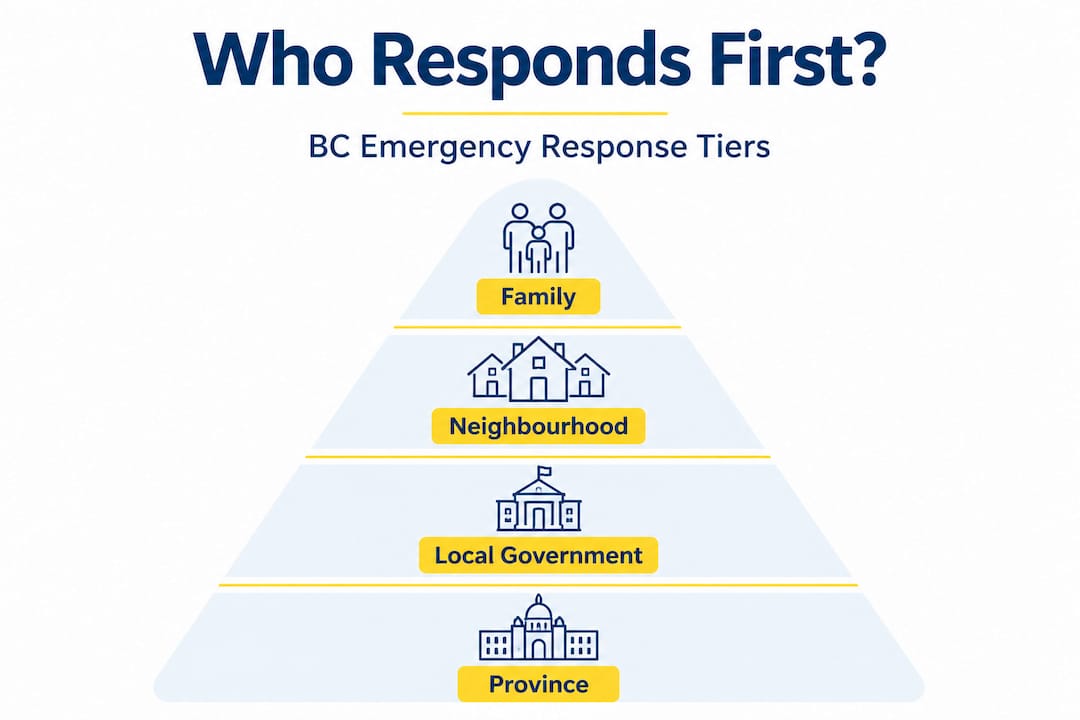
Most BC families assume that when “the Big One” hits, provincial or federal teams will be the first on the scene managing the crisis. That assumption is understandable but incorrect, and it matters enormously for how you prepare. Under the Emergency and Disaster Management Act (2023), local governments such as municipalities and regional districts are primarily responsible for emergency management within their own jurisdictions. That means your city hall, your regional district office, and your local emergency coordinator are the ones shaping the immediate response to any major earthquake long before provincial or federal resources arrive at your doorstep.
Table of Contents
- The legal framework: Who is responsible for emergencies?
- How local governments plan for earthquakes
- From plan to action: Emergency Operations Centres and response
- What happens when local capacity is exceeded?
- Empowering residents: Community and family preparedness
- The uncomfortable truth: Why families must bridge the preparedness gap
- Next steps: Equip your family for resilience
- Frequently asked questions
Key Takeaways
| Point | Details |
|---|---|
| Local action is crucial | In BC, your municipality is the front line for emergency response and planning. |
| Family preparedness matters | Expect to be self-reliant for at least 72 hours after a quake, as help may take time. |
| Government and residents work together | Stronger communities rely on both official planning and household readiness. |
| Collaboration is key | Local, provincial, and Indigenous governments must coordinate for effective recovery. |
The legal framework: Who is responsible for emergencies?
Understanding who holds legal authority is the first step toward understanding how an earthquake response actually unfolds in BC. Many residents picture a top-down structure where the province swoops in to manage a disaster, but the law is clear on this point. Local governments are primarily responsible for emergency management within their boundaries, a responsibility that is both substantial and detailed.
Under the current legislation, every municipality and regional district in BC must:
- Develop and maintain a formal Emergency Management Plan (EMP) covering all four phases of emergency management
- Conduct risk assessments to identify the most probable and severe threats in their community
- Maintain business continuity plans so essential services can keep functioning during and after a disaster
- Declare states of local emergency when warranted, giving them expanded authority to direct resources and issue orders
- Coordinate directly with residents, First Nations, and neighbouring jurisdictions
These are not optional guidelines. They are legal obligations. As outlined in BC’s Disaster Recovery Guide, municipalities must prepare, maintain, and implement plans that cover mitigation, preparedness, response, and recovery, including thorough risk assessments and business continuity frameworks.
“Local governments are the backbone of emergency management in BC. They are not simply waiting for provincial direction. They are the ones writing the plans, training the responders, and leading the community through every phase of a disaster.”
This legal structure means your city’s emergency manager is your most important safety contact in a catastrophic earthquake scenario. Knowing what your local government is required to do, and what resources they maintain, is genuinely useful knowledge for any family. You can find government-endorsed earthquake kits from BC suppliers that align with what local emergency planners recommend families keep on hand.
How local governments plan for earthquakes
With the legal obligations established, the question becomes: how do municipalities actually translate those obligations into practical earthquake planning? The answer involves a structured methodology and rigorous ongoing analysis.
The most important planning tool is the Hazard, Risk, and Vulnerability Analysis (HRVA). This formal process examines all significant threats a community faces and ranks them by probability and potential impact. For coastal BC communities, earthquakes consistently rank among the top hazards. The Regional District of Nanaimo (RDN), for example, has conducted HRVA assessments in 2006, 2009, and 2019, each time refining the community’s understanding of earthquake risk.
These analyses use specific empirical benchmarks:
- A 1:475 year return period is used to evaluate the likelihood of a damaging earthquake event occurring in a given area
- A 1:200 year return period applies to life-threatening natural hazard assessments in subdivision planning
- Historical seismic data and geological surveys are combined with infrastructure vulnerability assessments
- Lessons from past events, including recent earthquakes in other regions, are incorporated into updated plans
Local earthquake plans also align with the Provincial Earthquake Immediate Response Strategy (PEIRS), which coordinates post-catastrophic event response across jurisdictions. PEIRS focuses on coordination following a catastrophic earthquake and sets standards that local plans must meet or exceed.
| Planning component | What it covers | Who is responsible |
|---|---|---|
| HRVA assessment | Identifies and ranks community hazards | Local government |
| Emergency Management Plan | Four-phase response framework | Local government |
| PEIRS alignment | Provincial coordination post-event | Province, with local input |
| Infrastructure assessment | Schools, bridges, utilities | Local government and province |
| Public education | Resident preparedness campaigns | Local government |
Pro Tip: Ask your local municipality or regional district for a copy of their most recent HRVA or emergency management plan summary. Most are publicly available and can tell you exactly which hazards your community faces and how planners have prioritised response.
Reviewing your local plan can also help you build a stronger household preparedness strategy. An earthquake preparedness checklist for BC residents can guide you through the specific supplies and steps that align with what local emergency managers expect families to have ready. You can also use a detailed home preparedness list for BC earthquakes to make sure nothing critical is overlooked.
From plan to action: Emergency Operations Centres and response
Planning documents are only as valuable as the operational infrastructure that supports them. In BC, the centrepiece of that infrastructure is the Emergency Operations Centre (EOC). Every local government is expected to maintain an EOC capable of scaling its activation level to match the severity of an event.
Local authorities lead the initial response by declaring states of local emergency, issuing evacuation orders, and coordinating all emergency services through the EOC using two key frameworks: BCERMS (British Columbia Emergency Response Management System) and ICS (Incident Command System). These standardised structures allow local teams to scale up seamlessly and integrate with provincial and federal partners when needed.
EOC activation follows a tiered approach:
| Activation level | Description | Typical trigger |
|---|---|---|
| Level 1: Monitoring | Staff on standby, situation being tracked | Minor earthquake, potential threat |
| Level 2: Partial activation | Select sections activated, coordination begins | Moderate earthquake, localised damage |
| Level 3: Full activation | All sections active, full resource mobilisation | Major earthquake, widespread impact |
The RDN’s EOC framework illustrates how this scaling works in practice. As an event escalates, additional sections of the EOC are brought online to manage logistics, communications, finance, and public information. Regular exercises and training are built into the system to ensure readiness benchmarks are consistently met.
One aspect of local emergency management that is often overlooked is the intentional integration of First Nations governance into EOC planning. Indigenous communities hold knowledge of local land, resources, and cultural priorities that is essential to effective and culturally safe emergency response. This collaboration is not incidental; it is built into the planning standards that BC local governments follow.
Pro Tip: Find out if your municipality holds public emergency exercises or drills. Participating in or simply observing these events can give your family a realistic sense of how a response unfolds and where the gaps might be for households in your neighbourhood.
When a major earthquake strikes, the EOC becomes the communications hub for your entire community. Staying informed about how your local EOC operates and where to access official updates can be the difference between good decisions and dangerous ones in the critical hours after a quake. Knowing what emergency supplies matter most for earthquake preparedness ensures that your family is not waiting on EOC supply lines to meet your basic needs.
What happens when local capacity is exceeded?
A catastrophic earthquake along the Cascadia Subduction Zone would be an event of a scale that exceeds the capacity of any single local government. No municipality, regardless of how well-prepared, can manage a magnitude 9.0 megathrust earthquake entirely on its own. This is why BC’s emergency management framework includes clear escalation pathways.
When local resources are exhausted, the municipality or regional district formally requests provincial support from the Ministry of Emergency Management and Climate Readiness (EMCR). This request triggers provincial resource mobilisation, including personnel, equipment, and financial support. The process is structured to avoid duplication and ensure that local command remains intact even as provincial assets flow in.
There are also some genuinely complex post-earthquake challenges that require joint planning at multiple levels of government. One of the most technical involves land itself. As noted in BC’s recent intentions paper on restoring legal boundaries after an earthquake, a major seismic event can physically shift ground and alter the legal land boundaries used for property ownership, infrastructure management, and governance. Restoring these boundaries requires coordinated effort using a “boundaries moved” principle, recognising that the ground itself may have shifted.
The recovery planning process also carries specific obligations:
- Municipalities must consult and cooperate with Indigenous governing bodies when developing recovery plans
- Affected communities must be involved in shaping the nature and pace of recovery
- Infrastructure restoration must be sequenced carefully to avoid creating new hazards
- Post-disaster financial assistance programmes require documentation from local authorities
“When local capacity is exceeded in a major disaster, the province steps in, but local government remains the primary coordinator. The handoff is structured, not a takeover.”
This escalation structure makes the quality of local planning directly relevant to how quickly your community recovers. Strong local plans with clear documentation and well-maintained EOCs make provincial support faster and more effective. Weak local planning creates confusion, delays, and gaps that families on the ground experience directly.
Empowering residents: Community and family preparedness
All of the planning, legal frameworks, and operational infrastructure described above only goes so far. The final and most personal layer of earthquake resilience is what happens at the household level.

BC’s local governments actively promote community preparedness through programmes like the Neighbourhood Emergency Preparedness Program (NEPP). These programmes help residents organise neighbourhood-level response networks, connect neighbours with each other, and identify local resources that could be shared in an emergency. They encourage families to create personal emergency plans and maintain 72-hour kits as a foundation for survival in the immediate aftermath of a quake.
The BC Emergency Management Strategy is clear on this point: residents must be prepared to be self-reliant for several days following a major earthquake. EOCs will be overwhelmed. Roads will be blocked. Emergency crews will be responding to the most critical situations first. Families who have not prepared will be waiting, and that wait will not be comfortable or brief.
Key household preparedness actions recommended by local emergency planners include:
- Maintaining a 72-hour emergency kit with water, food, first aid supplies, medications, and essential documents
- Creating a written family communication plan that accounts for scenarios where phones and internet are unavailable
- Identifying two meeting points: one near your home and one outside your neighbourhood
- Knowing how to shut off gas, water, and electricity in your home
- Building a support network with neighbours, especially for households with mobility limitations or medical needs
- Storing additional supplies beyond 72 hours, as post-earthquake disruption in coastal BC could last considerably longer
Pro Tip: Connect with your neighbours now, not after the shaking stops. Knowing who lives around you, who has first aid training, who has tools, and who may need assistance is one of the most effective forms of earthquake preparedness available, and it costs nothing.
Understanding how emergency kits help BC residents prepare for earthquakes is a practical starting point for any family reviewing their current level of readiness. A quality Government of BC earthquake kit ensures your supplies meet the standards that local emergency managers recommend.
The uncomfortable truth: Why families must bridge the preparedness gap
Here is something that BC emergency managers know well but rarely say loudly enough: the plans are good, the EOCs are capable, and the legal frameworks are solid. None of that will get water to your taps or food to your table in the 72 hours after a major earthquake.
The public consistently overestimates how quickly organised help will arrive after a catastrophic event. When roads are impassable, when bridges are down, when utility crews are managing simultaneous failures across hundreds of kilometres, your family’s wellbeing depends almost entirely on what you stored, planned, and practised before the ground moved. That is not a criticism of local governments; they are doing exactly what the law requires and more. It is simply the reality of what “the Big One” will look like on the ground.
The most resilient communities in BC are not the ones with the most sophisticated government plans. They are the ones where a high proportion of households have their own supplies, their own communication plans, and their own support networks established ahead of time. Government planning and household preparedness are not alternatives; they are complementary layers. The government layer handles infrastructure, coordination, and recovery. The household layer handles survival until help can reach you.
The families who choose the right earthquake kits for their needs are not being paranoid. They are being rational. They are reading the science, understanding the risk, and responding accordingly. That is precisely what every level of government in BC is asking you to do.
Next steps: Equip your family for resilience
Reading about emergency planning frameworks is a meaningful first step, but real preparedness means having the right supplies on hand before you need them.

At EarthquakeKit.ca, we offer kits designed specifically for BC families and workplaces, aligned with provincial and local government guidance. Whether you are starting from scratch or upgrading what you already have, explore our range of basic earthquake kits for households, or our group earthquake kits for strata buildings, workplaces, and neighbourhood preparedness groups. Every kit is built around the same 72-hour standard that your local emergency manager is counting on you to meet. The gap between what government can do and what your family needs in those first critical days is one that only you can close.
Frequently asked questions
What is the most important role of local governments in an emergency?
Local governments organise and lead the initial response, declaring states of emergency, issuing evacuation orders, and coordinating all emergency services through activated EOCs using BCERMS and ICS standards.
How do local governments work with Indigenous communities during emergency planning?
They are legally required to consult and cooperate with Indigenous nations, particularly for recovery and post-disaster planning, as outlined in BC’s legal boundary restoration framework for post-earthquake scenarios.
How long should BC families be prepared to be self-sufficient after an earthquake?
Families should be self-reliant for at least 72 hours, as local response programmes confirm that emergency crews will be managing multiple priorities simultaneously and cannot reach every household immediately.
What happens if a local government’s emergency plan is overwhelmed?
They formally request provincial support from the Ministry of EMCR, and recovery is then planned jointly, though local government retains coordination authority, as outlined in BC’s post-earthquake boundary restoration planning documents.
Are neighbourhood preparedness programmes effective?
Yes, NEPPs and community programmes increase resilience meaningfully by helping residents organise, share resources, and support vulnerable neighbours before and after an earthquake.