

Why pack emergency food: BC earthquake kit essentials
Posted by Karl Lundgren on
TL;DR:
- Many BC families rely on limited pantry supplies for earthquake preparedness, but true resilience requires carefully stored, shelf-stable emergency food. Authorities recommend at least three days, with one to two weeks being a more realistic target for major Cascadia events, due to prolonged disruptions. Selecting foods that require no refrigeration, little water, and have long shelf lives helps ensure safety and comfort during extended emergencies.
Many BC families believe that a few canned goods pushed to the back of a cupboard are enough to see them through a major earthquake. That assumption is understandable, but it leaves households genuinely unprepared. The Cascadia Subduction Zone poses a serious and ongoing threat to coastal British Columbia, and the disruption that follows a significant seismic event can last far longer than most people expect. Understanding what emergency food actually means for your earthquake kit, how much you need, and how to keep it ready can make all the difference when services fail and help is delayed.
Table of Contents
- What emergency food means for BC earthquake kits
- How long to plan for: 3 days or more?
- Choosing the right emergency food: safety and suitability
- Keeping your kit effective: organisation, portability, and maintenance
- What most guides miss about emergency food for families in BC
- Get started: trusted emergency food and kit options for your family
- Frequently asked questions
Key Takeaways
| Point | Details |
|---|---|
| Pack non-perishable food | Prepare at least three days of non-perishable food to keep your household safe during emergency disruptions. |
| Aim for longer readiness | Current BC guidance suggests stocking up to one or two weeks of emergency food for realistic earthquake resilience. |
| Match family needs | Include familiar, dietary-appropriate foods for children, allergies, and special family requirements. |
| Keep kits organised and current | Store kits where they’re easy to find, make them portable, and check supplies for expiry every six months. |
What emergency food means for BC earthquake kits
Emergency food is not simply whatever happens to be in your pantry. It is a deliberately chosen, carefully stored supply that your household can rely on when power is out, water is unsafe, and grocery stores are either damaged or stripped bare. This distinction matters enormously in the context of a major earthquake along the Cascadia Subduction Zone, where infrastructure failures could isolate communities for days or even weeks.
Regular pantry supplies often require refrigeration, cooking, or running water to prepare safely. Emergency food, by contrast, should need none of these things. It should be shelf-stable, require little to no preparation, and remain safe to eat under conditions that may include damaged kitchen facilities, broken gas lines, or disrupted municipal water service. Understanding how emergency kits help BC residents prepare for these realities puts the entire concept in perspective.
“BC and federal authorities are clear: every household should be able to sustain itself when services are disrupted and help may be delayed.” The Province of BC recommends collecting at least three days of non-perishable food and water, and suggests one to two weeks as a more robust standard. Public Safety Canada echoes the 72-hour minimum, and the Canadian Red Cross also advises keeping a disaster kit for at least three days.
Key characteristics that distinguish true emergency food from regular pantry supplies:
- No refrigeration required: Items must remain safe at room temperature for the duration of their shelf life.
- Minimal or no water needed for preparation: Water itself may be scarce or contaminated after a major earthquake.
- Long shelf life: Products should carry a best-before date well into the future, giving you time to rotate your supply without waste.
- High caloric density: Compact foods that deliver meaningful energy matter when stress and physical exertion are high.
- Familiarity: Food that your family will actually eat reduces the psychological burden during an already stressful situation.
Taking the time to stock your kit with genuinely appropriate emergency food is one of the most concrete steps a BC family can take toward real earthquake resilience.
How long to plan for: 3 days or more?
The 72-hour rule is the most widely recognised standard in emergency preparedness, and it has served as a useful baseline for decades. The logic behind it is straightforward: in most emergency scenarios, professional responders can reach most affected households within three days. But a large-scale Cascadia megathrust earthquake is not a typical emergency scenario.
A megathrust event along the Cascadia Subduction Zone could simultaneously damage roads, bridges, ports, pipelines, and communication networks across a vast region. Responders from outside the affected area may themselves face route closures and logistical delays. In that context, waiting for help to arrive within 72 hours may not be realistic.
This is why BC preparedness guidance has been shifting. The Regional District of Nanaimo notes directly that while preparedness guidance historically emphasised 72 hours, “recent events indicate it is more realistic to prepare for at least one week.” The Province of BC mentions the one to two week range as a stronger household target, and this aligns with what many emergency managers now advise.
| Planning horizon | Recommended by | Suitable for |
|---|---|---|
| 72 hours (3 days) | Public Safety Canada, Canadian Red Cross | Absolute minimum baseline |
| 1 week (7 days) | Regional District of Nanaimo, many BC sources | More realistic for major events |
| 1 to 2 weeks | Province of BC, emergency management experts | Households in high-risk or remote areas |
Pro Tip: Plan your food supply in terms of meals per person per day rather than vague “servings.” Three meals plus two snacks per person per day gives you a concrete framework to build and check your supply against.
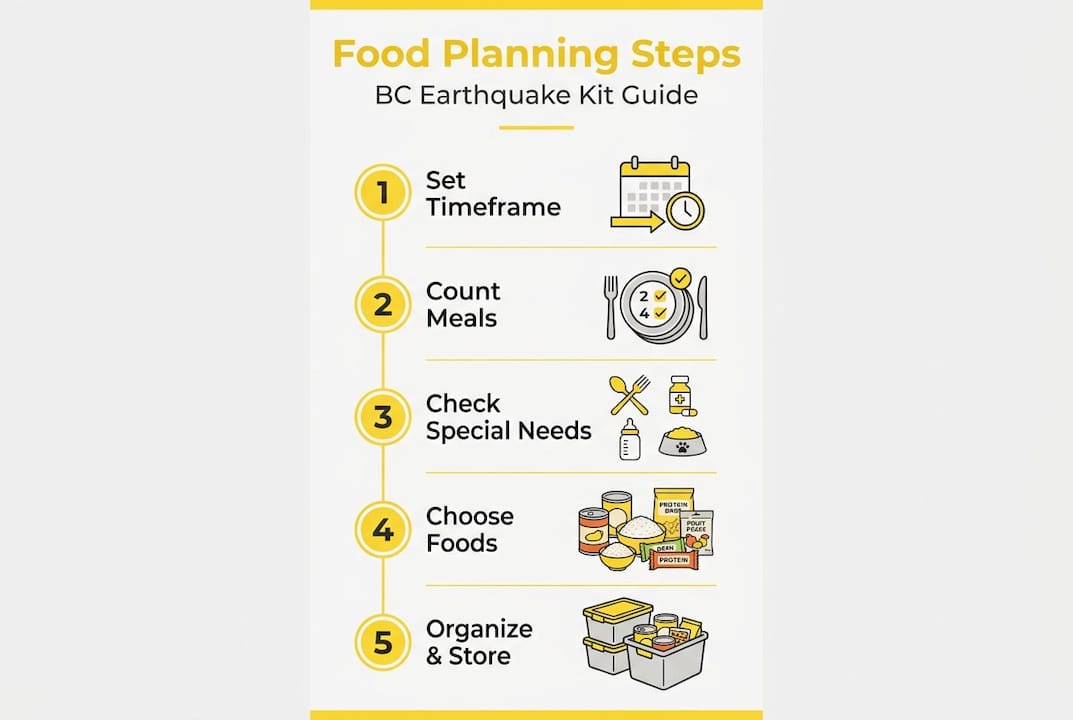
Deciding what is right for your family depends on several factors. Households with young children, elderly members, or individuals with medical conditions may need more time to self-manage safely. Families living in rural or coastal communities may face longer wait times for service restoration. And households without a reliable vehicle or with limited mobility may not be able to evacuate quickly, making a robust at-home supply even more important. The 72-hour kit guide for BC earthquake readiness walks through how to build a solid baseline and then scale up from there.
Choosing the right emergency food: safety and suitability
Once you have set a realistic timeframe, the next step is selecting the right foods. This is where many families make avoidable mistakes, packing items that seem practical but fail under real emergency conditions.
Health Canada advises that emergency kits should prioritise foods that won’t spoil, specifically citing canned goods and energy bars as solid examples. Replacing supplies before their label dates expire is equally important. A can of beans that expired two years ago provides no value during a disaster.
Foods to prioritise in your BC earthquake kit:
- Canned proteins: Tuna, salmon, chicken, beans, and lentils provide sustained energy and are shelf-stable for years.
- Energy bars and granola bars: Compact, calorie-dense, and require zero preparation.
- Dry cereals and oats: Useful for breakfasts and can be eaten without cooking if necessary.
- Crackers and rice cakes: A useful substitute when bread is unavailable.
- Nut butters (individual portions): High in calories and protein, with a long shelf life.
- Dried fruit and trail mix: Good for snacking and maintaining morale, especially for children.
- Baby formula and infant food: Critical if you have an infant at home.
For families with children, the emotional dimension of food matters as much as the nutritional one. Surrey’s emergency preparedness guidance specifically recommends packing foods that are familiar to your family, do not require refrigeration, need little to no preparation or water, and won’t increase thirst. A frightened child who refuses to eat unfamiliar food in an already stressful situation creates an added layer of difficulty that is entirely avoidable with a little advance planning.
| Family member type | Key food priorities |
|---|---|
| Adults | Canned goods, energy bars, nut butters, dried fruit |
| Children (school-age) | Familiar snacks, crackers, cereal, juice boxes |
| Infants | Formula, jarred or pouched baby food |
| Dietary restrictions | Gluten-free crackers, nut-free options, special medical foods |
| Elderly members | Easy-open packaging, soft foods, low-sodium options |
Pro Tip: Do a “test run” with your emergency food by eating from your kit for a single day before you finalise it. You’ll quickly discover what your family will and won’t eat under normal conditions, and those preferences become even more pronounced under stress.
The emergency supplies checklist for BC households is a useful reference for ensuring you haven’t overlooked key categories. And if you’re still working out what configuration suits your household, reviewing guidance on choosing kits for families is a practical next step.
Keeping your kit effective: organisation, portability, and maintenance
Packing the right food is essential, but it’s only part of the equation. A kit buried under boxes in a basement, with unlabelled cans and expired items, is not truly ready. Real readiness means your food supply is organised, accessible, and current.
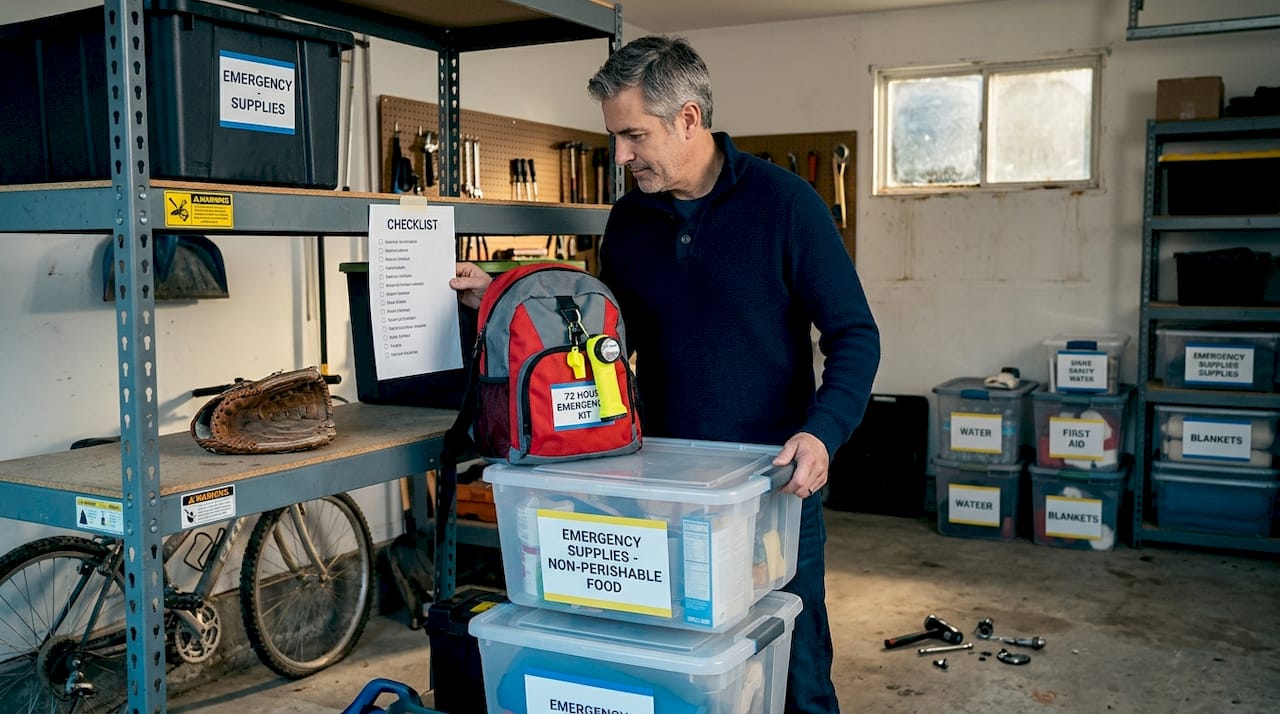
Public Safety Canada emphasises keeping your emergency kit organised and easy to find and carry, so you can access it quickly when power, water, or other services fail. The Province of BC notes that if your home is undamaged you can shelter in place and use your at-home kit, but if you must leave, grab-and-go bags for each family member are essential. That means your food supply may need to serve two different purposes depending on what the earthquake demands of you.
Here is a simple six-month maintenance process to keep your kit genuinely ready:
- Set a calendar reminder every six months (many BC families use the daylight saving time changes as a natural trigger).
- Remove all food items and check best-before dates systematically, setting aside anything expiring within the next six months.
- Consume or donate items nearing expiry rather than simply discarding them. This keeps costs down and reduces waste.
- Replace expired or nearly-expired items immediately, rather than leaving gaps in your supply.
- Check packaging integrity: Cans should show no rust, dents at seams, or swelling. Sealed pouches should show no tears.
- Re-evaluate your household’s needs: Have you added a family member? Does someone now have a dietary restriction? Update your kit accordingly.
Common maintenance pitfalls to avoid:
- Storing food in areas that experience temperature extremes (garages, car trunks in summer heat) can shorten shelf life significantly.
- Packing items in heavy, hard-to-carry containers defeats the purpose of a portable kit.
- Assuming your kit is “done” and never reviewing it is one of the most common mistakes BC households make.
The guidance on storing earthquake kits in BC homes covers location, temperature, and container choices in practical detail. Reviewing essential kit items alongside your food supply ensures nothing critical is overlooked.
What most guides miss about emergency food for families in BC
Standard emergency preparedness checklists are useful, but they rarely capture what actually happens when a family tries to use a hastily assembled kit under real pressure. After supporting BC families through preparedness planning and watching how people respond to real events, a few patterns become very clear.
The biggest gap is personalisation. Generic off-the-shelf kit guides often default to a “one size fits all” list that ignores the specific eating habits, allergy needs, and preferences of real families. A kit stocked with items your children have never seen and your spouse won’t touch is not a functional food supply. It’s a box of good intentions.
The second gap is duration optimism. Most BC residents, even well-intentioned ones, still think of earthquakes in terms of the 72-hour baseline. But a serious Cascadia event would be categorically different from the localised emergencies those guidelines were originally designed for. Communities across a massive swath of BC could face simultaneous disruptions. Supply chains, which were already shown to be fragile during the COVID-19 period, could fail rapidly under those conditions. Planning for one week is not alarmist. It’s simply honest.
The third gap is the emotional dimension of food. We tend to think of emergency food purely in nutritional terms, but food is deeply tied to comfort, routine, and a sense of normalcy. For children especially, eating a recognisable snack during an otherwise frightening experience genuinely helps. This is not a small thing. Families who pack foods their children actually enjoy, including the occasional small treat, report that the psychological burden of the situation is meaningfully lower. Guidance on emergency food for dietary needs extends this thinking into the specific challenges of gluten-free and other special diets.
Finally, there’s the matter of small habits. Rotating your food, labelling items with purchase dates, testing whether your family will eat what you’ve packed: these simple, unglamorous practices are what separate a genuinely effective kit from one that looks good on paper. The families who do these small things regularly are the ones who are truly prepared.
Get started: trusted emergency food and kit options for your family
Knowing what you need is the first step. Acting on that knowledge is what actually keeps your family safe.
EarthquakeKit.ca carries a range of options designed specifically for BC households and aligned with provincial preparedness standards. Whether you’re starting from scratch or upgrading what you already have, there’s a kit designed to match your household’s size and needs. Explore the basic BC earthquake kits as a solid starting point, or consider upgrading to one of the Government-compliant earthquake kits that meet BC and federal preparedness guidelines. Every kit we carry is built with the real conditions of a Cascadia event in mind, because in British Columbia, being prepared is not optional.
Frequently asked questions
What are the best non-perishable foods to pack for a BC earthquake kit?
Choose items that won’t spoil easily, such as canned goods, energy bars, dry cereals, nut butters, and baby food or formula if you have an infant. Replace all items before their label dates expire.
How often should I check or replace emergency food in my kit?
Check your kit every six months for expired or damaged items and replace them promptly. Many BC families use the seasonal time changes as a convenient reminder.
What special food should I pack for children or people with allergies?
Include familiar foods your family will actually eat, and accommodate any dietary restrictions with gluten-free crackers, nut-free snacks, special formula, or medically necessary items.
Why do recommendations vary between 72 hours and 2 weeks?
The 72-hour minimum is a baseline, but recent BC guidance acknowledges that major events like a Cascadia megathrust earthquake can disrupt services far longer, making at least one week of supplies the more realistic standard.
Can I use regular pantry food for my earthquake kit?
You can use pantry items, but choose only foods that don’t require refrigeration or complex preparation, and check expiry dates carefully. Not every pantry staple is suited for emergency conditions.
Recommended
- Gov BC Earthquake Kit – EarthquakeKit.ca
- Gov BC Earthquake Kits – EarthquakeKit.ca
- Why a home emergency kit is essential for BC earthquake safety – EarthquakeKit.ca
- Essential emergency kit items for BC earthquake prep – EarthquakeKit.ca
- Energy-dense foods: a smart guide to healthy choices – Granavitalis
Share this post
- 0 comment
- Tags: en, why pack emergency food