

Why a home emergency kit is essential for BC earthquake safety
Posted by Karl Lundgren on
TL;DR:
- Self-sufficiency during BC earthquakes is crucial as aid may be delayed for days or weeks.
- A well-prepared emergency kit should include at least 72 hours of food, water, first aid, and supplies.
- Regularly review, update, and customize your kit to meet your household’s specific needs and improve readiness.
When a major earthquake strikes British Columbia, the assumption that help will arrive within hours is one of the most dangerous misconceptions a family can hold. In reality, you could be on your own for several days while emergency responders prioritise the most critical situations, and infrastructure restoration may take weeks. BC sits in one of the most seismically active regions in North America, and the risk of a significant earthquake is not a distant possibility. It is a recognised, well-documented threat. A home emergency kit is not a precaution for unlikely events. It is your family’s most reliable line of defence when the systems you depend on every day simply stop working.
Table of Contents
- Why self-sufficiency matters in BC earthquakes
- What happens when you don’t have a home emergency kit?
- What to include in your home emergency kit
- How and when to use your emergency kit
- What most people get wrong about earthquake kits in BC
- Get prepared with reliable BC earthquake kits
- Frequently asked questions
Key Takeaways
| Point | Details |
|---|---|
| BC quake self-sufficiency | You may be on your own for days or weeks after an earthquake, so a home kit is crucial. |
| Essential supplies | Include food, water, and special items for each family member to meet at least 72 hours of needs. |
| Family routine integration | Store kits where everyone can reach them and update goods every six months to stay ready. |
| Support first responders | Using your kit and sheltering in place helps emergency services focus on urgent rescue efforts. |
Why self-sufficiency matters in BC earthquakes
British Columbia occupies a position along the Cascadia Subduction Zone, a tectonic boundary where the Juan de Fuca Plate is slowly sliding beneath the North American Plate. This geological reality means BC sits on a plate margin that is capable of producing megathrust earthquakes, among the most powerful seismic events on Earth. Felt earthquakes occur roughly once per decade at significant magnitudes, but smaller tremors are far more frequent. The unsettling truth is that experts widely agree BC remains underprepared for a major quake.
Earthquakes cannot be predicted. No technology currently exists that can tell us when the next one will strike, how long it will last, or how much damage it will cause. This unpredictability is precisely what makes advance preparation so critical. Waiting until a warning is issued is not an option, because no warning will come.
When a large earthquake occurs, several systems tend to fail simultaneously and quickly:
- Water supply lines can rupture underground, cutting off clean water to entire neighbourhoods
- Electrical grids often fail due to damaged infrastructure or safety shutdowns
- Natural gas lines may be shut off automatically or rupture, creating fire hazards
- Roads and bridges can become impassable due to debris, liquefaction, or structural damage
- Communication networks become overloaded or physically damaged, limiting emergency coordination
The first 72 hours after a major earthquake are the most critical window. Emergency responders will be stretched beyond capacity, triaging life-threatening situations first. Families who can sustain themselves during this period free up resources for those who cannot. Self-sufficiency in this context means having food, water, first aid supplies, and the means to shelter safely without relying on public utilities or outside assistance.
For BC families, choosing earthquake kits that are specifically designed for local conditions is an important first step. Generic kits may not account for BC’s unique combination of seismic risk, coastal geography, and variable climate.
“Being prepared means you can take care of yourself and your family while emergency responders focus on the most critical needs in your community.”
What happens when you don’t have a home emergency kit?
Imagine it is day two after a significant earthquake. Your taps produce nothing. The grocery store three blocks away is closed, its shelves already stripped or the building deemed unsafe. Your phone battery is nearly dead, and the cell network is intermittent at best. This is not a worst-case scenario. This is a realistic picture of what many BC households could face.
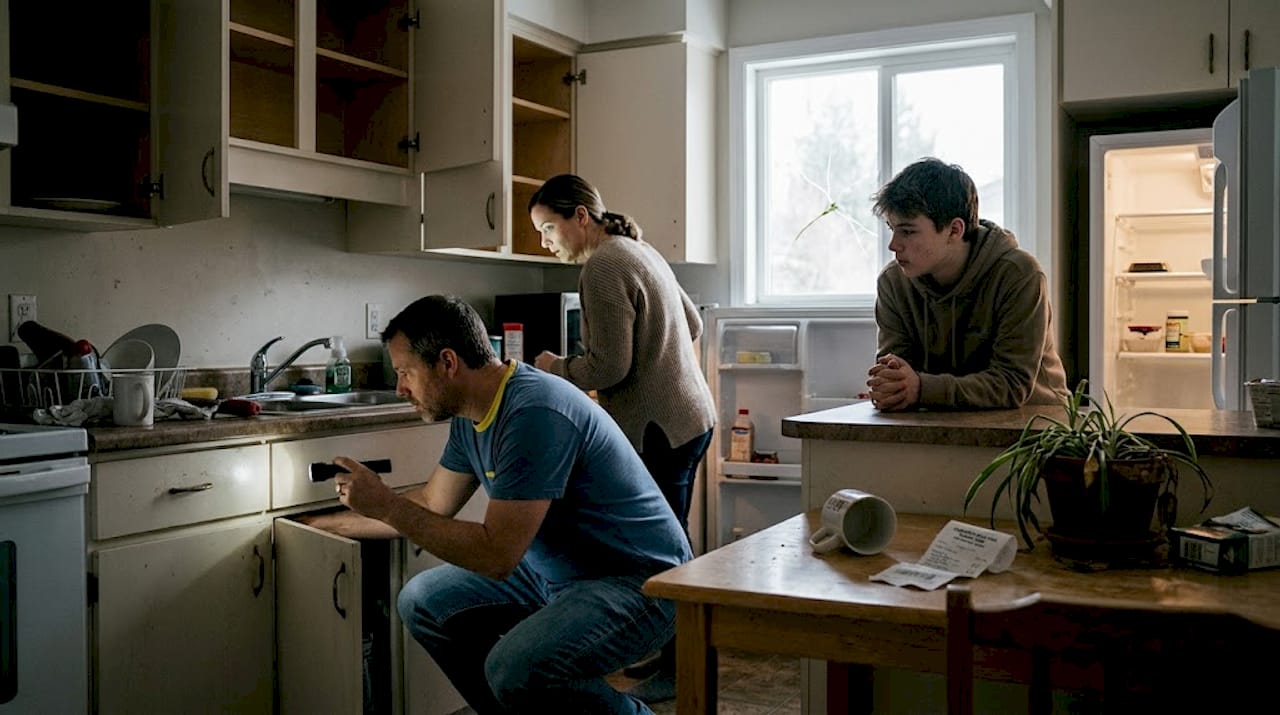
According to provincial guidance, phone, gas, electric, and water services may all be disrupted following a major earthquake. Roads may be blocked, stores closed, and gas stations out of service. Families without emergency kits face compounding hardships that build quickly.
Consider this sequence of events for an unprepared household:
- Hour 1 to 6: Shock and assessment. Minor injuries go untreated due to no first aid supplies. Candles are found but no reliable lighting exists.
- Hour 6 to 24: Tap water is unsafe or unavailable. Bottled water from the fridge runs out by evening. Cooked food is impossible without gas or electricity.
- Day 2: Refrigerated food begins to spoil. Prescription medications are running low with no pharmacy access. Children and elderly family members are particularly vulnerable.
- Day 3 and beyond: Dehydration becomes a real risk. Without sanitation supplies, hygiene deteriorates. Anxiety and stress compound physical challenges.
For families managing chronic conditions, infants, or pets, these gaps become emergencies within emergencies. A diabetic family member without insulin refrigeration, a baby without formula, or a pet without food all represent urgent situations that an emergency kit directly addresses.
| Situation | With a home emergency kit | Without a home emergency kit |
|---|---|---|
| Water access | 4L per person per day stored | Dependent on disrupted supply |
| Food | 72-hour to 1-week supply ready | Reliant on closed or empty stores |
| First aid | Supplies on hand for minor injuries | No treatment for cuts, burns, or illness |
| Lighting | Flashlights and batteries available | Dependent on candles or phone torch |
| Sanitation | Supplies included for hygiene | Deteriorating conditions quickly |
| Stress level | Manageable, family feels prepared | High anxiety, reactive decision-making |
For guidance on organising your kit so that it is easy to access and use under pressure, thoughtful storage planning makes a significant difference in how effectively you can deploy it when it counts.
What to include in your home emergency kit
A well-stocked home emergency kit is not simply a bag of random supplies. It is a carefully considered collection of essentials, sized and customised for your specific household. Provincial guidelines recommend at least 72 hours of supplies, ideally stretching to one or two weeks, including food, water at 4 litres per person per day, and any required medications. Recent BC events have reinforced that one week is a more realistic minimum.
Here are the core categories every kit should cover:
- Water: 4 litres per person per day, stored in food-grade containers. For a family of four over seven days, that is 112 litres.
- Food: Non-perishable items such as canned goods, dried fruit, nuts, energy bars, and freeze-dried meals. Prioritise foods your family will actually eat.
- First aid: A well-stocked kit including bandages, antiseptic, pain relievers, and any prescription medications with a rotating supply.
- Lighting and communication: Flashlights, extra batteries, a hand-crank or battery-powered radio for emergency broadcasts.
- Tools and safety: A multi-tool, work gloves, dust masks, duct tape, and a whistle for signalling.
- Sanitation: Hand sanitiser, toilet paper, waste bags, and feminine hygiene products.
- Documents: Copies of identification, insurance papers, and emergency contacts in a waterproof bag.
| Kit item | Recommended quantity | Typical shelf life |
|---|---|---|
| Bottled water | 4L per person per day | 1 to 2 years (store-bought) |
| Canned food | 3 meals per person per day | 2 to 5 years |
| Energy bars | 2 to 3 per person per day | 1 to 3 years |
| Batteries (AA/AAA) | 12 to 24 units | 5 to 10 years (unused) |
| First aid supplies | Per kit instructions | 3 to 5 years |
| Prescription medications | 7-day minimum supply | Varies, rotate regularly |
For households with infants, include formula, nappies, and baby food. Pet owners should pack food, water, and any medications for animals. Those with mobility limitations or specific medical needs should consult Surrey’s supply kit tips for additional guidance on adapting kits to individual circumstances.
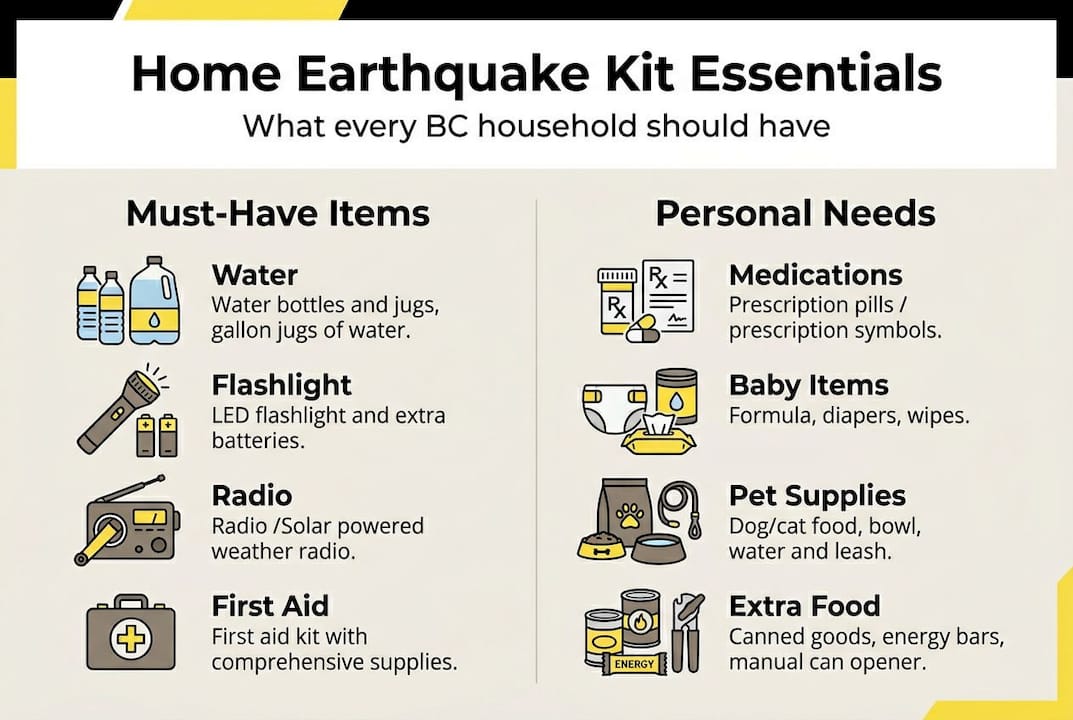
Pro Tip: Store your kit in a cool, dry location that every adult in the household knows. A dedicated waterproof bin near your main exit is ideal. Review your personal supplies checklist against your current kit contents at least twice a year.
If building a kit from scratch feels overwhelming, exploring alternative kit suppliers can help you compare options and find a solution that fits your household’s needs and budget.
How and when to use your emergency kit
Having a kit is only half of the equation. Knowing when and how to use it is equally important. After an earthquake, your first priority is assessing whether your home is safe to remain in. Look for structural damage, gas leaks, and fire hazards before settling in place.
If your home is undamaged or only lightly affected, shelter-in-place is strongly recommended. Staying home and using your emergency kit actively supports first responders by reducing the number of people flooding reception centres and emergency shelters. This is a direct contribution to community recovery.
Here is a practical sequence for deploying your kit after a quake:
- Assess safety first. Check for gas smells, visible structural cracks, and fire risks before accessing your kit.
- Locate your kit. Confirm it is accessible and undamaged. If stored near an exit, retrieval should be straightforward.
- Establish water and food routines. Ration carefully based on your stored supply and the number of people in your household.
- Monitor emergency broadcasts. Use your battery-powered or hand-crank radio to receive updates from emergency management authorities.
- Tend to first aid needs. Address minor injuries promptly to prevent infection or worsening conditions.
- Maintain sanitation. Use stored supplies to keep hygiene standards up, particularly if water service is disrupted.
For detailed guidance on using your kit post-earthquake, reviewing an organisation guide before an emergency ensures you are not figuring out logistics under stress.
Pro Tip: Set a calendar reminder every six months to check expiry dates on food, water, and medications. The RDN kit standards recommend rotating perishable items regularly to keep your kit fully functional.
- Keep your kit near a known exit point, not buried in a storage room
- Ensure every adult household member knows where the kit is and how to use it
- Include a written copy of your family emergency plan with the kit
- After any significant local earthquake, reassess and restock your kit
What most people get wrong about earthquake kits in BC
The 72-hour benchmark has become so widely repeated that many BC residents treat it as a finish line rather than a starting point. In our view, this is one of the most common and consequential missteps in local preparedness culture.
The PrepareBC standard of 72-hour self-sufficiency exists because responder delays are a known reality, not because three days is sufficient. Recent BC events, including the 2021 heat dome and the November 2021 flooding that cut off entire communities, demonstrated clearly that disruptions can last well beyond a week. Earthquake scenarios along the Cascadia Subduction Zone would likely be far more severe.
Many families also build a kit once and never revisit it. Medications expire. Children grow and their needs change. Batteries drain even in storage. A kit that was adequate three years ago may be dangerously incomplete today.
The other gap we see consistently is a lack of customisation. Generic advice is a starting point. Your household has specific needs, whether that is a family member with a chronic condition, a pet, or an infant. Addressing those specifics is what separates a kit that works from one that falls short when it matters most. Reviewing common family kit mistakes can help you identify gaps before a crisis does.
Get prepared with reliable BC earthquake kits
Understanding the risk is the first step. Taking action is what actually protects your family. At EarthquakeKit.ca, we offer earthquake preparedness kits designed specifically for BC households, with options for every situation.
Whether you need a basic earthquake kit for your home, a solution for your workplace, or group earthquake kits for larger households or organisations, we have options built around BC’s specific risks. Our personal supplies kit is a practical starting point for individuals who want to build or supplement their preparedness. Professionally assembled kits remove the guesswork and ensure nothing critical is overlooked. Take the step today, because the time to prepare is always before the earthquake, never after.
Frequently asked questions
What is the minimum amount of water I should keep in my home emergency kit?
Prepare at least 4 litres of water per person per day, for a minimum of three days, though covering a full week is strongly recommended given BC’s earthquake risk.
How often should I update or rotate items in my emergency kit?
You should rotate kit contents at least every six months to ensure food, water, and batteries remain fresh, usable, and within their expiry dates.
Can I rely on earthquake insurance instead of a home emergency kit?
No. Earthquake insurance may cover property loss but provides no immediate supplies or assistance during the critical days following a disaster, making a personal kit essential regardless of your coverage.
What are grab-and-go bags and do I need them if I already have a home kit?
Grab-and-go bags are lighter evacuation kits designed for rapid departure and are recommended alongside a full home kit to ensure you are prepared whether you shelter in place or need to leave quickly.