

Stay prepared: Why updating emergency supplies matters
Posted by Karl Lundgren on
TL;DR:
- Regularly updating emergency supplies is essential because items like food, water, and medications expire quickly and household needs change over time. BC families are advised to conduct semiannual kit reviews aligned with daylight saving time, complemented by an annual needs reassessment to ensure ongoing preparedness. Treating the emergency kit as a living household resource, maintained through consistent routines and involving all family members, enhances genuine readiness for seismic events and other emergencies.
Many BC families purchase an earthquake kit, store it in a closet, and consider the task done. It isn’t. Emergency supplies have expiry dates, household needs shift as children grow, and medications lose potency over time. A kit that was complete and reliable two years ago may now be a collection of expired food, flat batteries, and outdated prescriptions—false confidence dressed up as preparedness. For those of us living along the Cascadia Subduction Zone, where a major megathrust earthquake remains a serious and documented risk, that false confidence is a genuine danger. This article explains exactly how to keep your family’s supplies current, relevant, and ready.
Table of Contents
- Why emergency supplies aren’t ‘set-and-forget’
- The BC approach: Semiannual checks and annual reassessments
- What most people miss: Prescription meds and changing needs
- Simple routines for BC families: Staying ready year-round
- What surprised us after years of BC kit reviews
- Earthquake kits that make staying prepared easy
- Frequently asked questions
Key Takeaways
| Point | Details |
|---|---|
| Semiannual checks are essential | Update expiry-prone supplies every six months to stay earthquake-ready. |
| Household needs change yearly | Reassess kits annually to adapt to growing kids, health changes, and seasonal needs. |
| Prescription meds need frequent attention | Rotate medications every refill, not just at expiry, for safety and accuracy. |
| Easy reminders make updates automatic | Link kit checks to daylight saving time for foolproof, regular maintenance. |
| Involve the whole family | Make emergency kit updates a shared habit to boost engagement and effectiveness. |
Why emergency supplies aren’t ‘set-and-forget’
The assumption that an emergency kit is a one-time purchase is one of the most common and costly misconceptions in household preparedness. Most of the core contents inside a typical grab-and-go bag have a finite shelf life. Food rations, bottled water, batteries, and medications all carry expiry dates, and those dates arrive faster than most families realise.
Water stored in standard plastic containers can degrade in quality over time, particularly when exposed to temperature fluctuations common in BC garages and storage spaces. Emergency food rations typically carry three to five year shelf lives, but that window shortens significantly if stored in warm or humid conditions. Alkaline batteries self-discharge at roughly five to ten percent per year, meaning a set of batteries purchased four years ago may not reliably power a flashlight when you need it most.
The PreparedBC Flood Preparedness Guide is clear on this point:
“Check and replace the contents at least every 6 months.”
That recommendation is not a suggestion. It reflects the reality that expiry timelines for the most critical kit items cluster in the six to twelve month range, particularly for medications and opened or temperature-exposed food and water.
Beyond expiry, household composition changes constantly. Children outgrow clothing stored in emergency bags. New allergies may make old emergency food choices dangerous. A family member may develop a chronic health condition requiring additional medication or specialised equipment. The Surrey Emergency Program specifically advises checking expiry dates and rotating prescription medication supplies on a regular basis, treating this as an ongoing household responsibility rather than a periodic afterthought.
The RDN Emergency Kit Guidance from the Regional District of Nanaimo reinforces this message, recommending semiannual grab-and-go bag check-ins and specifically calling out the need to replace expired food, water, and medications.
Items that need the most frequent attention include:
- Food rations: Check against printed expiry dates; replace as needed every six to twelve months.
- Bottled water: Replace every six to twelve months or per manufacturer guidance.
- Batteries: Test every six months; replace any that are weak or corroded.
- Prescription medications: Rotate with every refill; never rely on outdated prescriptions.
- Over-the-counter medications: Check expiry dates at each semiannual review.
- Bandages and first aid supplies: Replace items that are damaged, expired, or no longer sterile.
- Children’s clothing and footwear: Update when sizes change, typically at least once per year.
Families who treat their kits as living resources, rather than static purchases, are the ones who will genuinely be ready when the ground shakes. For a detailed overview of what should be inside your bag, the guide to essential kit items for BC is a useful starting point.
The BC approach: Semiannual checks and annual reassessments
Different levels of government offer slightly different guidance on how often to update emergency supplies, but taken together, they create a clear picture of best practice for BC families.
BC’s provincial and municipal sources focus primarily on the six-month cycle, tying it directly to the expiry timelines of the most perishable kit items. This is a practical, evidence-based recommendation that acknowledges how quickly food, water, and medications can become unreliable. The PreparedBC Flood Preparedness Guide anchors this guidance, and Ready.gov at the national level adds an annual reassessment layer focused on changing household needs rather than expiry alone.
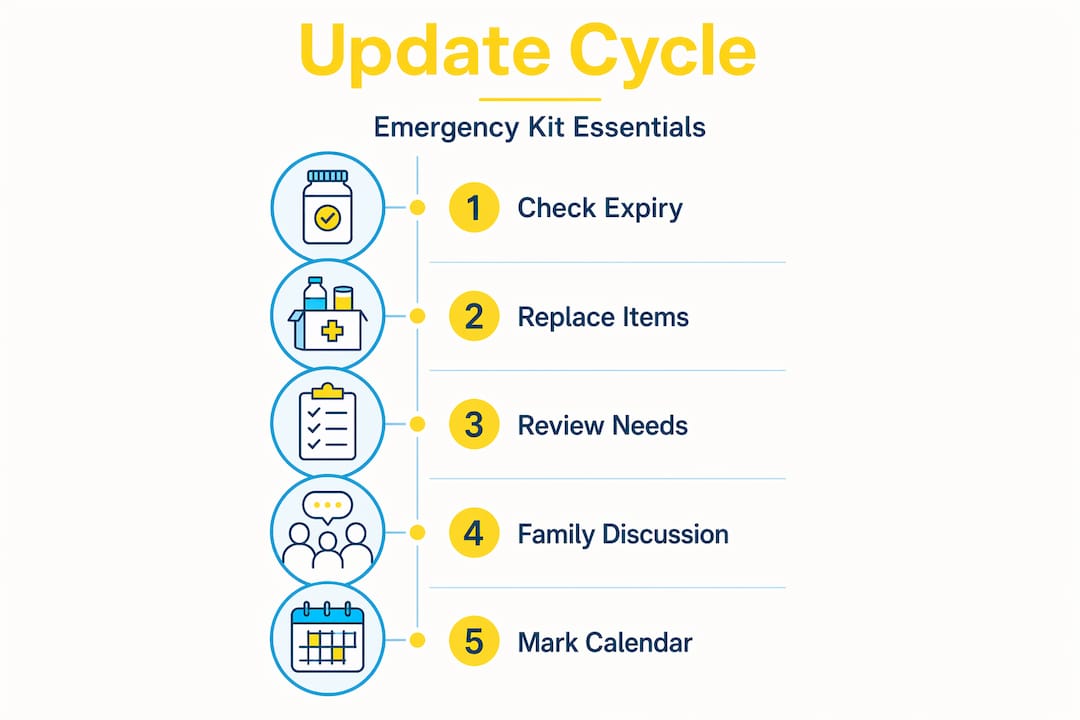
These two frameworks are not in conflict. They are complementary. The semiannual check addresses perishables. The annual reassessment asks broader questions: Has our family grown? Has someone’s medical situation changed? Do we have the right seasonal clothing? Do we have enough supplies for everyone?
| Review type | Frequency | Primary focus | Recommended by |
|---|---|---|---|
| Expiry check | Every 6 months | Food, water, batteries, medications | PreparedBC, Surrey, RDN |
| Household needs assessment | Annually | Family size, health changes, seasonal items | Ready.gov, PreparedBC |
| Prescription rotation | With each refill | Medication accuracy and potency | Surrey Emergency Program |
| Full kit audit | Annually | Everything, including clothing and documents | BC municipal guidance |
Pro Tip: Use the twice-yearly daylight saving time changes as your natural reminder. When you set your clocks forward in spring and back in fall, take thirty minutes to open your emergency kit and run through your checklist. This simple habit ensures you never go more than six months without reviewing your supplies.
Both the semiannual and annual approaches matter for BC residents. We live in one of the most seismically active regions in North America, and the Cascadia fault carries the potential for a magnitude 9.0 or greater earthquake. That reality demands more than a once-and-done approach. For guidance on annual updates for BC kits and how to structure your review, dedicated resources exist to walk you through the process. And if you are still building your primary kit, the guide to choosing earthquake kits for BC families covers the fundamentals.
What most people miss: Prescription meds and changing needs
Even families who diligently check their kits for expired food often overlook two critical areas: prescription medications and the shifting requirements of growing children. These are among the most common gaps we see in household preparedness, and they carry real consequences.
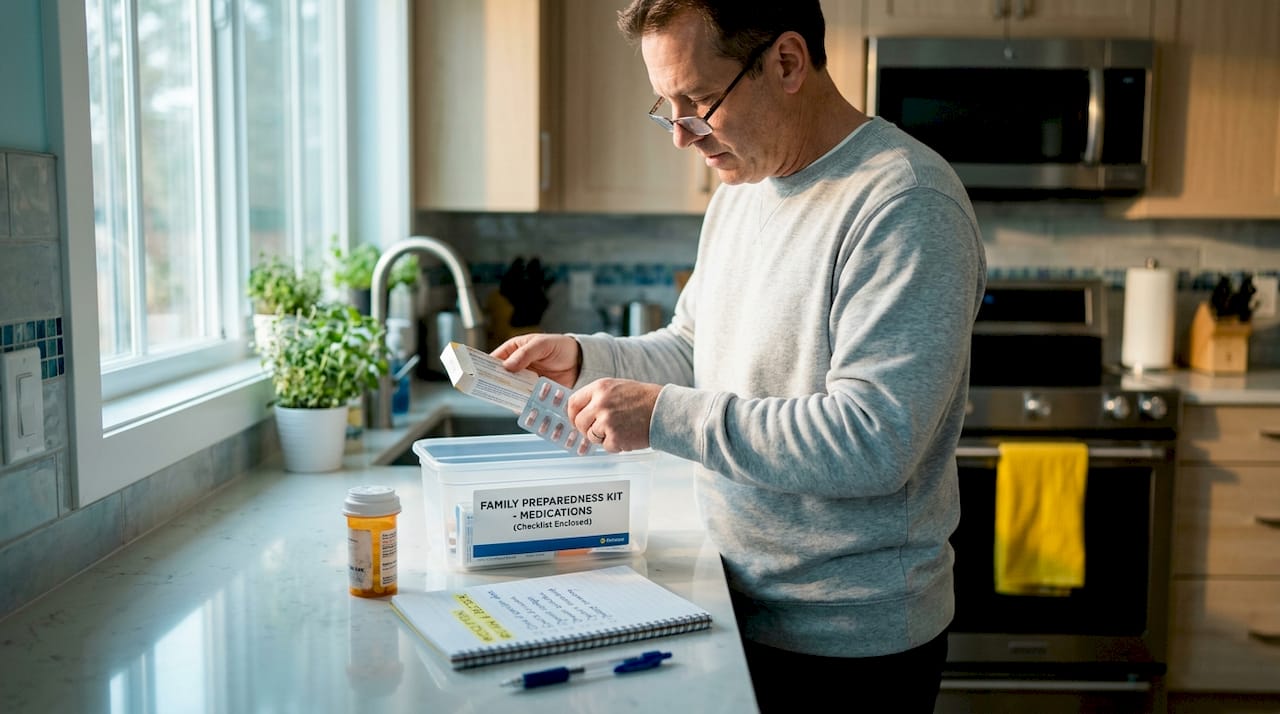
Prescription medications are not simply about expiry dates. A medication you filled eighteen months ago may no longer reflect your current dosage, your doctor may have changed your prescription entirely, or the drug may have degraded well before its printed date if stored in a warm location. The Surrey Emergency Program is explicit: families should rotate prescription supplies whenever they fill a prescription, not just when the calendar tells them to. This means your emergency kit medication supply is always drawn from your most recent and most current fill.
Children’s needs change with remarkable speed. A child who was four years old when you assembled your kit is now six, and the spare clothing, shoes, and food items you packed for them no longer fit or may not match their current dietary restrictions. Allergies develop. Eating preferences that affect food choices in an emergency can shift. A kit assembled with care two years ago may inadvertently contain a food your child can no longer safely eat.
Here are the steps to keep your kit fully relevant for every member of your household:
- Review all prescription medications at each semiannual check and rotate supplies with every refill. Confirm that the medication in the kit matches the current prescription.
- Check children’s clothing and footwear every six months. Try on or measure against current sizes and replace items that no longer fit.
- Reassess food and dietary requirements annually or whenever a household member’s health changes. Remove items containing allergens that are now relevant and replace with safe alternatives.
- Update medical equipment needs, including spare glasses, hearing aid batteries, or any mobility aids that have changed.
- Review contact and document information, including emergency contact lists, insurance cards, and identification copies, at least once per year.
- Inspect infant and toddler supplies if you have young children, as formula, nappy sizes, and feeding equipment change rapidly in the first three years of life.
Pro Tip: Keep a written checklist specifically for prescription medications and family-specific items taped inside the lid of your kit bag. Each time a family member’s health situation changes or a prescription is updated, note it on the checklist and update the kit immediately rather than waiting for the next scheduled review.
For more on assembling supplies that work for younger household members, the guide on packing child-friendly kits covers this in detail. And for food-specific considerations, including calorie requirements and shelf-stable options, the guide on packing emergency food for BC kits is worth reading alongside this one.
Simple routines for BC families: Staying ready year-round
Understanding what needs updating is only half the challenge. The other half is building habits that ensure it actually happens. Most families mean to review their kits but find that months pass without opening the bag. The solution is to attach kit maintenance to events that are already fixed in your calendar.
The PreparedBC Flood Preparedness Guide recommends tying your semiannual kit checks to the “spring forward, fall back” daylight saving calendar events. This is practical advice because these transitions are impossible to miss and happen exactly six months apart.
Here are practical routines that BC families can build into their year:
- Set two recurring calendar reminders in your smartphone or family planner, one in March and one in November, labelled “emergency kit review.”
- Create a printed family checklist and store it with the kit. Include every item category, the expiry date of the most perishable item in each category, and a column to initial when checked.
- Store your kit where you can see it, not buried at the back of a storage room. Kits kept in visible, accessible locations get reviewed more reliably.
- Involve the whole family in the semiannual review. Children who understand what is in the kit and why it matters are more likely to take preparedness seriously as they grow.
- Use your phone’s app reminders or a dedicated emergency preparedness app to automate alerts for specific item expiry dates.
The following table offers a straightforward reference for update intervals by item category:
| Item category | Review interval | Action required |
|---|---|---|
| Emergency food rations | Every 6 months | Check dates; replace if within 6 months of expiry |
| Bottled water | Every 6 months | Replace if past date or compromised packaging |
| Alkaline batteries | Every 6 months | Test with tester; replace any weak or corroded |
| Prescription medications | With each refill | Rotate supply; verify dosage matches current Rx |
| Over-the-counter medications | Every 6 months | Check expiry; replace expired items |
| First aid supplies | Annually | Replace used, expired, or damaged items |
| Clothing and footwear | Every 6 months | Check fit, especially for children |
| Documents and contacts | Annually | Update insurance, ID, and emergency contacts |
For advice on where and how to store your kit at home, the resource on storing earthquake kits in BC homes provides practical guidance. And for families who want a structured system for keeping everything in order, the article on organising earthquake kits for BC covers labelling, sorting, and review systems in detail.
What surprised us after years of BC kit reviews
After reviewing emergency kits across BC, the pattern that stands out most clearly is not a lack of initial effort. Most families who care about preparedness do the hard work of assembling a quality kit. What is consistently missing is follow-through.
The first-year falloff is real and predictable. A family builds or purchases a solid kit, feels genuinely prepared, and then gradually stops thinking about it. Two years later, the food has expired, the batteries are flat, the children have grown out of the spare clothing, and the prescription in the bag is two dosage changes out of date. The kit still sits in its bag, looking prepared. But it is not.
What we have learned is that the families who maintain genuine readiness treat the kit as a shared household responsibility, not one person’s project. Involving children in the review process, even briefly, changes the culture around preparedness in a household. When a ten-year-old knows what is in the kit and why the batteries need testing, preparedness becomes a family value rather than a task.
The real mark of readiness is not buying the right kit. It is keeping that kit current and tailored to your family’s changing needs, season after season, year after year. A quality starting point makes this easier, and the Gov BC earthquake kit is assembled with BC-specific needs in mind. But even the best-assembled kit becomes unreliable without regular attention.
The uncomfortable truth is that a neglected kit can actually be more dangerous than no kit at all. It creates false confidence. Families who believe they are prepared when they are not may take risks or delay evacuation decisions that a more accurate self-assessment would prevent. Regular maintenance is not bureaucratic box-ticking. It is the difference between a kit that works and one that does not.
Earthquake kits that make staying prepared easy
Staying on top of semiannual reviews is far simpler when your kit is professionally assembled with clear expiry labelling and logical organisation. Whether you are starting from scratch or upgrading an outdated bag, having the right foundation matters.
At EarthquakeKit.ca, we offer earthquake kits designed specifically for BC families, individuals, offices, and larger groups. Our BC government-approved kits are built to meet provincial preparedness standards and include items selected for their reliability and shelf life. Clear labelling makes it straightforward to identify what needs attention at each review cycle, so your semiannual check takes minutes rather than hours. Whether you are a parent building your household’s first kit or a returning customer replacing outdated supplies, our range is designed to support ongoing preparedness, not just the initial purchase.
Frequently asked questions
How often should I update emergency supplies in British Columbia?
You should check and replace supplies at least every six months for expiry-prone items, and reassess your full kit annually to account for changing household needs.
Do prescription medications in my kit need updating with each refill?
Yes, the Surrey Emergency Program advises that you rotate your supply whenever you fill your prescription, ensuring that the medication in your kit is always current and correctly dosed.
What items expire fastest in earthquake kits?
Food, water, batteries, and medications are most prone to expiry. The RDN recommends that you check kit contents every six months specifically to address these high-turnover items.
Is there an easy way to remember semiannual checks?
Use the “spring forward” and “fall back” daylight saving time changes as your natural trigger. PreparedBC recommends tying reviews to consistent calendar reminders so that checks happen reliably every six months without relying on memory alone.
Recommended
- Why updating emergency kits annually matters for BC readiness – EarthquakeKit.ca
- Role of emergency supplies in BC earthquake preparedness – EarthquakeKit.ca
- Emergency supplies for earthquake preparedness in BC 2026 – EarthquakeKit.ca
- Emergency preparedness tips for BC residents in 2026 – EarthquakeKit.ca