

Build your family earthquake communication plan in BC
Posted by Karl Lundgren on
TL;DR:
- Communication infrastructure can fail quickly during BC earthquakes, making family plans essential.
- Families should establish an out-of-area contact and practice their emergency plan regularly.
- Involving children through drills and comfort items reduces anxiety and improves response efficiency.
When a major earthquake strikes coastal British Columbia, local phone networks can fail within minutes. Towers become overloaded, circuits jam, and families who haven’t planned ahead find themselves unable to reach one another. The silence that follows shaking ground is often more frightening than the quake itself. BC official guidance recommends that every family create a home emergency plan that includes a master contact list with at least one out-of-area contact. This guide walks you through exactly how to build that plan, involve your children, and keep it current so your family is ready when the ground moves.
Table of Contents
- Understand earthquake communication challenges in British Columbia
- Set up your family emergency communication plan
- Integrate age-appropriate strategies and involve children
- Practise, verify, and adapt your plan as situations change
- Why proactive, family-centred practice beats passive preparation every time
- Support your plan with the right BC earthquake kits and resources
- Frequently asked questions
Key Takeaways
| Point | Details |
|---|---|
| Out-of-area contact essential | Choose a trusted contact outside BC to relay messages when local networks fail. |
| Integrated practice | Drill your plan twice yearly and include children to reduce family anxiety and confusion. |
| Text messages beat calls | Use text, email, or social media instead of voice calls to improve odds of reaching family post-quake. |
| Regular updates matter | Review and revise your communication plan and contact cards yearly or whenever family circumstances change. |
Understand earthquake communication challenges in British Columbia
British Columbia sits above the Cascadia Subduction Zone, one of the most seismically active fault systems in the world. When a major earthquake occurs here, the effects on communication infrastructure are immediate and severe. Cell towers lose power, fibre lines snap, and thousands of residents try to call loved ones at the same moment. The result is a network collapse that can last hours or even days.
Understanding why this happens is the first step toward working around it. Voice calls consume far more network bandwidth than text messages or emails. When everyone in a region dials simultaneously, the system simply cannot handle the load. Text messages, by contrast, queue and transmit even on degraded networks. This is why BC emergency planning consistently prioritises non-voice communication in the immediate aftermath of a quake.
BC families also face a geographic reality that amplifies these challenges. Many communities sit on islands, peninsulas, or in valleys where infrastructure is limited to begin with. A BC earthquake communication plan must account for the possibility that your neighbourhood could be physically isolated, not just digitally cut off.
Here is a quick comparison of communication methods and their reliability post-earthquake:
| Method | Reliability post-quake | Notes |
|---|---|---|
| Voice calls | Very low | Networks overload instantly |
| Text messages (SMS) | Moderate | Queue and send on degraded networks |
| Email / social media | Moderate to good | Works when data is available |
| Battery radio | High | Receives broadcasts without network |
| Satellite communicator | Very high | Independent of local infrastructure |
Key actions every BC family should take before an earthquake:
- Prepare for at least 72 hours of self-sufficiency, including communication tools
- Practise your plan at least twice a year
- Participate in the Great BC ShakeOut drill to build real-world muscle memory
- Keep a battery-powered or hand-crank radio in your emergency kit
“During an earthquake, Drop, Cover, and Hold On. Aftershocks are expected. Do not call 911 simply to report the quake. Check EmergencyInfoBC.ca for updates.” — Emergency Management British Columbia
When choosing emergency kits for your household, make sure communication tools such as a battery radio and extra charging cables are included alongside food, water, and first aid supplies.
Set up your family emergency communication plan
With a clear understanding of BC’s challenges, let’s move step-by-step through building your robust emergency communication plan.
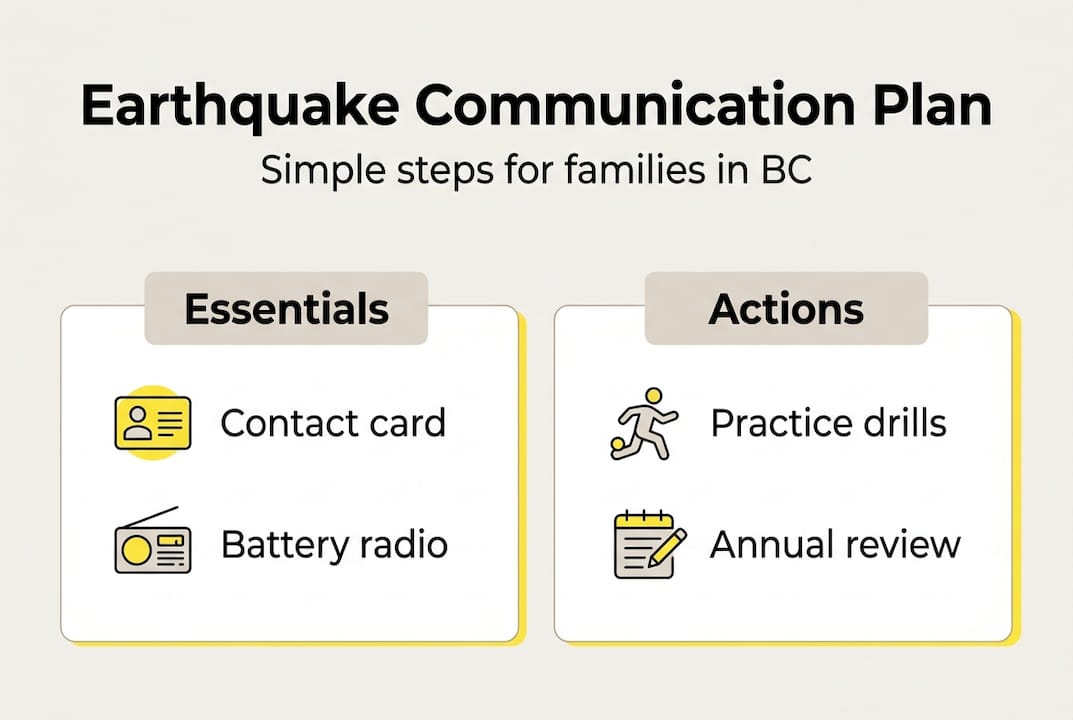
The foundation of any solid plan is a designated out-of-area contact. This is a person living outside British Columbia, ideally in a different province or country, who can serve as a relay point. When local networks are overwhelmed, long-distance calls or messages sometimes get through more easily than local ones. Every family member should know this person’s name and number by heart.
Follow these steps to build your plan:
- Choose your out-of-area contact. Pick someone reliable, available, and calm under pressure. Confirm they understand their role and are willing to serve as your family’s communication hub.
- Build your master contact list. Include your out-of-area contact, each family member’s mobile number, your children’s school contacts, your workplace, and your nearest neighbour.
- Create printed emergency contact cards. Laminate a small card for each family member. Digital records are useless when your phone is dead or lost.
- Designate two meeting places. Choose one close to home (such as your front driveway) and one further away in case your neighbourhood is inaccessible.
- Set a digital communication backup. Agree on a social media platform or group chat where family members will post status updates if voice calls fail.
The BC guidance on master contact lists is clear: use text messages, email, and social media over voice calls whenever possible, and always carry a physical emergency contact card.
Here is a sample plan structure to get you started:
| Step | Information required |
|---|---|
| Out-of-area contact | Name, phone number, email |
| Family member contacts | Name, mobile, workplace or school |
| Meeting place 1 | Address, landmark description |
| Meeting place 2 | Address, landmark description |
| Digital backup channel | Platform name, group name or handle |
Pro Tip: Store a laminated copy of your contact card inside your kit organisation binder so it is always accessible even if wallets and phones are lost.
Reviewing your creating your plan resources annually ensures your contact information stays accurate as families move and phone numbers change.
Integrate age-appropriate strategies and involve children
Once your plan is set, making it accessible and engaging for children is crucial for family safety.
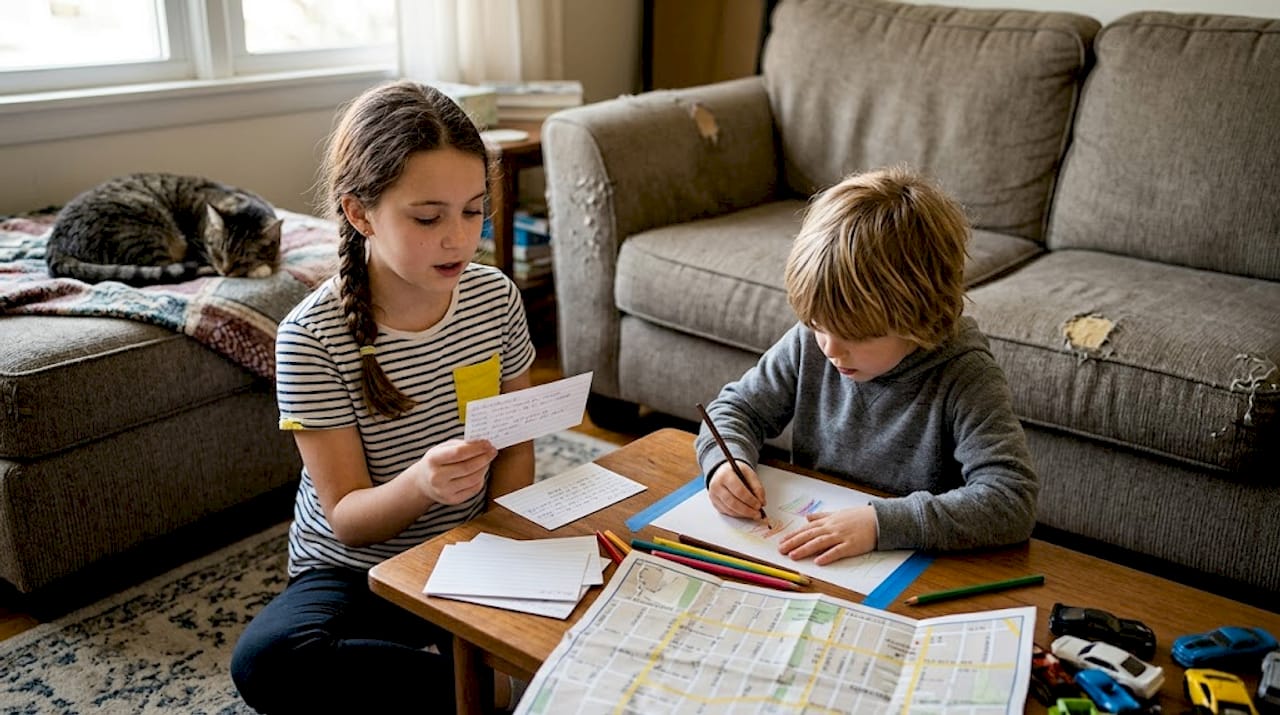
Children who understand what to do during an earthquake are calmer, more cooperative, and less likely to make dangerous decisions. The goal is not to frighten them but to give them a sense of control and competence. When children feel prepared, anxiety drops significantly.
Here are four steps to involve children effectively:
- Use games and drills. Practise Drop, Cover, and Hold On as a family game. Time yourselves, make it a challenge, and celebrate improvement. Young children respond well to repetition wrapped in play.
- Create comfort cards. Each child should carry a small card with emergency contact numbers, any allergy information, and a short comforting message from a parent. This card is their lifeline if they are separated from you.
- Map your home and neighbourhood together. Sit down with your children and draw a simple map showing your two meeting places, your out-of-area contact’s details, and the route from school to each location.
- Involve children in choosing family kits. When children help pack their own emergency supplies, they feel ownership and are more likely to remember what is in the kit and why it matters.
Additional considerations for families with school-age children:
- Ask your children’s school about their shelter-in-place and reunification protocols
- Confirm whether the school will hold children until a parent or designated adult arrives
- Ensure the school has updated emergency contact information for your family
- Include a comfort item such as a small toy or family photo in each child’s kit
Kid-focused earthquake preparation recommends age-appropriate games, comfort cards with allergy notes, neighbourhood mapping activities, and involving children in kit-building and drills to reduce anxiety and build genuine readiness.
Pro Tip: Practise the plan without warning occasionally. A surprise drill reveals gaps that a scheduled rehearsal never will.
Practise, verify, and adapt your plan as situations change
Finally, a plan is only effective if you rehearse and adjust it regularly. Let’s see how to do that in BC.
A written plan sitting in a drawer is not a safety net. It is a false sense of security. The families who fare best after a major earthquake are those who have walked through their plan enough times that the steps feel automatic, even under stress.
How often should you practise? BC guidance recommends practising your plan at least twice a year. The Great BC ShakeOut, held annually, is an ideal opportunity to run a full family drill and compare your readiness against the previous year.
Here is a checklist for keeping your plan current:
- Review all contact numbers every six months and update any that have changed
- Confirm your out-of-area contact is still willing and available
- Walk your children through both meeting places so they remain familiar
- Test your battery radio and replace batteries in all communication devices
- Update your contact cards if any family member changes school, workplace, or phone number
- Check your kit organisation for drills to ensure supplies are not expired
BC families also have access to several early warning tools that can give precious seconds of notice before shaking begins. The province uses an earthquake early warning system that delivers automatic alerts through mobile phones, television, and radio. Register for Voyent Alert and bookmark EmergencyInfoBC.ca so you receive updates the moment they are issued.
Statistic to remember: Families who practise emergency drills twice a year are significantly more likely to follow their plan correctly under stress than those who only read it.
As your family grows and changes, so should your plan. A toddler’s needs are very different from a teenager’s. A new pet, a family member with a medical condition, or a move to a new neighbourhood all require a plan update. Treat your emergency communication plan as a living document, not a one-time task. Pairing your plan reviews with choosing kits for practice sessions ensures your supplies and your strategy evolve together.
Why proactive, family-centred practice beats passive preparation every time
Most preparedness guides tell you to write a plan and store it somewhere safe. That advice is not wrong, but it is incomplete. A document does not prepare your children. A drill does.
Here is what experienced BC families and emergency management professionals understand that most guides overlook: the value of a communication plan is not in its existence but in its familiarity. When adrenaline surges and the ground stops shaking, people revert to what they have rehearsed, not what they have read.
Involving children transforms the entire dynamic. When kids know the plan, they become participants rather than passengers. They remind parents of steps. They comfort younger siblings. They make decisions confidently when separated. BC guidance consistently prioritises non-voice communication and out-of-area relay as the primary post-quake strategy, and integrating children into drills through play reduces anxiety and builds genuine competence.
The families who struggle after an earthquake are rarely the ones who lacked information. They are the ones who had a plan but never practised it. Don’t let your family emergency plan become a forgotten document. Make it a living habit.
Support your plan with the right BC earthquake kits and resources
A strong communication plan needs equally strong physical supplies to back it up. When your phone is dead, your contact card is laminated and ready. When the power is out, your battery radio is charged and waiting.
At EarthquakeKit.ca, we offer kits designed specifically for BC families. A basic earthquake kit covers the essentials for 72 hours of self-sufficiency, while a deluxe earthquake kit includes expanded communication and comfort supplies for larger households. Pair your kit with a BC earthquake map to help every family member understand local geography and evacuation routes. When you review your communication plan, review your kit at the same time. The two work best together.
Frequently asked questions
What is an out-of-area contact and why is it important?
An out-of-area contact is someone living outside British Columbia who acts as a communication relay when local networks are overwhelmed after an earthquake, making it easier for family members to confirm they are safe.
How often should we practise our family emergency communication plan?
BC guidance recommends practising at least twice a year, and participating in the Great BC ShakeOut drill provides realistic, community-wide practice that reinforces your family’s plan.
Should children carry their own emergency contact cards?
Yes. Children benefit from carrying comfort cards with contact information, allergy notes, and a reassuring message so they can communicate and self-identify during an emergency even if separated from parents.
Which apps or websites should BC families monitor during an earthquake?
BC families should check EmergencyInfoBC, Voyent Alert, and ShakeOutBC for real-time updates, and ensure their mobile devices are registered to receive automatic earthquake early warning alerts.
Recommended
- Create an earthquake communication plan for BC families – EarthquakeKit.ca
- Family earthquake safety workflow for BC families 2026 – EarthquakeKit.ca
- Family earthquake preparedness: Protecting your loved ones in BC – EarthquakeKit.ca
- Family emergency planning for earthquakes: A BC guide – EarthquakeKit.ca