

Family earthquake safety workflow for BC families 2026
Posted by Karl Lundgren on
British Columbia families face real earthquake risks every day, yet many lack a clear safety workflow when tremors strike. The Cascadia subduction zone threatens coastal communities with potentially devastating seismic events, making preparation essential for every household. This guide provides a practical, step-by-step workflow to help your family prepare for, respond to, and recover from earthquakes effectively in 2026.
Table of Contents
- Understanding The Earthquake Risk In British Columbia
- Preparing A Family Earthquake Safety Workflow
- Executing Your Earthquake Safety Plan During An Event
- Verifying Safety And Recovering After The Earthquake
- Earthquake Preparedness Products For BC Families
- How Do I Create A Simple Earthquake Safety Plan For My Family?
- What Emergency Supplies Should Every BC Family Have Ready?
- How Often Should Our Family Practice Our Earthquake Safety Workflow?
Key takeaways
| Point | Details |
|---|---|
| Structured workflows improve outcomes | Having clear roles and practiced responses reduces panic and injury risk during earthquakes. |
| Emergency supplies are non-negotiable | Water, food, first aid, and communication tools form the foundation of family preparedness. |
| Regular practice builds muscle memory | Drilling earthquake responses twice yearly ensures everyone knows exactly what to do. |
| Safe spots save lives | Identifying sturdy furniture and interior walls ahead of time protects family members from falling debris. |
| Post-event verification matters | Checking for injuries, hazards, and structural damage immediately after shaking stops prevents secondary injuries. |
Understanding the earthquake risk in British Columbia
Your family’s location in British Columbia puts you squarely in one of Canada’s most seismically active regions. The Pacific Ring of Fire generates frequent tremors along the coast, with the Cascadia fault capable of producing magnitude 9.0 earthquakes. British Columbia is a seismically active region with significant earthquake risks, making household preparation a practical necessity rather than paranoid overreaction.
Earthquake hazards extend far beyond ground shaking itself. Families face risks from falling furniture, shattering glass, collapsing chimneys, and ruptured gas lines. Even moderate magnitude events cause serious structural damage to homes, particularly older buildings not constructed to current seismic standards. Understanding these specific threats helps you prioritise which safety measures matter most for your household.
Residential earthquake risks include several categories worth noting:
- Falling objects from shelves, cabinets, and walls causing head injuries
- Structural failures in unreinforced masonry or wood-frame construction
- Utility disruptions cutting off water, electricity, and natural gas for days or weeks
- Fire hazards from broken gas lines and damaged electrical systems
- Blocked exits preventing safe evacuation routes
The 2001 Nisqually earthquake, though centred in Washington State, caused significant damage across the Lower Mainland, reminding BC families that even distant events create local consequences.
Awareness transforms abstract risk into concrete action. When you recognise that your kitchen cabinets could launch dishes like projectiles or that your water heater might topple without proper anchoring, preparation stops feeling optional. Every BC family should treat earthquake readiness as essential household maintenance, comparable to smoke detectors or carbon monoxide alarms.
Preparing a family earthquake safety workflow
Creating an effective safety workflow starts with assigning clear roles to each family member based on age and capability. Designate one adult to grab the emergency kit, another to account for children, and older kids to assist younger siblings. A structured family emergency plan is essential for effective earthquake preparedness, turning chaos into coordinated response.
Establish multiple communication methods since phone networks often fail during major seismic events. Identify an out-of-province contact person whom all family members can text or call to report their status. Text messages frequently get through when voice calls cannot, so teach everyone to send brief status updates. Create a physical card with emergency contact numbers for each family member to carry in wallets or backpacks.
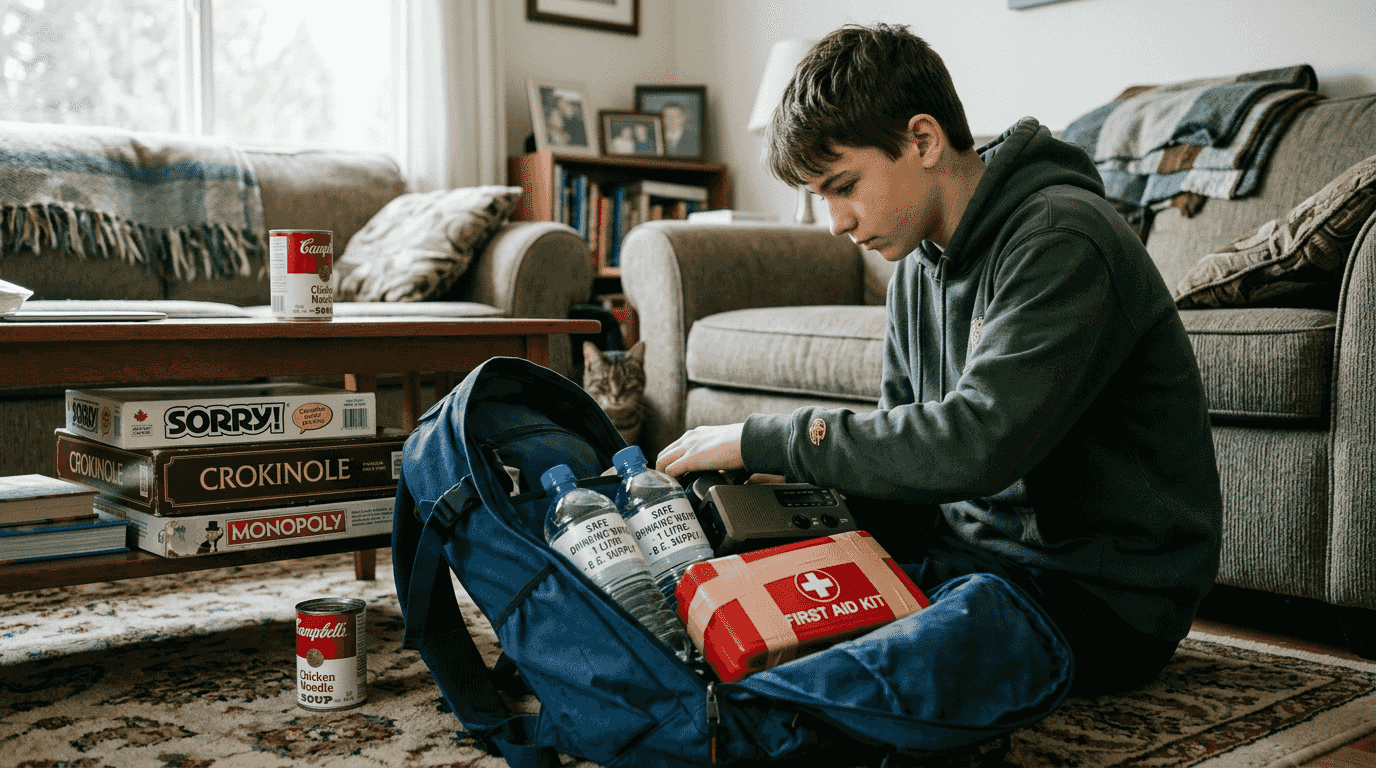
Your emergency kit represents your family’s lifeline for the critical 72 hours following a major earthquake. Assemble supplies tailored to your household’s specific needs, accounting for infants, elderly members, pets, and medical conditions. Store kits in multiple locations including your home, vehicles, and workplaces to ensure access regardless of where the earthquake strikes.
| Supply category | Essential items | Quantity per person |
|---|---|---|
| Water | Bottled water, purification tablets | 12 litres (3 days) |
| Food | Non-perishable items, can opener | 9 meals minimum |
| Medical | First aid kit, prescription medications | 7-day supply |
| Tools | Flashlight, battery radio, whistle | 1 set per kit |
| Documents | ID copies, insurance papers, cash | Waterproof container |
| Sanitation | Toilet paper, garbage bags, soap | 3-day supply |
Practice drop, cover, and hold on techniques until they become automatic reflexes for every family member. Drop to hands and knees to prevent being knocked down, take cover under sturdy furniture to protect from falling objects, and hold on to your shelter whilst moving with it if necessary. Run through this sequence regularly so children respond correctly without thinking during actual emergencies.
Develop a comprehensive checklist covering before, during, and after earthquake actions:
- Before: Secure heavy furniture, identify safe spots, store emergency supplies, establish communication plans, and practice evacuation routes.
- During: Drop, cover, hold on, stay indoors unless immediate danger exists, move away from windows, and avoid doorways.
- After: Check for injuries, inspect for hazards, turn off utilities if damaged, avoid using phones except for emergencies, and reunite at designated meeting points.
Pro Tip: Photograph your emergency kit contents and expiration dates every six months, storing images in cloud storage so you can quickly verify what needs replenishment without physically checking each item.
Executing your earthquake safety plan during an event
When ground shaking begins, immediate action determines whether your family escapes injury. Drop to the ground instantly before the earthquake knocks you down, eliminating fall risks. Take cover under the nearest sturdy table or desk, protecting your head and neck from falling debris. Hold on to your shelter firmly, moving with it if it shifts, maintaining protection throughout the shaking.
Staying indoors during shaking proves safer than attempting to exit, contrary to instinctive panic responses. Most earthquake injuries occur when people try running outside and get struck by falling building facades, power lines, or breaking glass. Remain in your protected position until shaking completely stops and you can assess surroundings safely.
Immediate safety actions like drop, cover, and hold on reduce injury risk significantly, particularly for children who may freeze or run unpredictably. Teaching kids to respond automatically through regular practice prevents dangerous hesitation when seconds matter.
Critical safety actions during earthquakes include:
- Moving away from windows, mirrors, and hanging objects that could shatter or fall
- Avoiding elevators entirely, which may malfunction or trap occupants between floors
- Staying clear of exterior walls where structural damage concentrates
- Protecting your head with arms if no shelter is available
- Remaining calm and reassuring children through verbal communication
Post-shaking awareness prevents secondary injuries as dangerous as the initial event. Aftershocks frequently follow major earthquakes, sometimes matching the original magnitude. Stay alert and ready to drop, cover, and hold on again if renewed shaking begins. Watch for unstable structures, hanging hazards, and damaged utilities before moving through your home.
Children who practice earthquake drills at school often respond better than adults during actual events because muscle memory overrides panic, demonstrating why home practice matters equally.
Keep emergency supplies accessible in multiple rooms rather than storing everything in one location that might become unreachable. Place flashlights, whistles, and sturdy shoes beside every bed so family members can navigate safely through darkness and debris immediately after shaking stops.
Pro Tip: Teach family members to use the whistle in their emergency kit for signalling rather than shouting, which exhausts voice and energy whilst producing less effective sound for rescuers to locate.
Verifying safety and recovering after the earthquake
Once shaking stops, immediately account for all family members and assess injuries before addressing property damage. Check each person systematically, providing first aid for cuts, bruises, or more serious trauma if you have training. Untrained individuals should focus on controlling bleeding with direct pressure and keeping injured family members comfortable whilst waiting for professional medical help.
Inspect your home methodically for hazards that could cause secondary injuries or prevent safe shelter. Look for gas leaks indicated by hissing sounds or sulphur odours, immediately turning off the main gas valve if detected. Check electrical systems for sparking, exposed wires, or burning smells, shutting off power at the breaker panel if any concerns exist. Examine structural elements including walls, ceilings, and foundations for cracks, sagging, or separation.
Post-earthquake safety assessments are vital to protect family members and plan next actions, determining whether you can safely remain in your home or must evacuate to emergency shelters.
Compare your emergency kit supplies against family needs for the coming days:
- Verify water supply remains uncontaminated and calculate consumption rates.
- Inventory food supplies and plan rationing if resupply may take longer than anticipated.
- Check medical supplies against any injuries sustained, noting what additional items you need.
- Test communication devices including battery-powered radios for emergency broadcasts.
- Assess shelter materials like tarps and blankets if your home suffered structural damage.
Deciding whether to stay or evacuate requires honest assessment of your home’s safety and your family’s immediate needs. Use this comparison to guide your decision:
| Remain at home if | Evacuate immediately if |
|---|---|
| Structure appears sound with no major cracks | Walls show significant cracks or bulging |
| Utilities function or can be safely shut off | Gas leaks cannot be controlled |
| You have adequate emergency supplies | No water or food supplies accessible |
| Family members are uninjured or have minor injuries | Anyone requires urgent medical attention |
| No immediate fire or collapse risk exists | Fire, flooding, or structural collapse threatens |
Document damage thoroughly with photographs and notes for insurance claims once safety is assured. Record structural issues, broken belongings, and any temporary repairs you make to prevent further damage. This documentation proves invaluable when filing claims and seeking disaster assistance from government programmes.
Establish contact with your out-of-province emergency contact to report your family’s status and location. Keep phone usage brief to preserve battery power and avoid overwhelming already strained networks. Monitor battery-powered radios for official emergency information, evacuation orders, and resource distribution locations.
Earthquake preparedness products for BC families
Building your family’s earthquake safety workflow becomes significantly easier with professionally assembled emergency kits designed specifically for BC’s seismic risks. Rather than spending hours researching and shopping for individual supplies, basic earthquake kits provide essential items in one convenient package, ensuring nothing critical gets overlooked.
Personal preparedness extends beyond household kits to individual supplies family members carry daily. Earthquake kit personal supplies fit easily in backpacks or vehicles, providing immediate access to essentials regardless of where earthquakes strike. These portable kits prove particularly valuable for family members who commute or spend significant time away from home.
Families seeking comprehensive preparedness aligned with official recommendations should explore government of BC earthquake kits, which meet provincial guidelines for household emergency supplies. These kits take the guesswork out of preparation whilst ensuring compliance with expert recommendations for BC’s specific seismic environment.
How do I create a simple earthquake safety plan for my family?
Start with these numbered steps to build an effective plan: identify safe spots in each room where family members should take cover, compile emergency contact information including an out-of-province contact person, designate meeting locations both inside and outside your home, and assemble emergency supply kits for each family member. Keep your plan simple and written in clear language everyone understands, avoiding complicated procedures that create confusion during actual emergencies. Review the plan together quarterly and practice earthquake drills twice yearly so responses become automatic. Update contact information, meeting locations, and supply lists whenever family circumstances change, such as new phone numbers or addresses. Family earthquake plan steps for BC parents provide additional detailed guidance for creating comprehensive household safety workflows.
What emergency supplies should every BC family have ready?
Every BC household needs water, non-perishable food, first aid supplies, flashlights, battery-powered radios, extra batteries, personal hygiene items, and copies of important documents stored in waterproof containers. Calculate supply quantities based on family size, planning for minimum 72 hours of self-sufficiency though one week proves more prudent for major seismic events. Adapt your kit to accommodate infants requiring formula and nappies, elderly family members needing prescription medications, and pets requiring food and supplies. Choosing the right earthquake emergency kits for BC families helps you select appropriate supplies matching your household’s specific needs and circumstances.
How often should our family practice our earthquake safety workflow?
Practice earthquake drills at least twice yearly, ideally spacing them six months apart to maintain readiness without creating drill fatigue. Each practice session should include drop, cover, and hold on techniques, evacuating to designated meeting points, and retrieving emergency supplies from storage locations. Vary drill timing between day and night to prepare for earthquakes occurring during different daily routines when family members occupy different rooms or even different buildings. Regular practice builds muscle memory that overrides panic during actual emergencies, significantly improving response effectiveness. Family earthquake plan steps for BC parents offers additional strategies for making practice sessions engaging and educational for children whilst maintaining serious safety focus.