

Family emergency planning for earthquakes: A BC guide
Posted by Karl Lundgren on
TL;DR:
- Most BC families lack comprehensive earthquake plans despite high seismic risk.
- Effective preparation includes creating clear family roles, escape routes, and communication points.
- Long-term readiness involves assembling supplies for at least two weeks and strengthening home safety.
British Columbia experiences about 4,000 earthquakes every single year, yet most families along the coast still don’t have a written plan, a stocked kit, or a rehearsed escape route. That gap between risk and readiness is exactly what this guide addresses. Whether you’re a parent with young children, caring for an elderly relative, or simply someone who wants to protect the people and pets you love, the steps here are practical, BC-specific, and designed to move you from uncertainty to genuine confidence. We’ll walk through building your family plan, assembling the right supplies, and knowing exactly what to do when the ground starts shaking.
Table of Contents
- Why family emergency planning matters in BC
- Core elements of a family emergency plan
- Assembling family emergency kits: Essentials and beyond
- What to do during and after an earthquake: Practical actions
- Long-term preparedness: Home safety, insurance, and resilience
- Why planning beyond the basics is essential
- Get equipped: Next steps for BC families
- Frequently asked questions
Key Takeaways
| Point | Details |
|---|---|
| BC faces real earthquake risk | Every family should have a plan and kit due to frequent earthquakes and the potential for major events. |
| Effective planning steps | Assign roles, practise drills, pick meeting locations, and keep updated contacts to ensure family safety. |
| Stock and maintain kits | Prepare kits with water, food, medical supplies, and special needs for at least 72 hours—ideally up to two weeks. |
| Practise annually | Review and rehearse your emergency plan every year so everyone knows what to do. |
| Go beyond 72 hours | Experts now advise families to plan for self-sufficiency of at least a week or more after a major earthquake. |
Why family emergency planning matters in BC
British Columbia sits above one of the most seismically active zones in North America. The Cascadia Subduction Zone, running offshore from northern Vancouver Island down to northern California, is capable of producing a megathrust earthquake of magnitude 8 or 9. Scientists estimate there is a 1 in 3 chance of a major earthquake striking the west coast within the next 50 years. That is not a distant, abstract risk. It is a near-certainty on a generational timeline.
When a major earthquake hits, emergency responders will be overwhelmed. Roads will be damaged, communication networks may fail, and help could be days or even weeks away. A personalised family earthquake preparedness plan is what bridges the gap between chaos and survival. Without one, families face critical decisions under extreme stress with no framework to guide them.
“The question for BC families is not if a significant earthquake will occur, but when. Planning now is the most responsible action any household can take.”
Effective BC preparedness involves more than buying a kit. It means knowing where your family will reunite, who is responsible for the dog, and how your children will reach safety if the quake strikes during school hours. Key reasons to plan now include:
- Emergency services may not reach your neighbourhood for 72 hours or longer after a major quake
- Families separated at work, school, or during travel need pre-agreed reunification points
- Vulnerable members, including seniors, infants, and people with disabilities, require tailored support
- Neighbourhood networks dramatically improve community recovery when formal services are stretched thin
The Province of BC offers the Emergency Ready Planner as a free, fillable tool to help households get organised. Using it is a smart starting point, but it works best when combined with the hands-on steps outlined below.
With these local risks in mind, let’s define what an effective family emergency plan actually looks like in British Columbia.
Core elements of a family emergency plan
Once you appreciate the importance of earthquake planning, it’s time to get hands-on with the key steps your BC family should take.
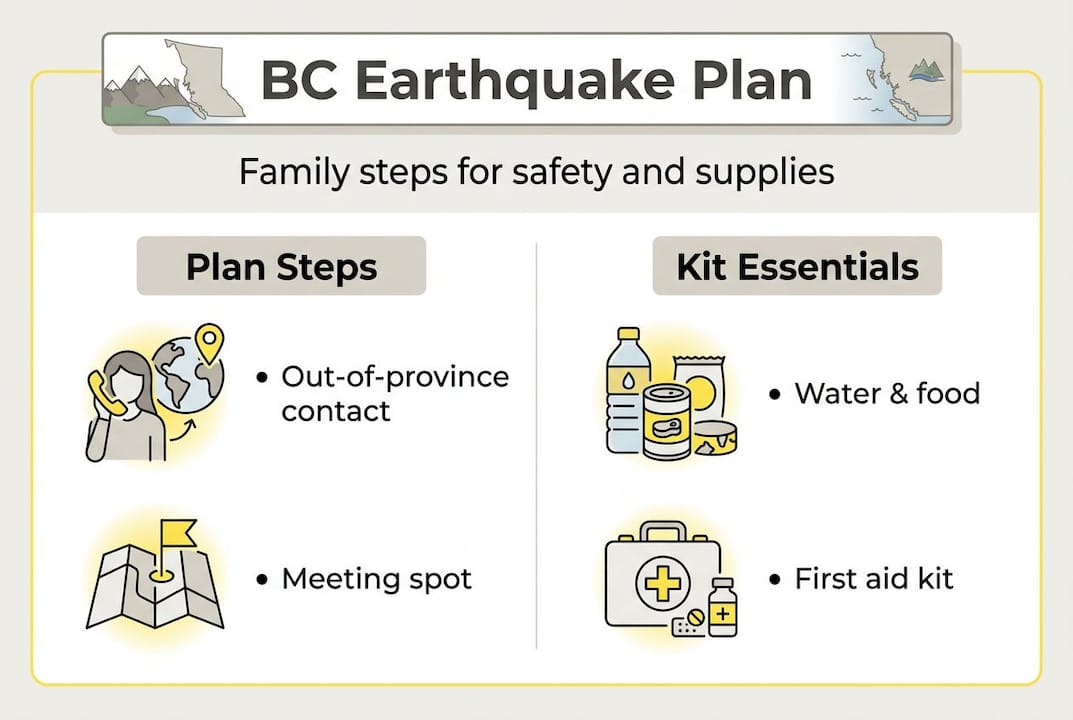
A solid plan is built around clarity: who does what, where everyone goes, and how you communicate. The PreparedBC guide recommends assigning specific tasks to each household member, drawing floor plans with escape routes marked, and designating both a nearby and a distant meeting place. Here is a step-by-step framework:
- Assign roles to each family member: who grabs the emergency kit, who collects the pet, who checks on a neighbour.
- Draw your home’s floor plan and mark two exit routes from every room.
- Choose two meeting spots: one just outside your home (e.g., the front driveway) and one farther away (e.g., a local park or community centre).
- Identify an out-of-province contact who can serve as a communication hub, since local lines are often jammed after a disaster.
- Practise Drop, Cover, Hold On with every household member, including children and seniors.
- Review and update your plan annually, or whenever your family composition changes.
The earthquake safety workflow for BC families also recommends using the emergency preparedness workbook from the Regional District of Nanaimo, which includes fillable templates for households of all sizes.
| Plan element | Why it matters |
|---|---|
| Out-of-province contact | Local networks are often overloaded after a quake |
| Two meeting spots | Accounts for road closures or building damage |
| Assigned roles | Reduces panic and speeds up response |
| Annual review | Keeps the plan current as your family grows or changes |
Pro Tip: Laminate a one-page summary of your plan and keep copies in your kit, your car’s glove box, and each child’s school bag. A plan that lives only in someone’s memory is a plan that often fails under stress.
When choosing family emergency kits, make sure your selections align with the specific needs identified in your plan, including any medical, dietary, or mobility requirements.
Assembling family emergency kits: Essentials and beyond
With your family plan in place, you’ll need reliable supplies to support self-sufficiency. Here’s how to assemble and organise your kits the right way.
The standard recommendation from BC authorities is to store 4 litres of water per person per day: 2 litres for drinking and 2 litres for hygiene. For a family of four, that means 16 litres per day minimum. Aim for at least a 72-hour supply, but given recent guidance, building toward two weeks is far more prudent.
Your kit should include the following core supplies:
- Non-perishable food (energy bars, canned goods, dried fruit) with a manual can opener
- A well-stocked first aid kit with instructions
- A minimum two-week supply of prescription medications
- Flashlight and extra batteries, plus a hand-crank or battery-powered radio
- Cash in small bills, since ATMs and card readers may be offline
- Copies of important documents: ID, insurance policies, medical records, and passports
- Pet food, water, and a carrier for each animal
- Infant supplies: formula, diapers, and comfort items
- Mobility aids, extra glasses, or medical device batteries for seniors
| Household type | Additional kit items |
|---|---|
| Families with infants | Formula, diapers, baby medications |
| Seniors or people with disabilities | Extra medications, mobility aids, medical device supplies |
| Pet owners | Food, water, leash, carrier, vaccination records |
| Families with allergies | Allergen-free food alternatives, EpiPen if prescribed |
Store everything in waterproof, clearly labelled containers. The official kit guide recommends rotating perishable items every six months. A good habit is to do this at the same time as your smoke detector battery check.
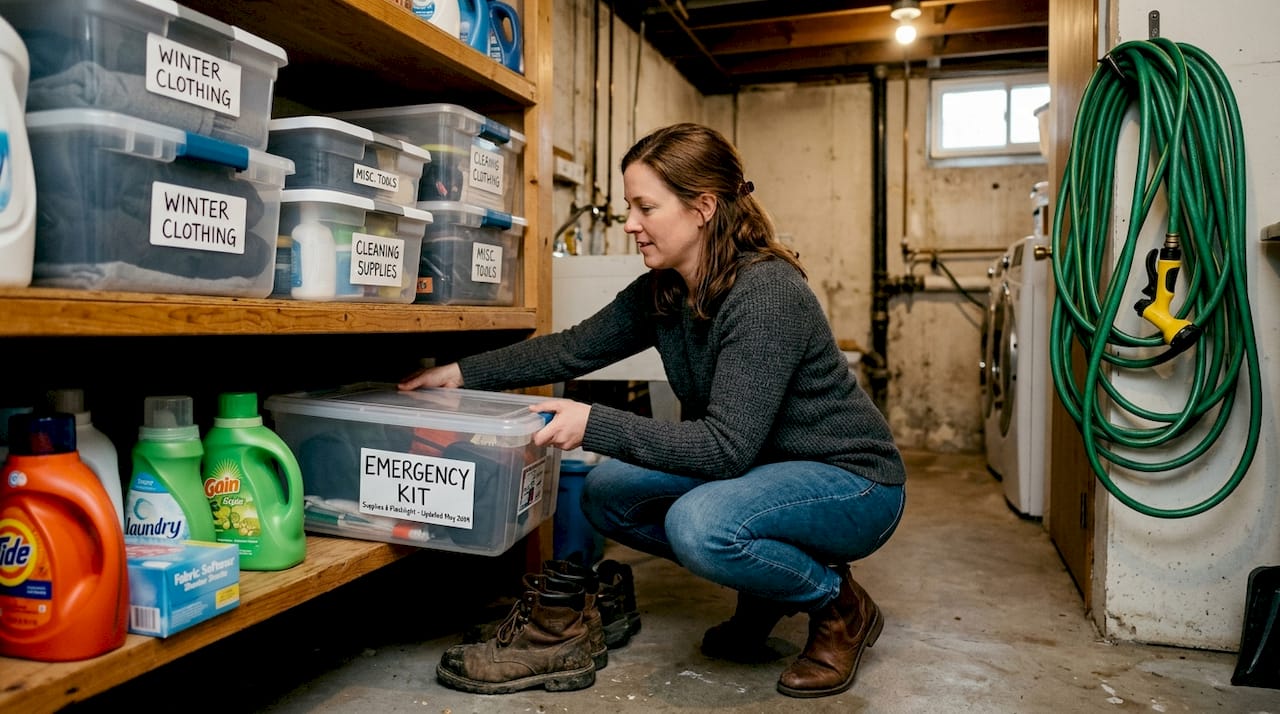
Pro Tip: Keep a smaller personal earthquake supplies kit at your workplace and one in each vehicle. A major quake can strike when your family is scattered across the city.
For a deeper look at what to include, the latest kit supplies guide and the kit organisation guide offer detailed breakdowns tailored to BC households.
What to do during and after an earthquake: Practical actions
Assembling your kits is about preparation. Now here’s what to do if the shaking actually starts and right after it ends.
The moment shaking begins, your instinct may be to run. Resist it. The safest immediate action is Drop, Cover, Hold On: drop to your hands and knees, take cover under a sturdy table or desk, and hold on until the shaking stops. Stay away from windows, exterior walls, and doorways.
Follow these steps in order:
- Drop, Cover, Hold On wherever you are: indoors, stay put; outdoors, move away from buildings and power lines.
- Do not use elevators in multi-storey buildings; use stairs only once shaking has stopped.
- Check for hazards immediately after: gas leaks, structural damage, fires, and downed power lines.
- Expect aftershocks and be ready to Drop, Cover, Hold On again at any moment.
- Evacuate if instructed or if your building is clearly unsafe.
- Coastal families must move to higher ground immediately after a prolonged shake, as tsunami risk is real along BC’s coast.
- Check on neighbours, especially elderly residents or those with disabilities who may need assistance.
Additional considerations for families:
- Children may be at school when a quake strikes; know your school’s reunification protocol in advance
- Pets can become frightened and unpredictable; keep them leashed or contained as soon as it is safe
- Seniors may need physical assistance evacuating; assign this responsibility clearly in your family plan
“After a major earthquake, do not assume your home is safe simply because it is still standing. Structural damage may not be visible from the outside.”
For more guidance on keeping every household member safe, the earthquake safety for families resource covers scenarios from apartment living to rural properties.
Long-term preparedness: Home safety, insurance, and resilience
After dealing with immediate aftermath, it’s time to think about strengthening your home and your community ties for the long haul.
Mitigating hazards inside your home is one of the highest-impact actions you can take before a quake ever strikes. Securing furniture, anchoring water heaters, storing heavy items on lower shelves, and installing cabinet latches all reduce the risk of injury during violent shaking. If your home was built before modern seismic codes, consider a structural assessment and potential retrofitting.
Key long-term actions include:
- Anchor bookshelves, cabinets, and large appliances to wall studs
- Strap your water heater with approved seismic straps
- Store chemicals and flammables in secure, low locations
- Join or start a Neighbourhood Emergency Preparedness Programme in your community
- Connect with your local fire hall or emergency management office for community resources
On the financial side, earthquake insurance is not included in standard home policies in Canada. It is an optional add-on, and uptake sits around 60 to 70% in BC’s highest-risk areas. Given the potential cost of rebuilding after a major event, reviewing your coverage with an insurance broker is a worthwhile step. More detail on coverage options is available in our earthquake insurance details resource.
Pro Tip: Neighbourhood networks are often the first responders after a major quake. Introduce yourself to your neighbours now, share your emergency contacts, and ask if anyone has first aid training or specialised equipment like a generator or water filtration system.
Why planning beyond the basics is essential
Here is an uncomfortable truth that most preparedness guides avoid: the majority of BC families who believe they are ready are only half-prepared. They have a kit without a plan, or a plan without a kit, or both but with critical gaps for children, seniors, or pets. Genuine readiness requires all the pieces working together.
Recent emergencies across Canada have shown that formal support may not arrive for well beyond 72 hours. Experts now advise planning for one to two weeks of self-sufficiency as a realistic baseline, not an extreme precaution. The 72-hour kit standard, while a useful starting point, was established decades ago and does not reflect the scale of disruption a Cascadia megathrust event would cause.
What actually makes the difference in community recovery is not any single kit. It is the relationships and communication structures built before disaster strikes. Neighbours who know each other, who have shared skills and resources, consistently recover faster than isolated households with better-stocked supplies. Our realistic supply timelines resource explores this in more depth.
The standard checklist is a floor, not a ceiling. Push past it.
Get equipped: Next steps for BC families
You now have a clear picture of what effective earthquake preparedness looks like for a BC family. The next step is putting it into action with the right supplies.
At EarthquakeKit.ca, we’ve built our kits specifically for BC households, accounting for the scale of disruption a major Cascadia earthquake would bring. Whether you’re starting with a basic earthquake kit for a small household or upgrading to a deluxe earthquake kit for a larger family with specialised needs, every option is designed to meet or exceed provincial recommendations. You can also build out your household’s readiness with individual personal supplies for each family member. Take the next step today, because the best time to prepare is always before you need it.
Frequently asked questions
How much water should I store per person in my earthquake kit?
Plan for at least 4 litres per person per day: 2 litres for drinking and 2 for hygiene. Aim for a minimum 72-hour supply, though building toward two weeks is now strongly advised.
How long should my family be prepared to be self-sufficient after a BC earthquake?
Experts now recommend planning for one to two weeks of self-sufficiency, as recent emergencies have shown that formal support can take far longer than 72 hours to reach affected communities.
What are the most important steps to creating a family emergency plan in BC?
Assign roles to each member, draw escape routes and meeting spots, establish an out-of-province contact, and practise the plan together at least once a year.
Do I need earthquake insurance for my home in BC?
Earthquake insurance is optional and not included in standard home policies in Canada. Given BC’s seismic risk, it is a worthwhile conversation to have with your insurance broker.
How often should I update or practise my family emergency plan?
Review and practise your plan at least once yearly and update it whenever your family’s size, health needs, or living situation changes.