

Workplace emergency kit tips for BC earthquake readiness
Posted by Karl Lundgren on
TL;DR:
- British Columbia workplaces should prepare for at least one week of earthquake supplies due to the region’s high seismic risk. Essential kit contents include water, food, medical, communication, and safety items, tailored for individual and group needs. Regular maintenance, staff training, and emergency drills are crucial to effective preparedness and response.
Building an effective workplace emergency kit in British Columbia is more complicated than it looks. Most managers assume a basic first aid kit and a few bottles of water will satisfy their obligations, but BC’s earthquake risk demands far more. The Cascadia Subduction Zone runs directly off the BC coast, and seismologists warn that a major megathrust earthquake could disrupt critical services for days or weeks. Conflicting guidelines, from federal 72-hour standards to BC’s recommended one-week supply, add to the confusion. This guide cuts through the noise and gives employees and managers a clear, practical path to genuine earthquake readiness at work.
Table of Contents
- Know your requirements: BC regulations and real-world risks
- Essential items for a BC workplace emergency kit
- Comparing emergency kit guidelines: 72 hours vs. one week
- Building, storing, and maintaining your emergency kits
- What most guides miss: The human factor in workplace emergency prep
- Get BC-compliant earthquake kits for your workplace
- Frequently asked questions
Key Takeaways
| Point | Details |
|---|---|
| BC regulations matter | Workplace earthquake kit standards in BC are stricter than federal rules, with both legal and practical requirements. |
| Pack for a full week | Experts now recommend one week of supplies for all workplace kits in BC, not just 72 hours. |
| Include personal needs | All emergency kits should cover special medications, employee disabilities, and accessibility. |
| Kits need maintenance | Check and refresh kit contents every six months to keep them effective and safe. |
Know your requirements: BC regulations and real-world risks
Understanding what is actually required of BC employers is the essential first step. WorkSafeBC and PreparedBC set out clear obligations: employers must conduct risk assessments, provide first aid kits, train employees, run annual drills, and prepare for workers with special needs such as mobility limitations or medical conditions. These are legal minimums, not optional suggestions.
BC’s earthquake risk makes these requirements especially significant. The province faces the highest earthquake risk in Canada, and approximately 98% of BC firms are small businesses, meaning most workplaces lack a dedicated safety officer to manage emergency planning. That reality places the burden squarely on managers and employees to stay informed and act.
It is worth distinguishing between the regulatory floor and genuine best practice. WorkSafeBC regulations tell you the minimum you must do to remain compliant. Best practice, informed by the BC earthquake hazard guide and regional emergency managers, goes considerably further. For example, regulations may not specify the exact contents of an earthquake kit, but PreparedBC and the Regional District of Nanaimo (RDN) provide detailed guidance that responsible employers should follow.
Several BC-specific considerations deserve attention:
- Small and isolated workplaces may not receive emergency services quickly after a major seismic event, making self-sufficiency critical.
- Employees with disabilities require tailored kits and evacuation plans, including accessible storage locations.
- Remote or industrial sites face unique hazards such as structural collapse, chemical spills, and limited communication.
- Urban offices must plan for shelter-in-place scenarios where leaving the building is not immediately safe.
Understanding workplace earthquake safety roles helps managers assign clear responsibilities before an emergency occurs, rather than improvising under pressure.
Essential items for a BC workplace emergency kit
With regulatory context established, the practical question becomes: what exactly goes into a BC workplace earthquake kit? The RDN recommends at least 4 litres of water per person, along with food, a flashlight, a battery-powered or hand-crank radio, a first aid kit, a hard hat, a whistle, cash, a change of clothing, toiletries, and any special medications. These are the core items every kit must include.
Beyond the basics, BC workplaces should consider two distinct kit types. A group kit is a shared resource for the entire office, typically stored in a central location. A personal grab-and-go bag lives under each employee’s desk and contains individual essentials for the first critical hours. Both are necessary because a major earthquake may separate employees from the central supply.
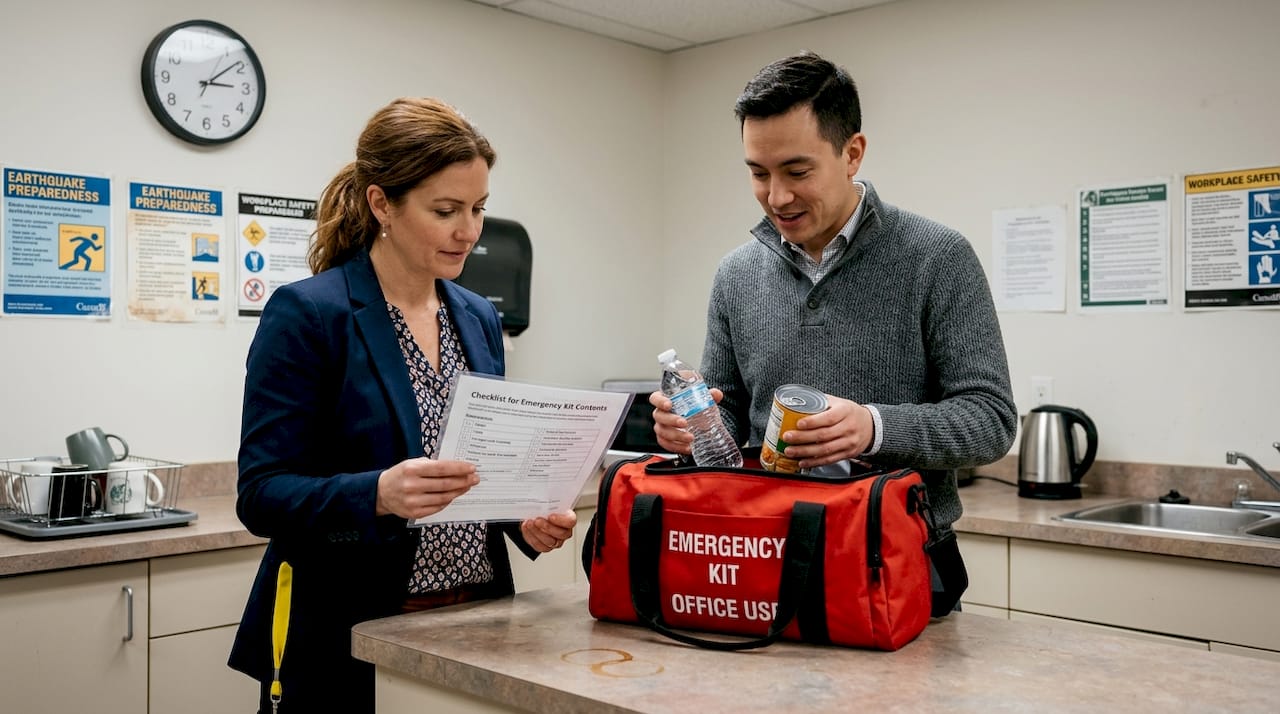
Here is a practical breakdown of recommended items:
| Category | Minimum requirement | BC best practice |
|---|---|---|
| Water | 4L per person | 8L+ per person (1-2 weeks) |
| Food | 3-day supply | 7-day non-perishable supply |
| First aid | Standard kit | Enhanced kit with trauma supplies |
| Communication | Battery radio | Hand-crank radio, backup phone charger |
| Personal safety | Hard hat, whistle | Dust respirator, work gloves, safety glasses |
| Special needs | Medications listed | Allergy info, mobility aids, extra prescriptions |
PreparedBC recommends a minimum of 3 days’ supplies, but ideally one to two weeks, and the RDN advocates for at least one full week. That means your group kit should scale accordingly for the number of employees on site.
Pro Tip: Store water in sealed, food-grade containers and keep them in a cool, dark location away from direct sunlight. BC’s mild but variable climate means temperatures in storage rooms can fluctuate enough to degrade plastic containers over time.
For detailed guidance on stocking your kit correctly, reviewing earthquake supplies for BC and a thorough list of essential kit items will help you avoid common gaps.
Comparing emergency kit guidelines: 72 hours vs. one week
One of the most common points of confusion for BC managers is the gap between federal guidelines and regional recommendations. The federal government and the Canadian Red Cross have historically recommended preparing for 72 hours. That standard made sense for most emergency scenarios, but BC’s earthquake risk has changed the calculation.
The RDN now advises one-week kits specifically because of BC earthquake realities. A major Cascadia Subduction Zone event could disrupt roads, utilities, and supply chains for far longer than three days. Emergency responders will be overwhelmed, and many workplaces may need to shelter in place until conditions are safe.
Here is a direct comparison to help you plan:
| Standard | Water per person | Food supply | Medical supplies | Rationale |
|---|---|---|---|---|
| Federal / Red Cross | 4L | 72 hours | Basic first aid | General emergencies |
| PreparedBC minimum | 4L | 3 days | Enhanced first aid | BC-specific hazards |
| RDN recommendation | 8L+ | 7 days | Full medications | Post-earthquake reality |
“After a major earthquake, the first 72 hours are just the beginning. Roads may be impassable, utilities may be down for weeks, and emergency services will be stretched beyond capacity. Workplaces that plan for only three days are taking a serious risk.” — Regional emergency preparedness guidance, BC
PreparedBC recommends 3 days minimum, ideally 1 to 2 weeks, and that guidance reflects lessons learned from major seismic events globally. The practical implication for BC workplaces is straightforward:
- Plan for at least one week of supplies for all employees.
- Include supplies for shelter-in-place scenarios, not just evacuation.
- Account for aftershocks, which can delay safe exit from a building by hours or days.
- Ensure kits cover communication failures, including printed contact lists and physical maps.
For a step-by-step approach to putting this together, the emergency kit guide offers a structured framework built specifically for British Columbians.
Building, storing, and maintaining your emergency kits
Knowing what to include is only half the challenge. How you assemble, store, and maintain your kits determines whether they will actually function when needed. Follow these steps to build a reliable system:
- Assign a kit coordinator. One person in the workplace should own the emergency kit programme. This person schedules checks, tracks expiry dates, and updates the kit as staff numbers change.
- Choose the right containers. The RDN recommends lightweight waterproof backpacks for personal grab-and-go bags. Group kits should be stored in clearly labelled, sealed bins.
- Place kits strategically. Personal bags go under desks. Group kits should be near exits but not in locations that could be blocked by debris. Consider multiple storage points for larger offices.
- Account for accessibility. Ensure kit locations and containers are reachable by employees with mobility limitations. Avoid high shelves or locked rooms that require special access during an emergency.
- Check kits every 6 months. Food, water, and medications all have expiry dates. Rotate stock regularly and replace anything that has expired.
- Use daylight saving time as a reminder. When clocks change in spring and autumn, use that moment to inspect kits, rotate supplies, and update any personal information such as emergency contacts.
Pro Tip: Tape a laminated checklist to the inside lid of each kit container. This makes it easy for any employee to conduct a quick inspection without needing to consult a separate document.
Maintaining kits is not glamorous work, but it is where most workplaces fall short. A kit that was assembled two years ago and never checked may have expired medications, degraded food, and dead batteries. For practical guidance on keeping supplies current, how emergency kits help BC residents prepare offers useful maintenance frameworks.
What most guides miss: The human factor in workplace emergency prep
Here is something worth saying plainly: a perfectly stocked earthquake kit will not save your workplace if no one knows how to use it, where it is, or what to do in the first minutes after shaking stops.
Most emergency preparedness guides focus almost entirely on gear. That is understandable, because gear is tangible and purchasable. But the workplaces that fare best after a real earthquake are those where employees have practised, where roles are clear, and where managers have built a genuine culture of readiness. A hard hat in a bin is useless if the person who needs it has never been shown where the bin is.
Afterquake communication failures are a serious and underappreciated risk. Phones go down, people panic, and without a practised plan, even well-equipped teams can make dangerous decisions. Regular drills, not just annual tick-box exercises but hands-on, scenario-based rehearsals, build the muscle memory that matters when the ground moves.
Managers who invest in earthquake readiness culture consistently outperform those who simply purchase supplies. The kit is the foundation, not the finish line.
Get BC-compliant earthquake kits for your workplace
If you are ready to move from planning to action, EarthquakeKit.ca offers earthquake kits built specifically for British Columbia workplaces.
Whether you are outfitting a small office or a large team, you will find BC-compliant workplace kits that meet or exceed provincial guidelines. For teams, group earthquake kits provide shared supplies scaled to your headcount. For individual employees, personal earthquake supplies are designed to fit under a desk and be grabbed in seconds. Every kit is assembled with BC’s specific seismic risks in mind, so you can be confident your workplace is genuinely prepared, not just technically compliant.
Frequently asked questions
How much water is required per person in a workplace earthquake kit in BC?
At least 4 litres of water per person is recommended for workplace earthquake kits in British Columbia, though the RDN encourages planning for more if a one-week supply is the target.
What is the difference between grab-and-go bags and group kits?
Grab-and-go bags are personal kits stored under individual desks, while group kits provide shared supplies for the entire workplace. Both are recommended for BC offices because a major earthquake may separate employees from a central supply.
How often should BC workplace emergency kits be checked?
Kits should be checked every 6 months, with food, water, and medications rotated as needed. Using daylight saving time changes as a reminder is a practical way to stay on schedule.
Are there special requirements for employees with medical needs?
Yes. Kits must account for special needs, including necessary medications, allergy information, and accommodations for employees with disabilities or mobility limitations.