

Emergency evacuation: what BC families must know in 2026
Posted by Karl Lundgren on
TL;DR:
- During shaking, the safest action is Drop, Cover, and Hold On, not running outside.
- Evacuate only after shaking stops if the building is unsafe or under specific threats.
- Families should prepare emergency kits, family plans, and practice drills for effective response.
Most BC families assume their first move during an earthquake is to run outside. That instinct is understandable, but it’s also one of the most dangerous things you can do. Research confirms that emergency evacuation in the context of earthquakes is not the primary immediate response during shaking. Running exposes you to falling objects, broken glass, and structural debris. This guide will clarify what emergency evacuation actually means in a BC earthquake scenario, when it becomes necessary, and how families with children can prepare with confidence rather than confusion.
Table of Contents
- Understanding emergency evacuation in earthquakes
- When and why to evacuate after an earthquake
- Key steps for family earthquake evacuation readiness
- Special considerations for schools and edge cases
- What most emergency guides miss about earthquake evacuation
- Take your family’s preparedness to the next level
- Frequently asked questions
Key Takeaways
| Point | Details |
|---|---|
| Don’t evacuate during shaking | The safest action is to Drop, Cover, and Hold On until the shaking stops, not to run outside. |
| Evacuate only if unsafe | Leave your home after an earthquake only if it’s structurally damaged or there’s a clear risk like fire or tsunami. |
| Practice family drills | Involve children in planning and drills to reduce anxiety and ensure everyone knows what to do. |
| Prepare for 72 hours | Have kits ready so your family can be self-sufficient for three days post-earthquake. |
Understanding emergency evacuation in earthquakes
The term “emergency evacuation” is frequently misunderstood when it comes to earthquakes. Many people picture grabbing their children and rushing for the door the moment the ground begins to move. In reality, that response is more likely to result in injury than to prevent it.
Emergency evacuation in an earthquake context refers to leaving a building or area after shaking has stopped, and only when specific conditions make staying put genuinely dangerous. The immediate protective action during shaking is always Drop, Cover, and Hold On. According to official BC earthquake safety guidance, running during shaking increases injury risk from falls and debris significantly. Most earthquake injuries come not from buildings collapsing, but from people being struck by flying or falling objects while trying to move.
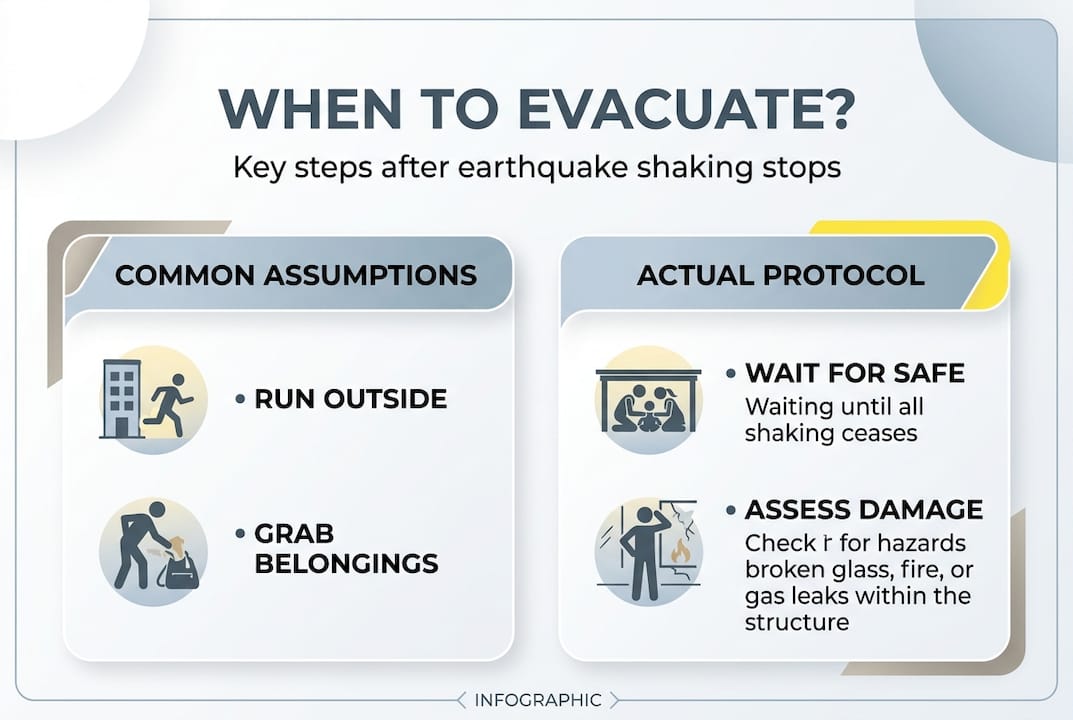
This distinction matters deeply for families. If you teach your children to run when the ground shakes, you are inadvertently putting them at greater risk. The safer lesson is to drop immediately, take cover under a sturdy table or against an interior wall, and hold on until the shaking completely stops.
Post-shaking evacuation is only warranted under specific circumstances:
- Your home shows signs of severe structural damage
- There is a fire, a gas leak, or a chemical hazard
- You are in a coastal or low-lying area with tsunami risk
- Emergency authorities have issued an official evacuation order
Understanding emergency kits and earthquake prep helps you be ready for those post-shaking moments when every second counts. Knowing why earthquake kits matter means recognising that preparation is not just about supplies, it’s about knowing what actions to take and when.
“The safest action during an earthquake is to drop, cover, and hold on. Do not run outside. Most injuries happen when people try to move or leave the building during shaking.” — PreparedBC
This table summarises the key difference between common assumptions and actual earthquake safety protocol:
| Common assumption | Actual protocol |
|---|---|
| Run outside immediately | Drop, Cover, Hold On until shaking stops |
| Evacuate the building during shaking | Stay sheltered in place during shaking |
| Stand in a doorway | Take cover under a sturdy table or desk |
| Evacuation is always needed after | Only evacuate if unsafe or ordered to do so |
When and why to evacuate after an earthquake
Once shaking stops and it’s safe to move, your next step is a rapid visual assessment of your surroundings. Do not assume everything is fine. Do not assume everything is dangerous either. A calm, systematic check helps you make the right call.
According to PreparedBC, evacuation is appropriate when a home is severely damaged and unsafe, or when there is a specific risk such as being near the shore when a tsunami warning is in effect. Other valid triggers include visible fire, the smell of gas, or a direct order from emergency services.
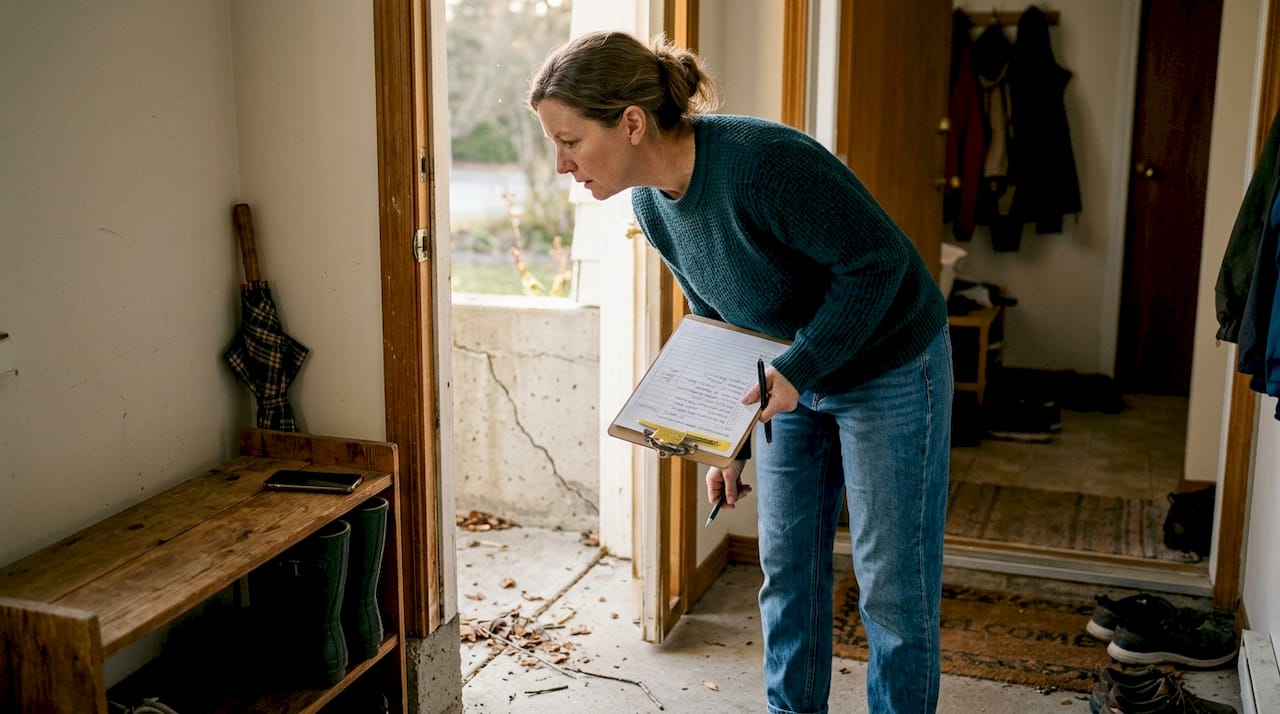
Here is a comparison of evacuation triggers by hazard type:
| Hazard | Evacuation trigger | Timing |
|---|---|---|
| Earthquake (structural) | Visible damage, unsafe structure | After shaking stops |
| Fire | Smoke, flames, alarm | Immediately |
| Gas leak | Smell of gas, hissing sounds | After shaking, do not use lights |
| Tsunami | Shaking near coast, official alert | Immediately after shaking |
If you determine evacuation is necessary, follow these steps:
- Wait for shaking to fully stop before moving.
- Check yourself and family members for injuries before anything else.
- Put on footwear to protect against broken glass and debris.
- Do not use elevators. Take stairwells.
- Avoid touching downed power lines or flooded areas.
- Move to your pre-designated family meeting point.
- Do not re-enter the building until authorities declare it safe.
For additional guidance on supplies and documentation to include in your go-bag, the emergency kit guide for British Columbians covers this in practical detail. For broader Canada earthquake preparedness information, the federal government also offers clear steps for households.
Pro Tip: If you live in a coastal community like Victoria, Vancouver, or any area near the Strait of Georgia, practise tsunami evacuation routes separately. After a major earthquake, the window to reach higher ground may be as short as 15 to 30 minutes.
Key steps for family earthquake evacuation readiness
Knowing when to evacuate is one thing. Actually being ready to do it calmly, with children in tow, is another. Families with kids face unique challenges: young children panic more easily, schools may be holding your child during an event, and reunification procedures can be stressful without prior planning.
PreparedBC recommends that families prepare grab-and-go bags for every member, practise family plans that include school pick-up authorisations, and involve children in drills like the Great BC ShakeOut. The Vancouver School Board also emphasises that psychological preparation through family drills prevents panic and is a cornerstone of trauma-informed emergency practices for children.
Here is what every BC family should have in place:
- Grab-and-go bags for each family member, including age-appropriate supplies for children such as comfort items, medications, and snacks
- A written family communication plan with out-of-province contacts, since local phone lines often overload after a major event
- Designated meeting points, one near home and one further away, known by every family member including older children
- School reunification cards completed and updated annually, identifying who is authorised to pick up your child
- Practised evacuation routes from every room in your home, not just the main door
For detailed guidance on earthquake kit organisation for families, it helps to assign specific roles to each family member so no one is standing still while another is overwhelmed. For families still choosing family earthquake kits, there are options designed specifically for households with children.
Visit the school earthquake safety steps from the Vancouver School Board to understand what your child’s school is already doing, and what you can reinforce at home.
Pro Tip: Practising drop-and-cover drills at home even twice a year makes the response automatic for children. When they encounter the real event at school or at a friend’s house, the muscle memory takes over.
Special considerations for schools and edge cases
BC schools are not built to evacuate during shaking. They are designed to shelter students in place. This surprises many parents who assume schools will immediately move children outside. In fact, schools in BC practise Drop, Cover, and Hold On as the primary earthquake response, keeping it clearly distinct from fire evacuation procedures, which do involve leaving the building promptly.
Reunification after a school earthquake event requires ID and authorised contacts. If your name is not on the school’s contact list, you will not be able to pick up your child regardless of the circumstances. Keeping those authorisations updated every school year is a small but critical task.
“Reunification protocols exist to protect children. Schools will not release students to anyone not listed as an authorised contact, even in an emergency. Plan ahead, and ensure your information is always current.” — Vancouver School Board
Beyond school settings, families should also review what to do in less common situations. Edge case guidance from the Government of Canada outlines several scenarios:
- Outdoors: Move away from buildings, trees, and overhead wires. Drop to the ground and protect your head and neck until shaking stops.
- In a vehicle: Pull over safely away from bridges, overpasses, and buildings. Stay inside with your seatbelt on until shaking stops.
- Using a wheelchair or mobility device: Lock your wheels, bend forward to protect your head, and cover your neck with your hands.
- Near a coastline: Move immediately to higher ground after shaking stops. Do not wait for an official warning if you felt strong shaking.
- During aftershocks: Drop, Cover, and Hold On again. Aftershocks can be nearly as strong as the initial event and can bring down already-weakened structures.
Review the full earthquake prep checklist to ensure your family has addressed each of these scenarios. For additional edge-case guidance, more earthquake protocols are available from PreparedBC.
What most emergency guides miss about earthquake evacuation
Most earthquake guides tell you to have a kit, know your exits, and practise a drill. That advice is sound, but it misses something important: the danger of over-evacuating.
When thousands of households panic and pour into the streets simultaneously, roads become impassable. Emergency vehicles cannot reach those who truly need help. Shelters fill beyond capacity. The instinct to flee, which feels responsible, can actively make the situation worse for your community.
BC’s guidance prioritises shelter in place unless your home is structurally unsound or you face a specific threat like a tsunami or fire. Staying put when it is safe to do so is not passive. It is a deliberate, informed decision that supports broader community resilience.
The lesson that rarely gets said clearly enough: knowing when not to evacuate is just as important as knowing how to do it. Drills and communication plans matter more than the split-second impulse to run. When you practise with your family and understand the criteria for genuine evacuation, you make better decisions under pressure. For families considering choosing earthquake kits, the right gear supports both sheltering in place and evacuating when truly necessary.
Take your family’s preparedness to the next level
Understanding evacuation protocol is the foundation. Having the right supplies makes it actionable. Whether you are sheltering in place for 72 hours or grabbing your bag and heading to a meeting point, the gear you have on hand determines how smoothly your family manages the transition from shock to stability.
At EarthquakeKit.ca, we offer solutions tailored specifically for BC families, homes, vehicles, and workplaces. Our Gov BC earthquake kits are designed in alignment with provincial recommendations, making it simple to meet the baseline standard. For individual readiness, our personal earthquake supplies ensure that every member of your household, including your children, has what they need when it matters most. Being prepared is not a one-time purchase. It is an ongoing commitment to your family’s safety.
Frequently asked questions
What does emergency evacuation mean in the context of an earthquake?
Emergency evacuation means leaving a building or area after an earthquake if it is unsafe or you’re at risk from fire, gas leaks, or tsunamis. According to PreparedBC, evacuation occurs only after shaking stops and if the home is severely damaged or a specific threat is present.
What should you do with children during an earthquake before considering evacuation?
Everyone, including children, should Drop, Cover, and Hold On during shaking. The primary protection during shaking is this proven protocol, not evacuation, as moving during an earthquake significantly increases injury risk.
How long should a BC family plan to be self-sufficient after an earthquake?
British Columbians should be prepared to be self-sufficient for at least 72 hours after an earthquake. PreparedBC expects households to have kits and plans that support this minimum period without outside assistance.
Do schools in BC evacuate students during an earthquake?
BC schools keep students inside and use Drop, Cover, and Hold On during shaking. According to the Vancouver School Board, earthquake procedures are distinct from fire evacuation and involve sheltering in place rather than exiting the building during the event.
What are edge-case safety actions during an earthquake (e.g., outside, in a car)?
If you are outdoors, move away from structures and drop to the ground. If you are in a vehicle, pull over safely and stay inside. Government of Canada guidance also advises following Drop, Cover, and Hold On again during any aftershocks.