

Why vehicle emergency kits save lives during earthquakes
Posted by Karl Lundgren on
TL;DR:
- Most BC families focus on home earthquake preparations but overlook their vehicle supplies, creating a serious safety gap. Vehicle kits are essential for shelter, mobility, and safety during emergencies when roads are blocked or you are away from home. Regularly maintaining and updating these kits ensures your family remains self-sufficient and prepared for at least 72 hours in an earthquake scenario.
Most BC families have put thought into home earthquake preparedness, yet the same families drive to work, school, and weekend activities every single day without a single emergency supply in the boot. That gap is a serious vulnerability. BC vehicle emergency kits help families reduce harm and act while waiting for help, especially if you must shelter in your vehicle after an earthquake strikes. This article clarifies exactly why your car is a critical preparedness layer, what belongs inside it, and how to keep those supplies genuinely useful when the ground starts to shake.
Table of Contents
- Why your vehicle is essential in earthquake emergencies
- Core reasons vehicles need emergency kits in BC
- What goes in a BC vehicle emergency kit?
- Keeping your kit reliable: Maintenance and readiness
- What most BC families overlook about vehicle kits
- Ready to get your BC vehicle emergency kit?
- Frequently asked questions
Key Takeaways
| Point | Details |
|---|---|
| Vehicle kits are a must | Having a stocked emergency kit in your vehicle prepares your family for the realities of earthquakes in British Columbia. |
| Complement home kits | Vehicle kits do not replace home kits but fill crucial gaps when evacuation or road sheltering becomes necessary. |
| Self-sufficiency is key | Your kit should help you survive without outside assistance for at least 72 hours. |
| Regular maintenance matters | Check, refresh, and organise your kit at least twice a year to ensure reliability. |
Why your vehicle is essential in earthquake emergencies
With the reality that most earthquakes in BC strike without warning, your vehicle can very quickly become your safety hub. Imagine you are on the Port Mann Bridge, or driving through a tunnel near Burnaby, when a major seismic event along the Cascadia Subduction Zone releases decades of built-up energy. Roads ahead may be impassable. Buildings around you could be structurally compromised. Emergency services will be stretched across hundreds of simultaneous incidents, and you will be on your own for some time.
PreparedBC earthquake guidance makes clear that during an earthquake, you may need to stay in your vehicle rather than evacuating immediately, and preparedness guidance therefore emphasises actions like pulling over safely and staying inside. That single instruction changes everything about how you should think about your car. It is not just transportation. It is potentially your shelter, your supply depot, and your communication centre.
Understanding how emergency kits help BC residents clarifies that being stocked in your vehicle reduces the burden on first responders too. When families can shelter safely in place and manage basic needs independently, emergency vehicles can move through cleared corridors to reach the people who need rescue most urgently. A well-prepared vehicle is, in that sense, a form of civic responsibility.
Here are the core scenarios where a vehicle kit becomes critical in a BC earthquake:
- Stranded on a highway or bridge with no access to food, water, or medical supplies
- Picked up children from school during an aftershock and cannot safely return home
- Caught between locations, such as between work in Burnaby and home in Surrey, with roads blocked
- Sheltering in your vehicle overnight because your home has been red-tagged as unsafe for entry
- Waiting for a ferry crossing that has been suspended due to seismic damage at the terminal
Why earthquake kits matter in BC goes beyond individual comfort. It is about maintaining calm, making sound decisions, and keeping your family safe during a window of time when professional help simply cannot reach everyone.
“Your vehicle may become your temporary home after a major earthquake. Treating it that way, before the emergency happens, is what preparedness actually means.”
Pro Tip: Keep a pair of sturdy closed-toe shoes inside your vehicle at all times. Broken glass and debris are common after earthquakes, and many people are caught in sandals or dress shoes that offer zero protection.
Core reasons vehicles need emergency kits in BC
Understanding vehicle importance, it is crucial to see why separate kits are recommended and what core needs they address in BC specifically.
Power, water, and normal services can be disrupted for extended periods following a major earthquake, meaning households and individuals in vehicles must be self-sufficient. In BC’s lower mainland, a megathrust earthquake on the Cascadia Subduction Zone is projected to cause widespread infrastructure failure. That means no tap water, no functioning ATMs, no fuel deliveries, and possible disruptions to cellular networks for days or longer.
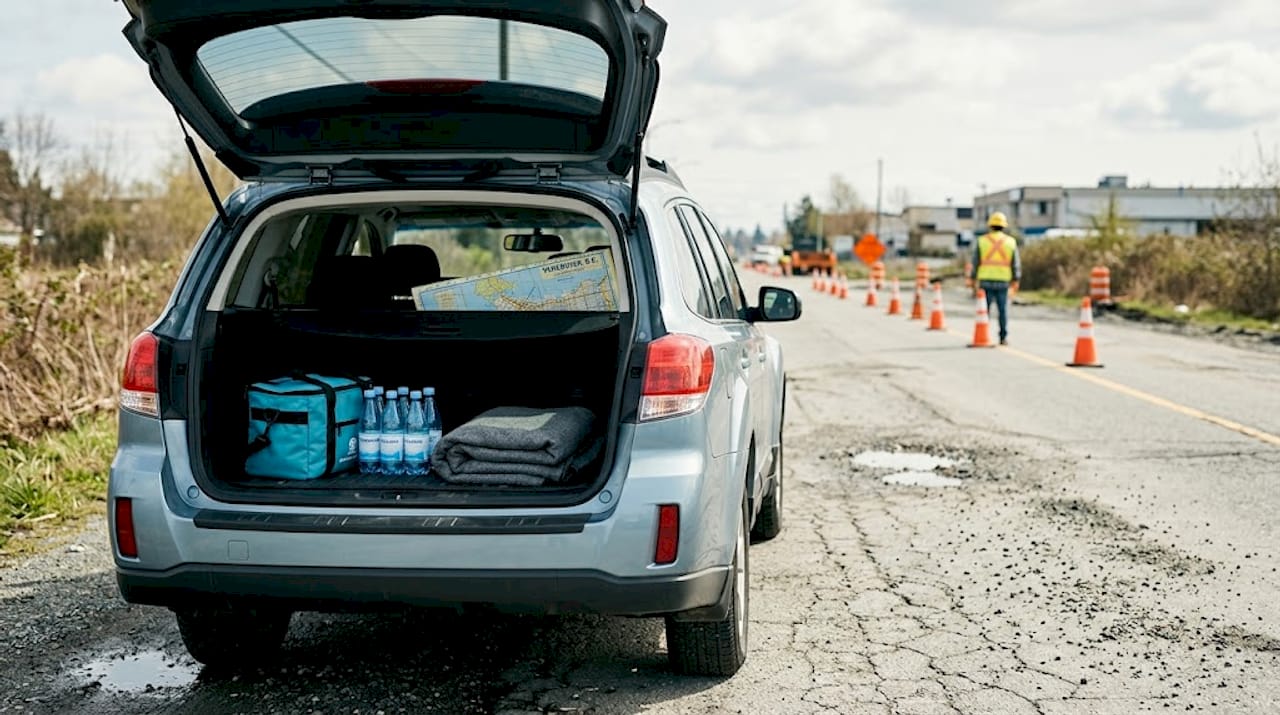
Your home kit covers your household’s needs when you are able to stay in place. But your vehicle kit addresses a completely different set of circumstances: evacuation, road stranding, mobility, and the reality of being away from home when disaster strikes. These are not redundant preparations. They are complementary layers of a sound family emergency plan.
Vehicle kits complement household kits by helping you get through the period when you may need to evacuate or shelter while roads are unsafe. Think of the two kits as covering two different physical locations and two different types of need.
The table below summarises the key differences:
| Need | Home kit | Vehicle kit |
|---|---|---|
| Shelter | Temporary shelter in place | Shelter inside the vehicle |
| Food and water | Extended supply (7+ days) | Short-term supply (72+ hours) |
| Mobility | Not applicable | Traction tools, road maps |
| Signalling | Whistle, radio | Flares, whistle, flashlight |
| Medical | Full first aid kit | Compact first aid kit |
| Warmth | Blankets, heating | Emergency blankets, extra clothing |
Families with young children or pets face additional considerations. A well-chosen earthquake kit accounts for formula, diapers, pet food, and comfort items that make a frightening situation more manageable. These are not luxuries. They are essential tools for keeping children calm and safe while adults manage the situation.
“Self-sufficiency is not just about physical survival. It is about maintaining enough stability to make good decisions under extraordinary stress.”
Here is what a vehicle kit must support in BC-specific earthquake conditions:
- Surviving independently for at least 72 hours without outside assistance
- Basic medical care for common injuries from glass, debris, or falls
- Warmth during cold BC winters or damp coastal nights
- Communication and navigation when cellular networks are down
- Comfort and safety for children, elderly family members, or pets
What goes in a BC vehicle emergency kit?
With clear needs established, let us look at exactly what experts recommend you store in your vehicle for BC conditions.
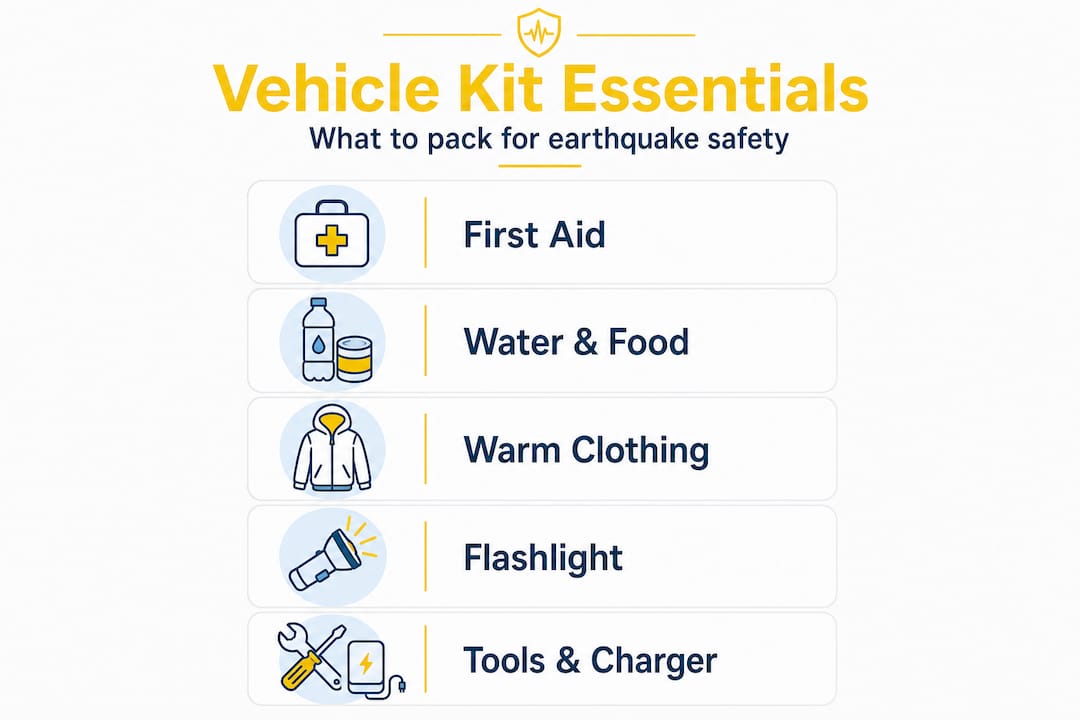
Vehicle emergency kits provide essentials tailored to the most likely immediate roadside needs: basic medical support, warmth and protection, visibility and signalling, and supplies to survive being stranded. The specific items recommended for BC align with both federal guidance and provincial earthquake preparedness standards.
Emergency car kit checklists in BC commonly align with the federal emergency car kit concept: food and water, blankets and clothing, first aid, signalling, and traction and roadside tools stored in the trunk. The checklist below reflects that guidance with BC-specific additions.
Numbered checklist for a BC vehicle emergency kit:
- Water: Minimum four litres per person in sealed, freeze-resistant containers suitable for BC winters
- Non-perishable food: Energy bars, dried fruit, crackers, and canned goods with pull-tabs for at least three days
- First aid kit: Bandages, antiseptic wipes, pain relief, gloves, and a first aid manual
- Emergency blankets: At least one Mylar thermal blanket per person, plus a heavier wool or fleece blanket
- Extra clothing: Warm layers, waterproof jacket, work gloves, and closed-toe shoes for each family member
- Seatbelt cutter and window breaker: Compact tools that can be kept within reach of the driver
- Wind-up or hand-crank flashlight: Avoids dependence on batteries that may have discharged
- Whistle: A loud, simple signalling device that works without power or batteries
- Copies of emergency plan and road maps: Physical copies in case your phone battery is dead
- Sand or cat litter: For traction if your vehicle is stuck on icy or debris-covered roads
- Tow rope and jumper cables: For vehicle recovery or assisting others
- Small fire extinguisher: Vehicles can ignite after collisions or in post-earthquake fires
- Cash in small bills: ATMs will not function during power outages
- Portable battery pack: For charging phones before the battery pack itself discharges
- Pet supplies: Water, food, and a leash or carrier if travelling with animals
The full emergency kit checklist for BC drivers also recommends storing prescription medications, infant supplies where relevant, and any essential kit items specific to your family’s medical needs.
A comparison of seasonal considerations for BC vehicle kits is useful here:
| Season | Primary risk | Key additions |
|---|---|---|
| Winter | Cold, icy roads, freezing temperatures | Extra blankets, hand warmers, freeze-proof water |
| Spring | Flooding, mudslides, slippery roads | Waterproof gear, traction tools |
| Summer | Heat, wildfires, extended stranding | Extra water, dust masks |
| Autumn | Wet roads, early freeze risk | Warm layers, traction aids |
Pro Tip: Organise your kit using clearly labelled, waterproof bags or containers inside a single duffel bag stored in the boot. Under acute stress, you will not have time to sort through loose items. Clear organisation can make the difference between finding your first aid kit in thirty seconds or not at all.
Keeping your kit reliable: Maintenance and readiness
Stocking a kit is not enough. It takes regular attention to keep your vehicle supplies genuinely usable in a real emergency.
Kits become ineffective if items expire or batteries fail, so established sources recommend scheduled replacement and refreshing of food, water, and batteries. Energy bars expire. Water containers crack over BC winters. Batteries drain on their own. A kit that has not been checked in two years is not a safety net. It is a false sense of security.
The following maintenance routine keeps your vehicle kit dependable:
- Set a calendar reminder every six months, aligned with the change of seasons, to open and inspect the full kit
- Check expiry dates on all food and water, replacing anything within three months of its expiry date
- Test battery-powered items, including flashlights and portable chargers, and replace batteries that are weak
- Update personal documents, including emergency plan copies, and add any new family members or pets
- Swap seasonal items, exchanging summer items for winter ones in October and reversing the process in April
- Involve your children in the review process so they know what is in the kit and where to find it
Involving children builds two important things simultaneously: familiarity with the kit’s contents, and confidence. Children who understand what the emergency plan is and where supplies are kept are less likely to panic during an actual event. Reviewing your kit selection as a family also creates natural opportunities for conversations about earthquake safety, evacuation routes, and meeting points.
Pro Tip: Set your six-month kit review to coincide with the spring and fall clocks change, which many Canadians already use as a reminder to check smoke detector batteries. Linking the two routines makes it easier to build the habit.
What most BC families overlook about vehicle kits
Here is an uncomfortable truth: most BC families who consider themselves prepared have a home kit, possibly a good one, and give almost no attention to the vehicle. The cultural conversation about earthquake preparedness in BC tends to revolve around the home, and that focus, while understandable, creates a serious gap.
The real risk for many people is not being at home when the Cascadia Subduction Zone ruptures. You could be on the highway between Vancouver and Langley. Your teenager could be on a school bus. Your partner could be three cities away at a work appointment. The earthquake does not wait for you to be in the safest possible location. It happens when it happens.
PreparedBC guidance is clear that if your home is not damaged, staying home may be the safest option, which means vehicle kits complement rather than replace household kits. That is the right framing. It is not either/or. A genuinely prepared family treats the vehicle kit with the same discipline as the home kit: regular checks, clear inventory, and a shared understanding of where everything is.
The contrarian insight here is this: the vehicle kit is actually easier to maintain than the home kit because it is smaller and more focused. There is no excuse not to have one. The barrier is not cost or complexity. It is mindset. BC families who shift from treating the vehicle kit as a secondary afterthought to treating it as a primary safety tool will be far better positioned when the ground shakes.
Reviewing the earthquake kit guide as a household, covering both home and vehicle kits together, is the most efficient way to close the gap. Do it together. Do it on a schedule. Make it routine.
Ready to get your BC vehicle emergency kit?
Taking the step from awareness to action is where preparedness becomes real. Whether you are building a kit from scratch or improving what you already have, EarthquakeKit.ca offers curated vehicle and earthquake kits designed specifically for British Columbia families, conditions, and earthquake risk.
Our kits are selected with BC’s seismic reality in mind, covering everything from compact car kits for solo commuters to larger family kits that account for children and pets. Every kit is ready to store in your vehicle today, with no sourcing or assembly required. If you are serious about closing the gap in your family’s earthquake preparedness, browsing our home earthquake kit options alongside our vehicle kits is the natural next step. Real preparedness covers every location your family occupies.
Frequently asked questions
How long should a BC vehicle emergency kit support my family?
Vehicle kits should support self-sufficiency for at least 72 hours when stranded, covering food, water, warmth, and basic medical needs without outside help.
Is it better to stay in my car or leave after an earthquake?
If your home is undamaged, stay there; otherwise, sheltering in your vehicle is a safe option until roads are passable and help can reach you.
How often should I check or update my car emergency kit?
Review and refresh food, water, and batteries every six months to ensure everything is usable and within its expiry date when an emergency occurs.
What makes BC vehicle kits different from regular car kits?
BC kits are designed for earthquake evacuation and sheltering scenarios, longer periods of self-sufficiency, severe coastal weather, and family-specific needs that a generic roadside kit does not address.
What should I never leave out of a vehicle emergency kit?
Never omit water, non-perishable food, a first aid kit, warm clothing, signalling tools, and essential supplies for children or pets, as these are the items most critical during the first hours after an earthquake.