

Top advantages of home kits for earthquake safety in BC
Posted by Karl Lundgren on
TL;DR:
- BC households need emergency kits for self-reliance and reducing response pressure after earthquakes.
- Essential kit items include water, food, first aid, medications, light, and important documents.
- Maintaining and integrating kits with plans and community practices builds genuine resilience.
British Columbia sits directly above the Cascadia Subduction Zone, one of the most seismically active fault systems in the world, and the question facing every family is not whether a major earthquake will occur but whether they will be ready when it does. A well-stocked home kit can keep your household self-sufficient for 72 hours to a full week, bridging the critical gap before emergency responders can reach you. This article breaks down the genuine benefits of home emergency kits, what they should contain, how to choose between your options, and what it actually takes to move from anxiety to real preparedness.
Table of Contents
- Why every BC household needs a home emergency kit
- What to include: Essential items for family-ready kits
- Home kits versus store-bought and DIY: A head-to-head comparison
- Grab-and-go bags: Speed and mobility when every second counts
- Maintenance, planning, and community: The secret to real resilience
- The real difference: Why kits alone aren’t enough for BC families
- Take the next step: Trusted earthquake kit options for BC families
- Frequently asked questions
Key Takeaways
| Point | Details |
|---|---|
| Self-sufficiency is critical | Home kits keep families safe and independent for up to a week after an earthquake. |
| Custom kits offer best protection | Tailoring supplies to your family—babies, pets, chronic illness—ensures real readiness. |
| Store and rotate for reliability | Keep kits accessible, use waterproof containers, and rotate supplies every 6-12 months. |
| Kits plus plans boost confidence | When paired with household planning and drills, kits measurably raise family preparedness. |
| Quick access means survival | Grab-and-go bags add vital speed for evacuations, complementing larger home kits. |
Why every BC household needs a home emergency kit
When a significant earthquake strikes, the immediate aftermath is rarely orderly. Roads crack and buckle, bridges close, and power lines go down. First responders, however dedicated, are simply outnumbered. After a major event along the Cascadia fault, emergency teams could be dealing with tens of thousands of calls simultaneously across Greater Vancouver, Victoria, and communities up and down the coast.
That reality makes the home emergency kit one of the most practical investments a BC family can make. Preparedness experts and the BC government agree: kits reduce stress, protect lives, minimise damage, and build the kind of community resilience that high-seismic-risk areas like Vancouver urgently need. A household that is not relying on emergency services for basic survival needs frees up those services for people in critical condition.
There is also a psychological dimension that often goes unacknowledged. Families who have prepared report lower anxiety before and after seismic events. Knowing that food, water, and medical supplies are within reach gives people a sense of agency that is genuinely calming during chaos.
“Having a plan and supplies before an emergency happens can reduce stress and help you respond more effectively.” — Government of Canada
After a 4.7-magnitude earthquake rattled BC communities recently, officials were quick to note that first responders become overwhelmed in the post-quake period, reinforcing the government’s long-standing recommendation that all residents maintain a kit at home, in their vehicle, and at their workplace. Beyond individual safety, community preparedness improves when more households are equipped. A neighbourhood where most residents have supplies is far more capable of mutual aid than one where everyone is immediately dependent on external help.
Key reasons every BC household should prioritise a home emergency kit:
- Self-reliance during the critical first 72 hours to one week, when services may be unavailable
- Reduced pressure on emergency services, freeing responders to assist the most vulnerable
- Emotional stability for children and elderly family members during a frightening event
- Protection against secondary hazards such as water contamination and food shortages
- Stronger neighbourhood resilience when multiple households are prepared
For a thorough look at home kit essentials for earthquake safety, it helps to understand exactly what items make a kit genuinely effective.
What to include: Essential items for family-ready kits
Building a useful kit means going beyond a generic checklist and thinking carefully about the real needs of everyone in your household. The City of Surrey’s emergency programme recommends stocking water at four litres per person per day, along with non-perishable food, a first aid kit, prescription medications, a flashlight, a battery-powered or hand-crank radio, extra batteries, and cash in small bills. These are the non-negotiable foundations.
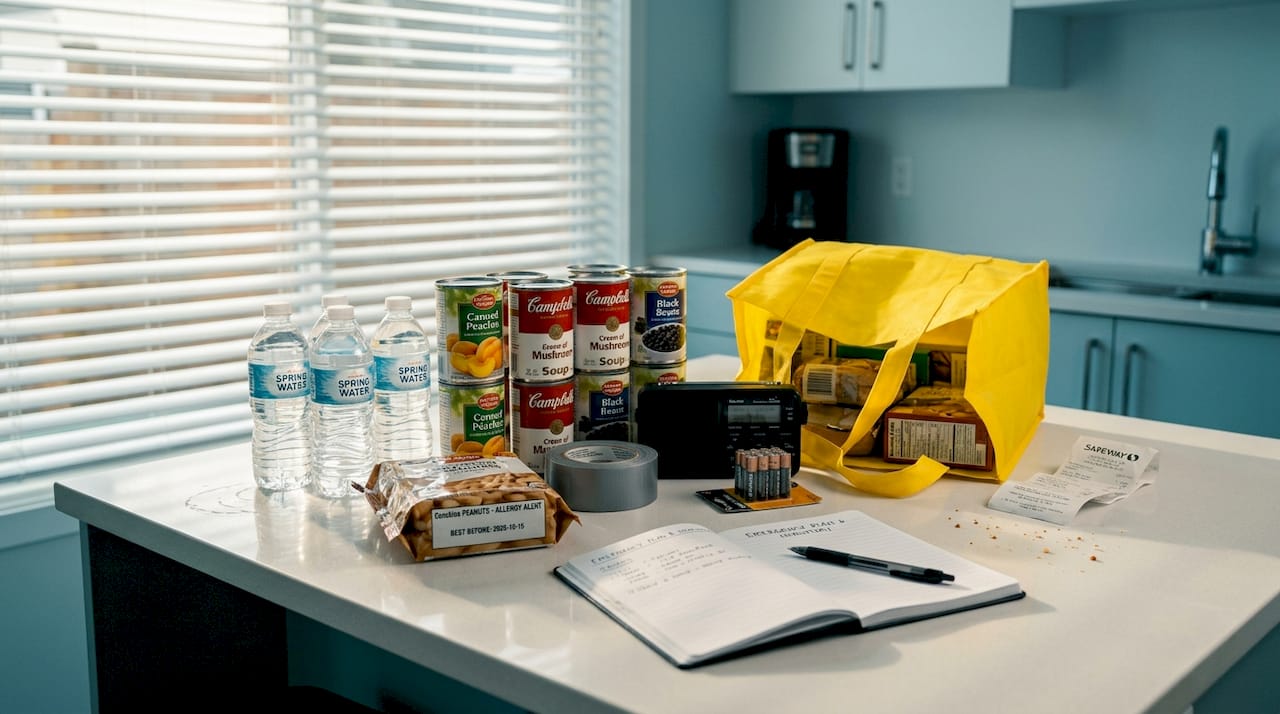
However, a truly family-ready kit goes further. Consider the specific key emergency supplies that reflect your household’s unique circumstances.
Essential items to include in your home emergency kit:
- Water: Four litres per person per day, minimum 72-hour supply (more for pets)
- Non-perishable food: Canned goods, energy bars, dried fruit, foods your family will actually eat
- First aid kit: Bandages, antiseptic, gauze, medical tape, and a first aid manual
- Prescription medications: A minimum seven-day supply, along with a written list of dosages
- Flashlight and extra batteries, plus a backup battery-powered lantern
- Battery or hand-crank radio to receive emergency broadcasts without internet
- Cash in small denominations, since ATMs and card terminals fail during power outages
- Copies of important documents: Passports, insurance policies, medical records, and identification
- Warm clothing and emergency blankets, especially for BC’s variable autumn and winter temperatures
- Sanitation supplies: Hand sanitiser, wet wipes, garbage bags, and a portable toilet option
- Baby formula, diapers, or special infant food if you have young children
- Pet food, leash, and vaccination records for companion animals
Pro Tip: When stocking food, choose items your family regularly eats and enjoys, not just whatever seems shelf-stable. After a traumatic event, familiar food provides genuine comfort, especially for children. Rotate these items into your regular pantry and replace them as needed.
Families with allergies must be especially deliberate. An emergency is not the time to discover that the granola bars in the kit contain nuts, or that the canned soup has ingredients your child cannot tolerate. Label allergy-specific items clearly and review the contents with every household member.
Home kits versus store-bought and DIY: A head-to-head comparison
Once you have decided to build a kit, you face a second decision: should you assemble one from scratch or purchase a ready-made option? Both approaches have genuine merit. The right choice depends on your time, budget, and family’s specific requirements.
| Factor | Store-bought kit | DIY kit |
|---|---|---|
| Time to assemble | Ready immediately | Several hours to days |
| Cost | Fixed, often bundled | Variable, can be lower or higher |
| Personalisation | Limited | Fully customisable |
| Completeness | Generally thorough | Depends on research and effort |
| Quality control | Consistent | Varies by item source |
| Storage container | Usually included | Chosen separately |
| Maintenance ease | Straightforward | Requires your own tracking system |
Store-bought kits are convenient and well-suited for families who want a reliable baseline without investing significant planning time. They typically include all the core items in one waterproof container, ready to go. The trade-off is that they may not account for specific dietary restrictions, pet needs, or medical equipment your family requires.
DIY kits, on the other hand, let you build exactly what your household needs. A family with a toddler, an elderly grandparent, a diabetic member, and two cats has very specific requirements that no off-the-shelf kit fully addresses. The effort required is real, but the result is a kit that fits your life precisely.
The City of Surrey recommends storing all supplies in waterproof, clearly labelled containers in a cool and accessible location, and rotating food and water every 6 to 12 months regardless of whether the kit was purchased or assembled at home.
Pro Tip: If you purchase a store-bought kit, treat it as a strong starting point rather than a finished product. Supplement it immediately with family-specific items: medications, allergy-safe snacks, and supplies for infants or pets. Review personal earthquake kit supplies to fill any gaps specific to your household.
Whatever approach you choose, choosing earthquake kits for families means considering who is in your household today, and reviewing that list annually as your family changes.
Grab-and-go bags: Speed and mobility when every second counts
A full home kit is designed for sheltering in place, but some earthquakes make staying home impossible. Fire, structural damage, gas leaks, or rising water can force an immediate evacuation. That is where the grab-and-go bag becomes essential.
A grab-and-go bag is a smaller, lighter pack containing only the most critical items your family needs for the first 24 to 72 hours away from home. It should be positioned near an exit, ideally by the front or back door, so that anyone in the household can grab it and leave within minutes. According to BC’s flood preparedness guide, these bags should contain copies of essential documents, medications, and basic supplies stored accessibly near exits.
“In a sudden evacuation, what matters most is speed. If your bag is not ready to go, it is not ready at all.”
What to pack in a grab-and-go bag:
- Photocopies or USB drive of key documents: ID, passports, insurance, bank account numbers
- Prescription medications for every household member, in original labelled containers
- Water and compact snacks such as energy bars or dried fruit
- Flashlight and spare batteries
- Small first aid kit
- Phone charger and portable power bank
- Emergency cash
- Warm layer and rain jacket, because BC weather can shift without warning
- A written emergency contact list, since phone batteries die and memory fails under stress
For more guidance on emergency bag supplies for BC specific to the 2026 season, review the latest recommendations for your region and household type. The grab-and-go bag is not a replacement for your home kit. It is an essential complement, covering the scenario where leaving in a hurry is unavoidable.
Maintenance, planning, and community: The secret to real resilience
Owning a kit is the beginning, not the end. A kit stocked three years ago with expired food, flat batteries, and medication your family no longer takes is not a safety net. It is a false sense of security. Real preparedness requires consistent, deliberate maintenance.
Nearly 70 percent of Vancouver residents now report having emergency supplies at home, and research shows that this confidence is meaningfully higher when those supplies are paired with a written family emergency plan. The kit provides the materials. The plan provides the direction.
Steps to maintain an effective home emergency kit:
- Check expiry dates twice a year, ideally aligned with daylight saving time changes in spring and autumn
- Replace water supplies every six months, even if the containers appear sealed and clean
- Update medications whenever prescriptions change, and dispose of expired ones safely
- Update documents after any major life change: new address, new family member, new insurance policy
- Test batteries and electronic items annually, including radios and flashlights
- Review the kit with all household members, including children old enough to understand its purpose
| Maintenance task | Recommended frequency |
|---|---|
| Water replacement | Every 6 months |
| Food rotation | Every 6 to 12 months |
| Medication review | Every renewal or annually |
| Battery and electronics check | Annually |
| Document update | After any major life change |
| Full kit review with household | Annually |
Community preparedness programmes are an often-overlooked multiplier. When neighbours are prepared and connected, recovery is faster and more humane. Programmes like the Great ShakeOut drill, which BC residents participate in each year, pair with household preparedness by practising response under realistic conditions. Securing heavy furniture, identifying safe spots in each room, and rehearsing evacuation routes all make a significant difference.
The emergency kit maintenance guide from EarthquakeKit.ca provides a detailed annual schedule tailored to BC households, covering rotation timelines and seasonal considerations. For broader context on why kits matter in a community framework, the helpful earthquake kit strategies resource offers practical insight grounded in BC’s seismic reality.
The real difference: Why kits alone aren’t enough for BC families
Here is what we have observed after years of working with BC families on earthquake preparedness: the households that feel genuinely ready are not necessarily the ones with the most expensive kits. They are the ones where every member knows what to do, where to go, and who to contact when the ground stops shaking.
Research supports this view. Survey data consistently shows that preparedness confidence is significantly higher in households that combine supplies with a written plan and regular practice. Government agencies, the Insurance Bureau of Canada, and UBC researchers all reach the same conclusion: kits are essential but incomplete without integration into a broader family strategy.
This matters especially for renters, newcomers to BC, and those without strong social networks. These groups often have less access to preparedness information and may assume that earthquake preparation is a homeowner’s concern or something handled by landlords. It is not. Every person living in BC’s seismic zones benefits from understanding how kits fit within a larger framework that includes communication plans, evacuation routes, and community connections.
The uncomfortable reality is that buying a kit and storing it in a closet is not preparedness. It is the beginning of preparedness. The families who move from anxiety to genuine confidence are the ones who treat their kit as a living part of their household routine, not a one-time purchase. That shift in thinking is where the real advantage lies.
Take the next step: Trusted earthquake kit options for BC families
Understanding the benefits of home emergency kits is valuable. Acting on that knowledge is what actually keeps families safe.
EarthquakeKit.ca offers a range of options built specifically for British Columbians, from BC government-recommended kits that meet provincial preparedness standards to deluxe kit options designed for families who want more comprehensive coverage. Every kit is selected with BC’s specific seismic risks in mind, and ordering is straightforward and secure. If you are starting from scratch or updating an older kit, the personal supplies for emergencies section helps you fill in exactly what your household is missing. The best time to prepare was before the last earthquake. The second best time is right now.
Frequently asked questions
How long should a home emergency kit last for a BC earthquake?
A home emergency kit should provide enough supplies for 72 hours per household member, though experts recommend preparing for up to one full week given the potential scale of a Cascadia Subduction Zone event.
What if my family has allergies or special needs?
Customise your kit by including allergy-safe foods and all medications or equipment that your family requires on a daily basis, reviewing these items every time a medical need changes.
Where should I store my home emergency kit?
Store your kit in a cool, accessible location close to an exit, in a waterproof, clearly labelled container that every household member can identify and reach quickly.
How often should I update or rotate supplies?
Rotate food and water every 6 to 12 months and check medications and batteries at least annually to ensure everything in your kit is functional when it matters most.
Do most Vancouver families have emergency kits?
Nearly 70 percent of Vancouver residents now report having emergency supplies, with the highest levels of preparedness confidence found among those who also have a written household emergency plan in place.
Recommended
Share this post
- 0 comment
- Tags: advantages of home kits, en