

Workplace earthquake preparedness tips for BC employers
Posted by Karl Lundgren on
TL;DR:
- British Columbia faces high earthquake risk due to the Cascadia Subduction Zone, with a one-in-three chance of a major quake within 50 years.
- Employers are legally required to develop and regularly update site-specific emergency response plans, conduct annual drills, and involve workers in safety measures.
- Physical workplace preparations, including securing heavy furniture and maintaining emergency kits, are essential for actual resilience and safety during earthquakes.
British Columbia sits directly above the Cascadia Subduction Zone, one of the most seismically active fault systems on the planet. The province records roughly 1,200 earthquakes every year, and scientists place a one-in-three chance of a major quake striking southwestern BC within the next 50 years. For employers, that risk is not abstract. It translates into a direct legal obligation under WorkSafeBC regulations, a duty of care to every person on your payroll, and a practical need to keep operations running after a seismic event. This article delivers concrete, regulation-aligned steps to help you meet that obligation and protect your team.
Table of Contents
- Understand BC’s earthquake risks and workplace legal duties
- Create and test a workplace earthquake emergency plan
- Earthquake-proof your workplace environment
- Prepare workplace emergency kits and supplies
- Why ‘checklist compliance’ isn’t enough: Building true earthquake resilience
- Equip your BC workplace for confidence and compliance
- Frequently asked questions
Key Takeaways
| Point | Details |
|---|---|
| Know your legal obligations | WorkSafeBC regulations require written plans, staff training, and annual earthquake drills for all BC workplaces. |
| Physical preparation matters | Securing the workspace and teaching safe behaviours can significantly reduce injury and damage. |
| Emergency kits save lives | Workplace kits need 72 hours of supplies and should be tailored to team size and specific needs. |
| Review and improve regularly | Test, update, and involve employees in all stages for effective and compliant preparedness. |
Understand BC’s earthquake risks and workplace legal duties
The scale of BC’s seismic exposure is significant, and it shapes every decision an employer should make about workplace safety. A magnitude 5+ quake strikes somewhere in the province roughly once every decade, but the Cascadia Subduction Zone is capable of producing megathrust earthquakes in the magnitude 8 to 9 range. Events of that size release energy that can sustain violent shaking for several minutes, far longer than most people expect. Offices, warehouses, and retail spaces across the Lower Mainland, Vancouver Island, and the Sea-to-Sky corridor are all within the projected impact zone.
Understanding why earthquake kits matter is the first step, but employers must also understand their legal footing. All BC employers must plan, prepare, and train employees for emergencies under WorkSafeBC OHS Regulation sections 4.13 to 4.16 and Part 32, which covers Evacuation and Rescue. These are not guidelines or suggestions. They are enforceable requirements, and non-compliance can result in orders, penalties, and, in the worst case, liability following an incident.
Key regulatory obligations for BC employers include:
- Written emergency response plan (ERP): A documented, site-specific plan that addresses evacuation routes, assembly points, rescue procedures, and re-entry protocols.
- Annual drills: At minimum, one full practice exercise per year, with records kept on file.
- Worker engagement: Employees must be involved in hazard identification and risk assessments, not simply handed a policy document.
- First aid coverage: Adequate trained first aid attendants and supplies must be available at all times.
- Accessibility provisions: Plans must explicitly address the safety of employees with disabilities or mobility limitations.
“Emergency preparedness is not a one-time task. It is an ongoing process that requires regular review, worker involvement, and a genuine commitment to keeping plans current.” — SafeCareBC
Treating these obligations as a living part of your workplace culture, rather than a compliance checkbox, is what separates organisations that survive a major earthquake from those that do not.
Create and test a workplace earthquake emergency plan
A written Emergency Response Plan is the foundation of everything else. Without it, even well-intentioned employees will make dangerous decisions during the chaos of a real earthquake. The plan must be specific to your building, your team size, and your operational context. A generic template downloaded from the internet will not satisfy WorkSafeBC requirements, and it will not serve your workers well when the ground starts moving.
Here is a practical sequence for developing and maintaining an effective ERP:
- Conduct a site-specific hazard assessment. Walk through your entire workspace and identify structural risks, heavy objects that could fall, blocked exits, and areas where employees with mobility needs could become trapped. Document everything.
- Assign clear roles and responsibilities. Designate a Floor Warden, an Evacuation Coordinator, and a First Aid Lead. Every employee should know who these people are before an emergency occurs.
- Map evacuation routes and assembly areas. Post clear signage. Identify at least two exit routes from every area of the building in case one is blocked by debris.
- Develop re-entry and rescue procedures. Establish who is authorised to declare the building safe for re-entry and what criteria must be met before employees return.
- Schedule and conduct annual drills. Participating in the Great BC ShakeOut, which has drawn over 730,000 BC participants in recent years, is an excellent benchmark. It provides a structured, province-wide exercise that gives your team realistic practice and connects your organisation to a broader preparedness community.
- Review and update the plan regularly. Trigger a review whenever your team size changes significantly, your workspace is renovated, new hazards are identified, or a real earthquake occurs anywhere in the region.
Pro Tip: After every drill, hold a 15-minute debrief with your team. Ask what went smoothly, what caused confusion, and what would have been different in a real event. The most valuable improvements to your ERP come from the people who practised it, not from the person who wrote it.
Consulting emergency kit tips for BC workplaces alongside your ERP development ensures your supplies align with your procedures. Your emergency kit guide for BC offices can help you match kit contents to your specific team size and building type.
“Drills must be conducted at least once every year, and written procedures must cover evacuation, rescue, and re-entry. Risk assessments must actively engage workers, and plans must address employees with disabilities.” — SafeCareBC
Earthquake-proof your workplace environment
A solid emergency plan is only as effective as the physical environment it operates in. Unsecured furniture, improperly stored heavy equipment, and blocked exits can turn a manageable seismic event into a fatal one. Physical mitigation measures are not optional extras. They are a core part of your duty of care.
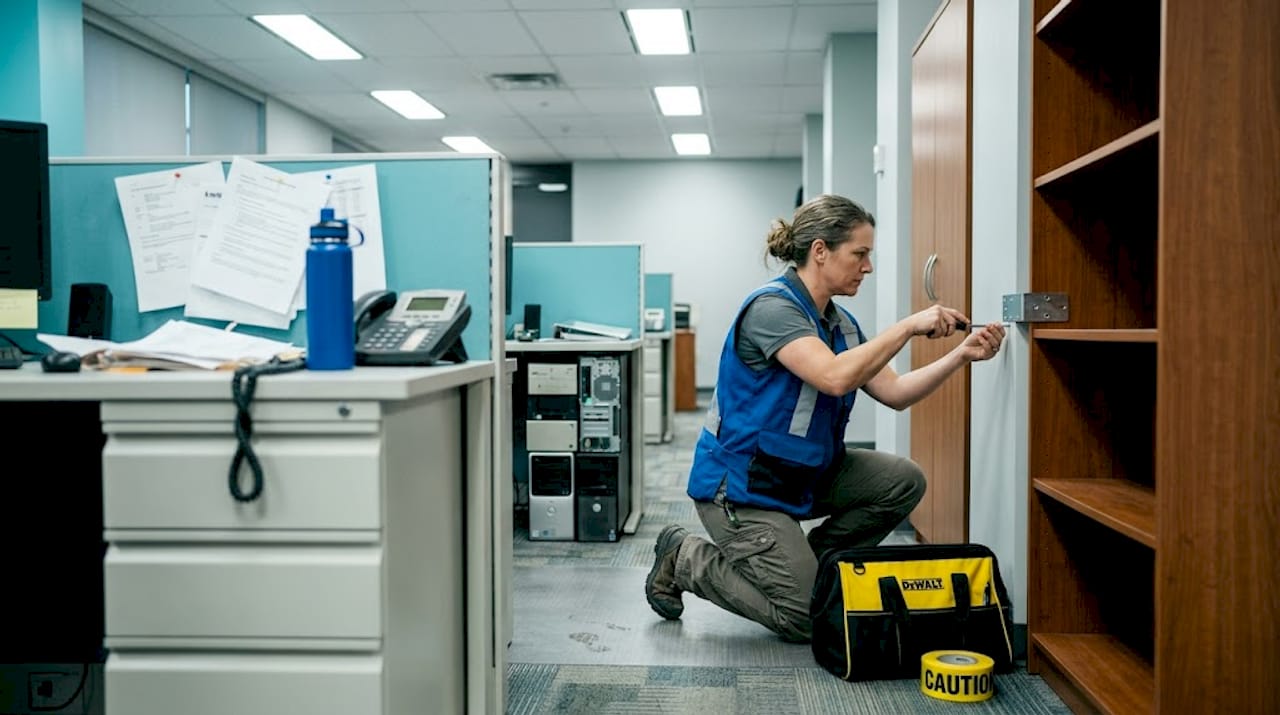
The Province of BC recommends that workplaces secure tall furniture and heavy items including filing cabinets, bookshelves, server racks, and water heaters. Cabinet doors should have latches that prevent them from flying open during shaking. Desks should be positioned away from windows where possible, since broken glass is one of the most common causes of injury in an earthquake.
Here is a comparison of mitigation measures by priority level:
| Priority | Hazard | Recommended action |
|---|---|---|
| Critical | Tall shelving and filing cabinets | Anchor to wall studs with L-brackets |
| Critical | Server racks and heavy equipment | Bolt to floor or use anti-tip straps |
| High | Cabinet doors with loose contents | Install positive-latch hardware |
| High | Water heaters and gas appliances | Strap to wall; ensure flexible connectors |
| Medium | Desk placement near windows | Relocate desks at least 1.5 metres from glass |
| Medium | Overhead storage | Move heavy items to lower shelves |
Knowing how to shut off utilities is equally important. Employees responsible for utility shutoffs should receive hands-on training, not just written instructions. Gas shutoffs in particular require a specific tool and must only be restored by a qualified technician. Practise the procedure so it becomes automatic.
During an actual earthquake, the safest action is to Drop, Cover, and Hold On under a sturdy desk or table until the shaking stops. This is a critical point that many employees get wrong. Evacuating during active shaking is dangerous because falling debris, broken glass, and unstable structures create serious hazards the moment someone stands up and moves. Train your team to stay put until the shaking fully stops, then assess the situation before moving.
Additional physical safety measures to prioritise:
- Identify safe shelter spots at every workstation before an earthquake occurs.
- Ensure employees with disabilities have a personalised evacuation plan that does not rely on elevators.
- Post utility shutoff instructions near the relevant equipment, laminated and clearly visible.
- Store emergency supplies for earthquake safety in a location that remains accessible even if interior doors are jammed by structural movement.
Pro Tip: Walk your workspace with fresh eyes at least once per year specifically looking for new hazards. Office layouts change over time. New furniture arrives, storage habits shift, and what was a clear exit route last year may now be partially blocked.
Prepare workplace emergency kits and supplies
Even the most thorough emergency plan will fall short if your workplace lacks the physical supplies to sustain employees after a major earthquake. Infrastructure failures following a significant seismic event can disrupt water, power, and communications for 72 hours or more. Your workplace kit must bridge that gap.
The Regional District of Nanaimo recommends that workplace emergency kits include at minimum 4 litres of water per person per day, along with food, a flashlight, a whistle, a battery-powered or hand-crank radio, cash in small bills, medications for employees with known needs, sturdy shoes, and work gloves. For a workplace with 20 employees, that means storing at least 240 litres of water for a 72-hour supply. That volume requires deliberate planning and dedicated storage space.
| Supply item | Recommended quantity | Notes |
|---|---|---|
| Water | 4 litres per person per day | Rotate every 6 months |
| Non-perishable food | 3-day supply per person | Consider dietary restrictions |
| First aid kit | 1 per 10 employees | Check contents annually |
| Flashlights and batteries | 1 per 5 employees | Test batteries every 6 months |
| Battery or hand-crank radio | 1 per floor | Tune to local emergency frequency |
| Cash (small bills) | $50-$100 per person | ATMs may be offline post-quake |
| Sturdy shoes and gloves | 1 pair each per person | Store near workstations |
| Whistle | 1 per person | For signalling if trapped |
| Medications | Individualised | Coordinate with employees privately |
Emergency plans must be living documents, tested and reviewed on a regular schedule. The same principle applies to your physical supplies. A kit that was assembled three years ago and never checked may contain expired food, dead batteries, and medications that are no longer relevant to your current team.
Understanding how emergency kits help BC workplaces function effectively after a major event can help you make smarter purchasing decisions. Using an earthquake preparedness checklist ensures nothing critical is overlooked when you are assembling or auditing your kit.
Pro Tip: Assign a specific staff member to be the Kit Coordinator. Give them a calendar reminder every six months to inspect supplies, rotate perishables, and update the kit to reflect any changes in team size or employee needs. This single accountability measure dramatically reduces the chance of discovering a critical gap during an actual emergency.
Why ‘checklist compliance’ isn’t enough: Building true earthquake resilience
There is a pattern we see repeatedly in workplace preparedness across British Columbia. An organisation invests time in drafting a solid Emergency Response Plan, purchases a kit, runs one drill, and then files everything away until the next WorkSafeBC audit. On paper, they are compliant. In practice, they are not prepared.
True earthquake resilience requires something that a checklist cannot measure: a genuine culture of preparedness. That means employees who actually know what to do without consulting a document, managers who feel empowered to make decisions under pressure, and an organisation that treats each drill as a real learning opportunity rather than a procedural inconvenience.
Emergency plans must be tested and reviewed regularly, and the lessons from each exercise must actually change the plan. If your last drill revealed that three employees did not know where the assembly point was, that is not a minor note for the minutes. It is a signal that your communication approach needs to change before the next event.
One of the most overlooked aspects of earthquake preparedness is employee empowerment. When a major quake strikes, communications will likely fail. Managers may not be reachable. The employees who are physically present in the moment will need to make real decisions: whether to shelter in place, how to assist an injured colleague, when it is safe to move. If your preparedness programme has only ever told employees what to do rather than why, they will freeze when the situation does not match the script.
Reviewing choosing the right earthquake emergency kits is a useful exercise, but the mindset behind the kit matters just as much as the contents. A kit that employees know how to use, stored in a location they can find in the dark, is worth far more than a premium kit that no one has ever opened.
The BC earthquake risk environment is also not static. Scientific understanding of the Cascadia Subduction Zone continues to evolve, and WorkSafeBC updates its guidance accordingly. An organisation that reviews its ERP only when forced to will always be operating on yesterday’s best practices. Build a review cycle into your annual calendar, treat it as seriously as a financial audit, and you will be genuinely ahead of the risk.
Equip your BC workplace for confidence and compliance
Knowing what your workplace needs and actually having it in place are two different things. At EarthquakeKit.ca, we supply earthquake preparedness kits designed specifically for BC workplaces, scaled to your team size and aligned with provincial recommendations.

Whether you manage a small office, a large facility, or a multi-site operation, we carry group kits, deluxe options, and government-aligned solutions that take the guesswork out of compliance. Our kits are built around the 72-hour self-sufficiency standard recommended by the Province of BC and include the core supplies your team needs to stay safe and functional after a major seismic event. Browse our workplace earthquake kit options and take a concrete step toward protecting your people and your business today. Preparedness is not a one-time purchase. It is an ongoing commitment, and we are here to support every stage of it.
Frequently asked questions
What are the minimum legal requirements for earthquake preparedness in BC workplaces?
BC employers must have a written ERP, engage staff in risk assessments, run yearly drills, and ensure provisions for all employees including those with disabilities, as mandated under WorkSafeBC OHS Regulation sections 4.13 to 4.16 and Part 32.
How much water and food should a workplace store for earthquake preparedness?
Workplace kits should include at least 4 litres of water per person per day, along with enough non-perishable food to sustain every employee for a minimum of 72 hours following a major earthquake.
What is the safest action during an earthquake at work?
The safest action is to Drop, Cover, and Hold On under a sturdy desk or table and remain there until the shaking completely stops, then assess the situation before evacuating.
How often must earthquake drills be conducted in BC offices?
BC employers must conduct drills at least once per year as part of their written emergency preparedness obligations under WorkSafeBC OHS Regulation, with records of each drill kept on file.
Recommended
- Workplace earthquake preparedness checklist for BC offices – EarthquakeKit.ca
- Workplace emergency kit tips for BC earthquake readiness – EarthquakeKit.ca
- Earthquake preparedness guide for BC residents 2026 – EarthquakeKit.ca
- Disaster preparedness in BC: Your earthquake safety guide – EarthquakeKit.ca