

Workplace earthquake preparedness checklist for BC offices
Posted by Karl Lundgren on
TL;DR:
- BC workplaces must assess seismic risk, conduct inspections, and follow legal safety requirements.
- An effective plan includes written procedures, regular drills, role assignments, and stocked emergency kits.
- Practical training and realistic drills are crucial for team readiness and successful emergency response.
Workplace earthquake preparedness checklist for BC offices
Missing even one step in your workplace earthquake preparedness plan can put lives at risk and expose your organisation to serious legal consequences. British Columbia sits directly above the Cascadia Subduction Zone, and the threat of a major megathrust earthquake is very real. WorkSafeBC requires written emergency procedures, annual drills, and hazard-specific planning for every workplace in the province. Whether you are a manager building a plan from scratch or an employee trying to understand your responsibilities, this checklist approach turns a complicated set of requirements into clear, actionable steps.
Table of Contents
- Know your workplace earthquake risk and legal requirements
- Essential items for your workplace preparedness checklist
- Planning for people: Roles, drills, and accessibility
- After the shaking: Post-earthquake procedures and continuity planning
- What most guidelines miss about BC workplace earthquake preparedness
- Get equipped: Next steps for workplace earthquake readiness
- Frequently asked questions
Key Takeaways
| Point | Details |
|---|---|
| Annual drills essential | Running earthquake drills at least once each year keeps your workplace compliant and ready for emergencies. |
| Written plans required | Every BC employer must have a documented earthquake procedure tailored to their worksite. |
| Inclusive preparedness | Plans must account for the safety of all staff, including those with disabilities or specific needs. |
| Practice and refine | Checklist preparedness only helps if you rehearse, review, and update your plan regularly. |
Know your workplace earthquake risk and legal requirements
Before you can build an effective plan, you need to understand the specific seismic risk your workplace faces. Not every building or location in BC carries the same level of exposure, and your preparedness obligations scale with your risk profile. This is not optional groundwork. It is the foundation on which every other checklist item rests.
BC employers must determine whether their workplace is in an earthquake hazard zone and conduct a formal site inspection. The province’s hazard mapping tools and resources through Emergency Management BC can help you identify your zone. Workplaces in Greater Vancouver, Victoria, and coastal communities face some of the highest seismic risk anywhere in Canada, given their proximity to the fault system.
Understanding the broader earthquake risk in BC also means recognising how building age, construction type, and contents all factor into your vulnerability. Older unreinforced masonry buildings, for example, perform far worse during seismic events than modern wood-frame or steel structures.
A site inspection for earthquake safety should address several key areas:
- Structural integrity: Is your building seismically assessed? Request documentation from your building owner or facility manager.
- Falling hazards: Identify bookshelves, filing cabinets, overhead storage, and heavy equipment that could topple or shift during shaking.
- Exit routes: Confirm all emergency exits are clearly marked, unobstructed, and functional.
- Utilities: Know where shut-off valves for gas, water, and electricity are located, and ensure designated staff are trained to use them.
- First aid access: Verify that first aid kits and supplies are fully stocked and accessible.
- Anchor points: Check that tall furniture and equipment are properly secured to walls or fixed structures.
Documenting this inspection is as important as conducting it. WorkSafeBC requires annual drills and ongoing review of emergency procedures whenever workplace circumstances change. Written records of your inspections protect your organisation during regulatory reviews and demonstrate good faith compliance.
Pro Tip: Create a dated inspection log for every walkthrough. Photograph hazards before and after mitigation, and keep records on file for a minimum of three years to support regulatory compliance.
Workplaces in seismically active zones should also consult a qualified structural engineer to evaluate whether retrofitting is warranted. While this is not always a legal requirement, it is a practical investment in reducing risk to your people and your operations.
Essential items for your workplace preparedness checklist
With your risk profile established and site inspection documented, the next step is assembling a thorough, actionable checklist for your workplace. This goes well beyond simply having a fire extinguisher in the break room. A genuine earthquake preparedness checklist reflects the full scope of what your organisation needs to do before, during, and immediately after a seismic event.
An earthquake response plan must be written, shared with all staff, and regularly practised through annual drills. Here is a numbered checklist you can adapt for your specific workplace:
- Develop a written emergency plan that addresses earthquake-specific hazards in your workplace, including fire risk after shaking, gas leaks, and structural damage.
- Create an evacuation map for every floor and post it prominently near exits, elevators, and common areas.
- Assign and document roles, including evacuation wardens, first aid attendants, a communications lead, and support personnel for workers with disabilities.
- Confirm accessible exits are never blocked and that alternate routes exist for all areas of the building.
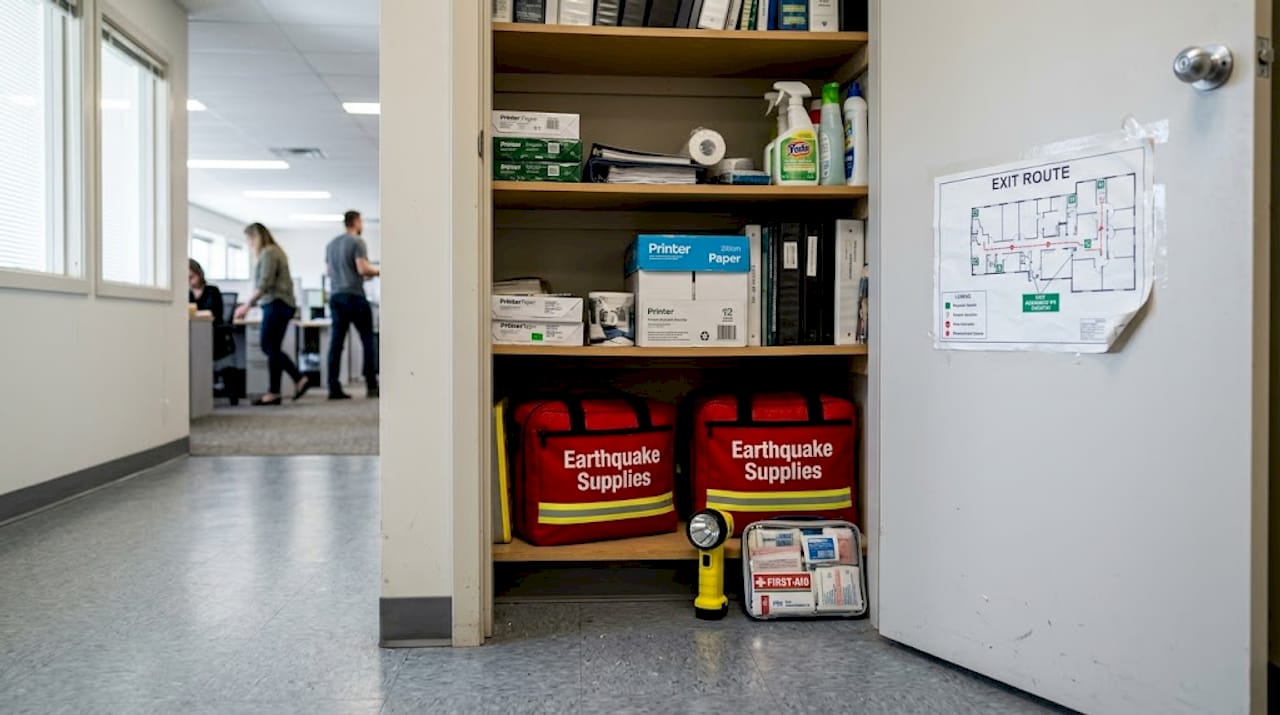
- Stock workplace emergency kits appropriate for your workforce size. Review emergency kit tips for guidance on what supplies to include per person.
- Post Drop, Cover, and Hold On instructions in multiple languages if your workforce includes non-English speakers.
- Schedule an annual drill, ideally aligned with the Great BC ShakeOut each October, which gives workplaces a structured, province-wide opportunity to practise.
- Physically secure loose items: anchor bookshelves, filing cabinets, and large monitors to walls or desks.
- Establish a communication protocol for contacting employees, clients, and stakeholders after an event.
- Review and update your plan after every drill, after significant staff changes, and any time your physical workspace changes.
“PreparedBC recommends Drop, Cover, and Hold On as the primary protective action during shaking, and securing items in advance to reduce falling hazard injuries.”
A complete checklist for safety should be treated as a living document, not a one-time exercise. Seasonal reviews help ensure that kits remain stocked, personnel remain current on their roles, and any building changes are reflected in your evacuation routes.
Pro Tip: Assign one staff member as your dedicated Emergency Preparedness Coordinator. This person owns the checklist, coordinates drills, updates records, and serves as the single point of accountability for regulatory compliance.
Workplace emergency kits should be stored in accessible locations that are unlikely to become blocked by debris. Aim for enough supplies to sustain your workforce for at least 72 hours, including water, food, first aid supplies, a battery-powered radio, flashlights, blankets, and any site-specific tools such as utility shut-off wrenches.
Planning for people: Roles, drills, and accessibility
A checklist means nothing without people who are ready to act. One of the most overlooked aspects of workplace earthquake preparedness in BC is the human element. Equipment matters, but having clearly assigned roles and regularly practised procedures is what determines whether your plan actually works when the ground starts to move.
WorkSafeBC guidance states that the emergency plan must specifically address the safety of disabled workers, including evacuation, rescue, and re-entry procedures. This is a legal requirement, not a suggestion. If your current plan does not include individual accommodation protocols for workers with mobility limitations, visual impairments, or other disabilities, it is incomplete.
Key roles to assign and document include:
- Evacuation warden: Directs occupants to exits, conducts a sweep of their assigned area, and reports to the assembly point.
- First aid attendant: Provides immediate care for injuries and triages casualties before emergency services arrive.
- Communications lead: Manages internal and external communications, including contacting emergency services and notifying staff families if needed.
- Accessibility support officer: Assists workers who require additional support during evacuation and ensures their needs are planned for in advance.
- Utilities officer: Responsible for shutting off gas, water, and electricity as directed.
The following table outlines example role assignments for a mid-sized BC office:
| Role | Primary responsibility | Required skill/training |
|---|---|---|
| Evacuation warden | Direct staff to exits, conduct area sweep | Floor warden training, first aid basics |
| First aid attendant | Triage and treat injuries | Occupational first aid certification |
| Communications lead | Contact emergency services, staff, stakeholders | Familiarity with communication protocols |
| Accessibility officer | Assist workers with additional needs | Disability awareness, evacuation chair use |
| Utilities officer | Shut off gas, water, electricity | Utility shut-off training |
Effective drills simulate realistic conditions. That means running them without advance notice occasionally, including them during unusual times such as before 9 a.m. or after 4 p.m., and debriefing staff thoroughly afterwards. Every drill should generate a written debrief report noting what worked and what needs improvement.
For guidance on integrating earthquake preparedness into your broader earthquake safety guide, consider how your workplace plan connects to community and regional emergency response systems.
Pro Tip: Cross-train at least two staff members for every critical role. If your primary evacuation warden is sick on drill day, or absent during an actual event, operations should not stall. Redundancy in your human resources is as important as redundancy in your supply kit.
After the shaking: Post-earthquake procedures and continuity planning
The moment the shaking stops is not the moment the risk ends. Secondary hazards, including aftershocks, gas leaks, structural instability, and fire, can emerge within minutes. Your post-earthquake procedure needs to be just as specific and practised as your response during shaking.
Immediately after shaking stops, follow these steps in order:
- Stay put briefly: Do not rush to evacuate immediately. Take 60 seconds to assess your immediate environment for hazards such as broken glass, debris, or smoke.
- Account for all personnel: Use your designated assembly point and headcount system to identify anyone missing or injured.
- Check for hazards: Smell for gas, look for fire, assess visible structural damage, and report findings to your utilities officer.
- Evacuate if directed: Wait for the evacuation warden’s signal before moving. Do not use elevators under any circumstances.
- Provide first aid: Your certified attendant begins triage at the assembly point. Serious injuries should be reported to emergency services immediately.
- Do not re-enter the building until a qualified structural assessor or emergency services personnel declares it safe.
- Activate your communications protocol: Notify key stakeholders, initiate continuity procedures, and document all actions taken.
“Training and drills let you refine your plan before it is needed, revealing gaps that no amount of desktop planning will uncover.”
PreparedBC resources for workplaces emphasise the importance of continuity planning, particularly for scenarios where the building or worksite is not accessible after an event. If your workplace is inaccessible, you need a pre-established plan that addresses where staff should go, how operations will continue, and who holds authority to make decisions remotely.
For kit organisation tips that translate well to workplace settings, consider how you will store and access emergency supplies if primary storage areas are blocked.
The following table compares standard and advanced continuity strategies:
| Continuity strategy | Standard approach | Advanced approach |
|---|---|---|
| Staff communication | Phone tree | Automated mass notification system |
| Work location | Identify a backup site in advance | Pre-arranged lease or reciprocal agreement with another organisation |
| Data access | Local backup drives | Cloud-based systems with offsite redundancy |
| Authority structure | Manager decides on-site | Clear chain of command documented for remote scenarios |
| Client/stakeholder notification | Manual calls | Pre-drafted communications with defined triggers |
Businesses that have invested time in continuity planning recover significantly faster after a seismic event. The planning process itself also surfaces vulnerabilities in operations that are worth addressing regardless of earthquake risk.
What most guidelines miss about BC workplace earthquake preparedness
Most official guidelines do an excellent job of telling you what to do. They tell you to write a plan, conduct drills, assign roles, and stock kits. What they rarely address is the gap between having a plan on paper and having a workforce that can actually execute it under pressure.
The biggest failure mode we see in BC workplaces is what could be called the paper plan trap. A well-formatted binder sitting in a manager’s filing cabinet does not protect anyone. Staff who have never run a realistic drill will freeze, improvise, or simply follow whoever appears most confident, regardless of whether that person is actually the designated warden.
Inclusive, realistic drills matter far more than the document itself. Testing your plan with scenario-based exercises, such as “the main stairwell is blocked” or “your first aid attendant is working from home that day,” exposes real vulnerabilities that a checklist review will never surface. This is particularly important for supporting workers with disabilities, whose evacuation needs must be individually assessed and rehearsed, not simply noted in a policy document.
Managers in BC have an opportunity to lead from the front here. Investing in genuine community-level community preparedness thinking, meaning connecting your workplace plan to neighbourhood and municipal response systems, raises the bar for everyone. A plan tested against local realities is far more resilient than one designed in isolation.
Get equipped: Next steps for workplace earthquake readiness
Your checklist is only as effective as the supplies and resources behind it. Knowing what to do is essential, but having the right equipment on hand when communications fail and emergency services are stretched thin makes the critical difference.

At EarthquakeKit.ca, we offer workplace-ready solutions for BC offices of all sizes. Whether you are outfitting a small team or a large organisation, our group earthquake kits are designed for compliance and immediate usability. Our deluxe earthquake kits include the supplies recommended by provincial authorities, and our Gov BC earthquake kit aligns directly with the Province of BC’s preparedness guidance. Being ready is not just a legal obligation. It is the most practical investment your workplace can make in the safety of every person who walks through your door.
Frequently asked questions
What is legally required for earthquake preparedness in BC workplaces?
WorkSafeBC requires written emergency procedures, annual drills, and a plan for workplace-specific hazards, including earthquakes. Procedures must be revised whenever workplace circumstances change.
What should employees do during an earthquake at work?
Follow the Drop, Cover, and Hold On steps immediately when shaking begins, and wait until shaking has fully stopped before attempting to evacuate.
How often do BC workplaces need to run earthquake drills?
Drills are mandatory at least once per year and should also be conducted whenever emergency procedures are updated or significant changes occur in the workplace.
What if the workplace is inaccessible after an earthquake?
Employers must have a continuity plan in place that includes staff communication instructions, remote work options, and a clear strategy to resume or relocate operations from an alternate site.
Recommended
- Workplace emergency kit tips for BC earthquake readiness – EarthquakeKit.ca
- Build your BC earthquake preparedness checklist for safety – EarthquakeKit.ca
- Understanding the role of kits for workplace earthquake safety – EarthquakeKit.ca
- Earthquake preparedness checklist for BC residents 2026 – EarthquakeKit.ca