

Key benefits of disaster planning for BC earthquake safety
Posted by Karl Lundgren on
British Columbia sits directly above the Cascadia Subduction Zone, one of the most dangerous fault systems on Earth. With a 30% chance of a major earthquake in the next 50 years and 92% of the province’s population exposed to seismic risk, the question is not whether you should plan but how soon you can start. Disaster planning is not about fear. It is about giving your family a real advantage when the ground starts shaking and the systems you rely on go quiet.
Table of Contents
- Why disaster planning matters in British Columbia
- Top benefits of disaster planning for families
- Critical strategies for effective earthquake disaster planning
- Checklist of essential earthquake supplies for BC
- Community involvement and the bigger picture
- Special cases: Aftershocks, tsunamis, and insurance gaps
- Get prepared with trusted BC earthquake kits
- Frequently asked questions
Key Takeaways
| Point | Details |
|---|---|
| Planning saves lives | Disaster planning dramatically reduces injuries and fatalities during earthquakes. |
| Self-sufficiency is crucial | Being prepared lets families safely manage for days or weeks without help. |
| Essential kits are key | Water, food, first aid, and tools are must-have supplies for every BC home. |
| Community action multiplies safety | Neighbours who prepare together recover faster and help each other more. |
| Watch for secondary hazards | Planning ahead also protects against aftershocks, tsunamis, and service disruptions. |
Why disaster planning matters in British Columbia
BC is not just earthquake-prone in a general sense. The risk here is specific, measurable, and serious. A projected magnitude 9 event along the Cascadia fault could cause $128 billion in economic losses, roughly 3,400 fatalities, and damage to 18,000 buildings across the province. That is not a worst-case fantasy. It is a modelled outcome based on real geology.
Nearly 90% of BC businesses also operate within high-risk seismic zones. When a major quake hits, it does not just shake buildings. It disrupts supply chains, knocks out utilities, and overwhelms emergency services all at once. Understanding earthquake kit basics is a starting point, but the broader picture demands a full household plan.
Here is what makes BC’s situation unique compared to other Canadian provinces:
- Cascadia Subduction Zone sits just offshore, capable of generating megathrust earthquakes
- Urban density in Metro Vancouver and Victoria means millions of people face concentrated risk
- Soil liquefaction in low-lying coastal areas can amplify shaking and cause infrastructure failure
- Tsunami risk is real for anyone living near the coast, adding a second hazard after the initial quake
“Preparation is not optional in BC. It is a community-wide responsibility, and the cost of inaction is measured in lives and livelihoods.”
The scale of potential disruption means that waiting for government help is not a viable strategy. First responders will be stretched thin. Roads may be impassable. The families who fare best will be the ones who planned before the shaking started.
Top benefits of disaster planning for families
Planning ahead delivers concrete, measurable advantages. These are not abstract reassurances. They are outcomes backed by research and real-world disaster response data.
-
Reduced risk of injury and death. Preparedness lowers earthquake injuries and fatalities significantly. Families who have practised Drop, Cover, Hold On and know where to shelter are far less likely to be hurt by falling objects or structural collapse.
-
Self-sufficiency when systems fail. After a major quake, water, power, and communications can be down for days or weeks. Preparedness enables self-sufficiency for 72 hours to several weeks, which directly reduces the burden on emergency responders who are already overwhelmed.
-
Financial protection. A well-stocked home and a secured structure reduce property damage and the costs that follow. Knowing your insurance coverage before a disaster means you are not scrambling through paperwork in a crisis.
-
Lower emotional stress. Anxiety spikes when people feel helpless. Having a plan, a kit, and a meeting point gives your family a sense of control that genuinely reduces panic during and after a quake.
-
Stronger community resilience. When your household is prepared, you become a resource for your neighbours rather than a burden on the system. That ripple effect matters enormously at the community level.
Pro Tip: Walk through your home right now and identify three hazards: unsecured bookshelves, a water heater that is not strapped, and anything heavy stored above head height. Fixing those three things this weekend is already meaningful progress.
Reading about emergency kits for BC can help you understand exactly what supplies translate these benefits into real-world readiness.
“The families who recover fastest are not the luckiest ones. They are the ones who prepared.”
Critical strategies for effective earthquake disaster planning
Knowing you should plan is one thing. Knowing exactly what to do is another. Here are the most effective, evidence-based steps for BC households.
-
Practise Drop, Cover, Hold On. This is the single most important physical response during shaking. PreparedBC recommends annual ShakeOut drills so the response becomes automatic, not something you have to think about while the floor is moving.
-
Secure heavy furniture and appliances. Strap bookshelves, water heaters, and large appliances to wall studs. Use museum putty on shelves with breakables. These are cheap fixes that prevent serious injuries.
-
Create a simple family emergency plan. Decide on a meeting place outside your home and one further from your neighbourhood. Assign roles. Make sure every family member, including children, knows the plan by memory.
-
Consider a home retrofit. Older homes, especially those built before 1980, may not meet current seismic standards. A structural assessment and targeted upgrades can dramatically reduce collapse risk.
-
Review your insurance. Standard home insurance in BC does not cover earthquake damage. Separate earthquake coverage is available and worth the cost given the risk profile here.
When it comes to supplies, choosing earthquake kits that match your household size and specific needs is far more effective than assembling random items. A purpose-built earthquake survival kit ensures nothing critical is missing.
Key items to address in your household plan:
- Identify safe spots in every room (under sturdy tables, against interior walls)
- Know how to shut off your gas, water, and electricity
- Keep important documents in a waterproof, portable container
- Establish an out-of-province contact as a communication hub
Pro Tip: Store a pair of sturdy shoes and a flashlight under every bed. After a quake, broken glass on the floor is one of the most common causes of foot injuries.
Checklist of essential earthquake supplies for BC
No disaster plan is complete without the right gear. Here is what every BC household should have on hand, based on guidance from municipal emergency programmes.
| Category | What you need | Minimum quantity |
|---|---|---|
| Water | Stored drinking water | 4 litres per person per day, 3 to 7 days minimum |
| Food | Non-perishable, easy to prepare | 3 to 7 day supply per person |
| First aid | Fully stocked first aid kit | One per household |
| Light and communication | Flashlight, battery or hand-crank radio | One of each, with spare batteries |
| Medications | Prescription and over-the-counter essentials | 7-day supply minimum |
| Cash | Small bills for post-quake purchases | $200 to $500 recommended |
| Documents | Copies of ID, insurance, medical records | Waterproof container |
| Warmth | Blankets or sleeping bags, warm clothing | One set per person |
| Sanitation | Toilet paper, hand sanitiser, waste bags | 7-day supply |
| Pet supplies | Food, water, medications, carrier | Match pet’s needs |
Optional but valuable upgrades include a portable water filter, a multi-tool, a fire extinguisher rated for home use, and a whistle to signal for help if you are trapped.
For a ready-to-go solution, a personal earthquake kit covers the essentials without the guesswork. If you are starting from scratch, basic kits for BC offer a solid foundation that you can build on over time. Reviewing earthquake kit essentials helps you understand what is truly non-negotiable versus what is a nice-to-have.
Community involvement and the bigger picture
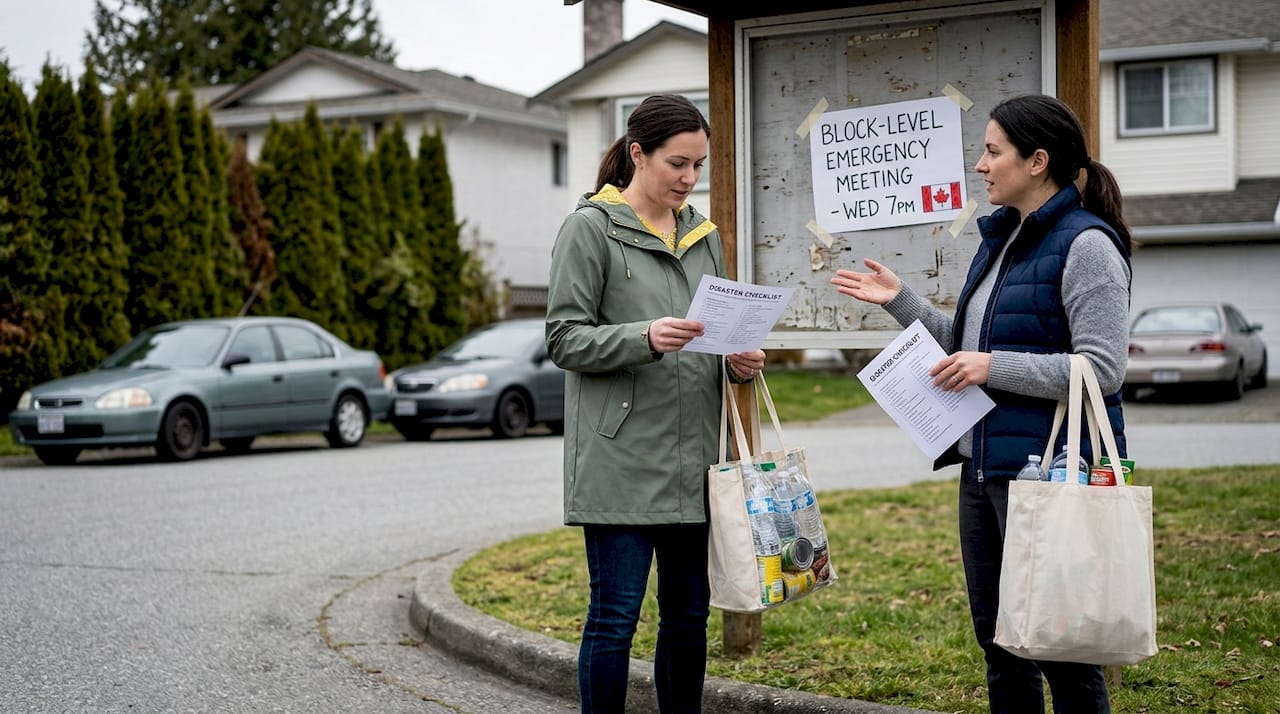
Individual action matters enormously, but the data is clear: community engagement predicts the highest levels of preparedness. Neighbourhoods where people know each other, share resources, and organise together recover faster and with fewer casualties.
Here is how you can contribute beyond your own household:
- Talk to your neighbours about their plans and share what you have learned
- Organise a neighbourhood drill or join a local ShakeOut event
- Share resources like water storage or tools with nearby families who may lack them
- Connect with your local emergency programme to find out about community response training
- Encourage your workplace or school to develop and practise an emergency plan
“When one household prepares, it helps that family. When a whole block prepares, it can save the entire street.”
Reading about community preparedness tips gives you practical ideas for extending your efforts beyond your front door. The more people in your community who are ready, the less chaos there will be when a major event actually occurs.
Special cases: Aftershocks, tsunamis, and insurance gaps
Even a solid plan can have blind spots. These are the areas BC families most commonly overlook.
Aftershocks are not a minor footnote. They can continue for days or even weeks after the main event, sometimes strong enough to collapse structures already weakened by the initial quake. Stay out of damaged buildings until they have been assessed by a structural engineer.
Tsunami risk is real for coastal BC residents. If you feel long or intense shaking near the coast, do not wait for an official warning. Move to high ground immediately. Every minute counts. Your survival kit advice should include a planned evacuation route to higher elevation.
Utility disruption can last far longer than most people expect. Gas leaks, broken water mains, and downed power lines are common after a major quake. Know how to shut off your home’s utilities before you need to.
Insurance gaps are a serious financial risk. Only 50 to 65% of BC homeowners carry earthquake insurance, meaning a large portion of the population faces potentially devastating out-of-pocket costs after a major event.
Key aftershock and secondary hazard reminders:
- Expect multiple aftershocks and plan to shelter in place if your building is safe
- Check for gas smells before using any open flame or electrical switch
- Avoid tap water until authorities confirm it is safe
- Keep your kit accessible even after the initial shaking stops
Pro Tip: Add earthquake insurance to your annual home insurance review. The premium is modest compared to the potential loss, and it is one of the most overlooked gaps in BC household financial planning.
Get prepared with trusted BC earthquake kits
With your plan in place, the final step is making sure you have the right supplies on hand and ready to go. Knowing what to do is only half the equation. Having the gear to back it up is what turns a plan into real protection.
At EarthquakeKit.ca, we make it simple to get equipped without the guesswork. Whether you are outfitting a single apartment or a large family home, our basic earthquake kits give you a reliable starting point. Families who want more robust coverage can step up to our deluxe earthquake kits, which include expanded supplies for longer self-sufficiency. For workplaces, schools, and strata buildings, our group earthquake kits are designed to cover multiple people efficiently. Every kit is built for BC conditions and ready to use the moment you need it.
Frequently asked questions
How does disaster planning reduce earthquake injuries?
Preparedness lowers earthquake injuries and fatalities by ensuring families know how to respond physically, where to shelter, and have the essential supplies to manage the immediate aftermath without outside help.
What is the most important item for earthquake preparedness?
Water is the top priority. Store 4 litres per person per day for a minimum of 3 to 7 days, as municipal water systems are often disrupted after a major quake.
How long do BC families need to be self-sufficient after a major earthquake?
Plan for a minimum of 72 hours, but ideally 1 to 2 weeks without outside assistance, as infrastructure repairs and emergency response can take far longer than most people expect.
Why is community engagement important for disaster preparedness?
Community engagement predicts the highest levels of preparedness, meaning neighbourhoods that organise and plan together recover faster and with fewer casualties than those where only individuals prepare in isolation.
Recommended
- Family earthquake safety workflow for BC families 2026 – EarthquakeKit.ca
- How to organise community earthquake preparedness in BC – EarthquakeKit.ca
- Why earthquake preparedness saves BC families: 40% boost – EarthquakeKit.ca
- Emergency supplies for earthquake preparedness in BC 2026 – EarthquakeKit.ca