

How government supports earthquake readiness in BC
Posted by Karl Lundgren on
British Columbia experiences roughly 4,000 earthquakes annually, yet many residents remain unclear about what the government actually does to protect families and communities. From seismic retrofits in schools to early warning systems that provide precious seconds before shaking begins, provincial and federal agencies work behind the scenes to strengthen infrastructure and promote household preparedness. This guide explains the specific initiatives that safeguard BC families, clarifies what resources are available to parents and children, and outlines practical steps you can take to align with government recommendations and protect your loved ones when the next earthquake strikes.
Table of Contents
- Key takeaways
- Government infrastructure and policy for earthquake safety
- Earthquake early warning systems and public alerts
- Family and community resources for earthquake preparedness
- Insurance coverage and risk assessment insights
- Earthquake preparedness solutions for BC families
- Frequently asked questions
Key Takeaways
| Point | Details |
|---|---|
| Government led preparedness | Emergency Management BC and PreparedBC coordinate guides and public education to promote family kits, plans and a unified response with federal agencies. |
| Seismic school retrofits | The Provincial Seismic Mitigation Programme uses SRG 2023 to upgrade low rise schools for life safety with cost effective reinforcements and a 2030 deadline. |
| Critical infrastructure upgrades | The ministry prioritises hospitals, fire stations and emergency operations centres to stay operational after a major earthquake through seismic upgrades and backup power and communication systems. |
| Early warning alerts | British Columbia participates in the Earthquake Early Warning system through the National Public Alerting System that sends automated alerts to phones, televisions and radios before shaking begins. |
| Household preparedness encouraged | Families are encouraged to assemble emergency kits, make family plans and follow guidance on Drop, Cover and Hold On. |
Government infrastructure and policy for earthquake safety
The Province of British Columbia, through Emergency Management BC and PreparedBC, leads earthquake preparedness by providing guides, promoting emergency kits, family plans, and the Drop, Cover, and Hold On methodology. Emergency Management BC coordinates with local governments, Indigenous communities, and federal agencies to ensure a unified response framework when disasters strike. The Ministry of Emergency Management and Climate Readiness oversees policy development, funding allocation, and public education campaigns that reach every corner of the province.
One of the most visible government initiatives is the Provincial Seismic Mitigation Programme for schools, which began in 2004 under the Ministry of Education. This programme uses the Seismic Retrofit Guidelines (SRG 2023) to perform life-safety upgrades in low-rise school buildings, focusing on cost-effective structural reinforcements that prevent catastrophic collapse. The original deadline for completing these retrofits was repeatedly extended and now stands at 2030, reflecting the technical complexities and funding challenges involved in upgrading hundreds of older buildings across the province. Parents can check with their local school district to see which schools have been retrofitted and what timelines remain for outstanding projects.
Beyond schools, the government prioritises upgrades in critical infrastructure such as hospitals, fire stations, and emergency operations centres. These facilities must remain operational immediately after a major earthquake to coordinate rescue efforts and provide medical care. The BC Ministry of Emergency Management report outlines capital investments in seismic upgrades and highlights the importance of resilient infrastructure in reducing fatalities and economic losses.
Key government infrastructure initiatives include:
- Seismic retrofits for schools, hospitals, and emergency facilities to prevent collapse
- Updated building codes that require new construction to meet higher earthquake resistance standards
- Investment in backup power systems and communication networks that function after grid failures
- Coordination with municipalities to identify and reinforce vulnerable bridges and overpasses
- Public education campaigns that teach families how to secure heavy furniture and water heaters
Pro Tip: Visit the earthquake preparedness checklist for BC residents to see how government recommendations translate into specific household actions, and explore choosing the right earthquake kits for BC families for guidance on assembling supplies that meet provincial standards.
The Seismic Retrofit Guidelines (SRG 2023) provide engineers with standardised methods for assessing and upgrading buildings, ensuring consistency across projects and maximising the effectiveness of public spending. These guidelines balance life-safety goals with fiscal realities, focusing on interventions that deliver the greatest risk reduction per dollar invested.
Earthquake early warning systems and public alerts
British Columbia participates in the Earthquake Early Warning (EEW) system through the National Public Alerting System, which sends automatic alerts to phones, televisions, and radios when seismic sensors detect the initial waves of an earthquake. These alerts provide seconds to tens of seconds of warning before the more destructive shaking waves arrive, giving people time to Drop, Cover, and Hold On. The system relies on a network of seismometers that continuously monitor ground motion, and sophisticated algorithms that calculate the earthquake’s location, magnitude, and expected intensity at various locations.
When an earthquake begins, the fastest seismic waves (called P-waves) travel ahead of the slower, more damaging S-waves and surface waves. Sensors detect the P-waves and immediately transmit data to processing centres, which issue alerts to areas that will experience strong shaking. The farther you are from the earthquake’s epicentre, the more warning time you receive. Even a few seconds can be enough to move away from windows, get under a sturdy desk, or stop a vehicle safely.
The National Public Alerting System uses the same infrastructure that delivers AMBER Alerts and severe weather warnings, ensuring that earthquake alerts reach the widest possible audience. Your phone will emit a loud, distinctive tone and display a message describing the expected shaking intensity and recommended actions. You do not need to download an app or subscribe to a service; the alerts are automatic for all compatible devices connected to Canadian cellular networks.
Steps to take when you receive an earthquake alert:
- Immediately Drop to your hands and knees to prevent being knocked over.
- Cover your head and neck under a sturdy table or desk, or against an interior wall away from windows.
- Hold On to your shelter and be prepared to move with it if the shaking causes it to shift.
- Stay in position until the shaking stops completely, then check for injuries and hazards before moving.
- Follow your family emergency plan and communicate with household members once it is safe to do so.
Pro Tip: Practise your Drop, Cover, and Hold On response with your family at least twice a year so that everyone reacts instinctively when an alert sounds, and keep emergency supplies for earthquake preparedness in accessible locations throughout your home.
“The Earthquake Early Warning system is not earthquake prediction. It detects an earthquake in progress and alerts people before the strongest shaking reaches them. The warning time varies depending on your distance from the earthquake’s source, and the system prioritises speed over precision to maximise protective actions.”
The EEW system is still evolving, with ongoing investments in additional sensors and faster processing algorithms. As the network expands and technology improves, warning times will increase and accuracy will improve, providing even greater opportunities for people to protect themselves before shaking begins.
Family and community resources for earthquake preparedness
The Province of British Columbia offers multilingual household preparedness guides that explain how families can create emergency plans, assemble 72-hour kits, and practise earthquake drills with children. These guides are available in languages including Punjabi, Mandarin, Cantonese, and Tagalog, reflecting the province’s diverse population and ensuring that all residents can access life-saving information in their preferred language.
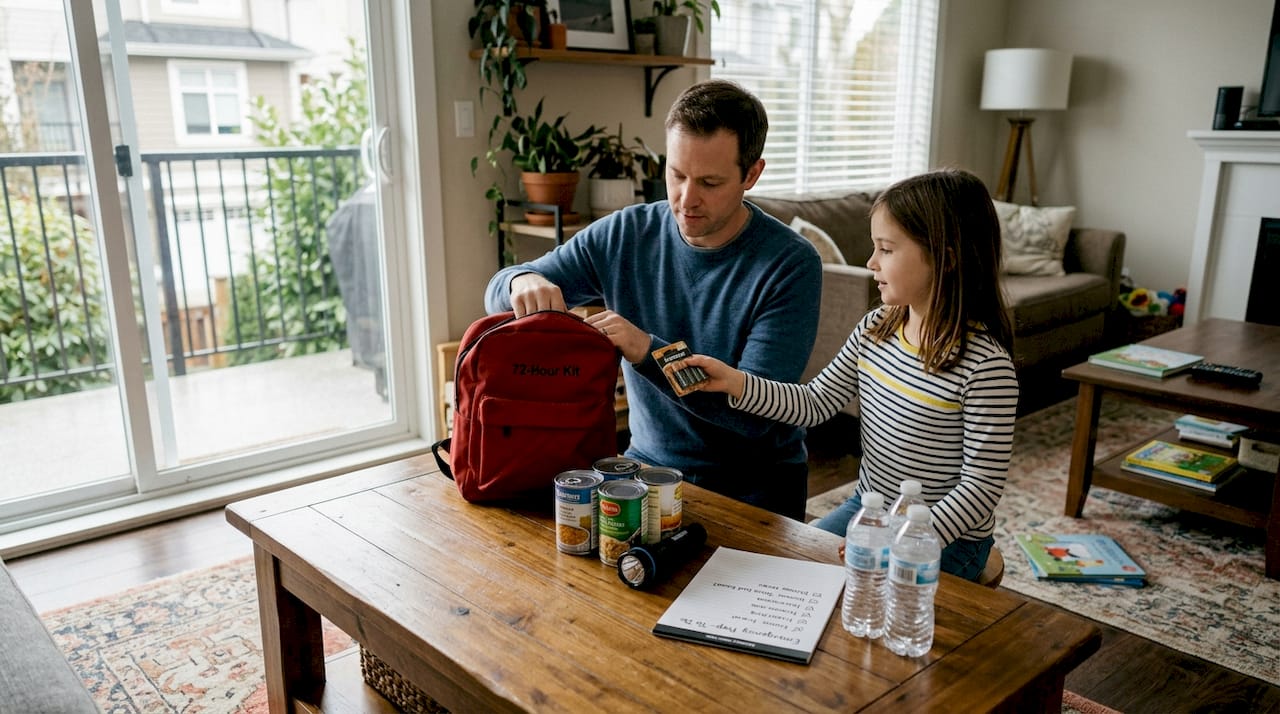
The Great BC ShakeOut is an annual earthquake drill that involves over one million participants across the province, including schools, workplaces, and community organisations. This coordinated drill reinforces the Drop, Cover, and Hold On response and provides an opportunity for families to test their emergency plans and identify gaps in their preparedness. Schools participate by conducting earthquake drills during the ShakeOut, teaching children how to protect themselves and where to reunite with parents after a disaster.
Government resources tailored for families include:
- Household Preparedness Guide with step-by-step instructions for creating family communication plans
- School emergency guides that explain evacuation procedures and parent reunification protocols
- Kid-friendly emergency kit checklists that help children understand what supplies are needed and why
- Community drill programmes that bring neighbours together to practise coordinated response
- Online videos and infographics that demonstrate proper earthquake response techniques
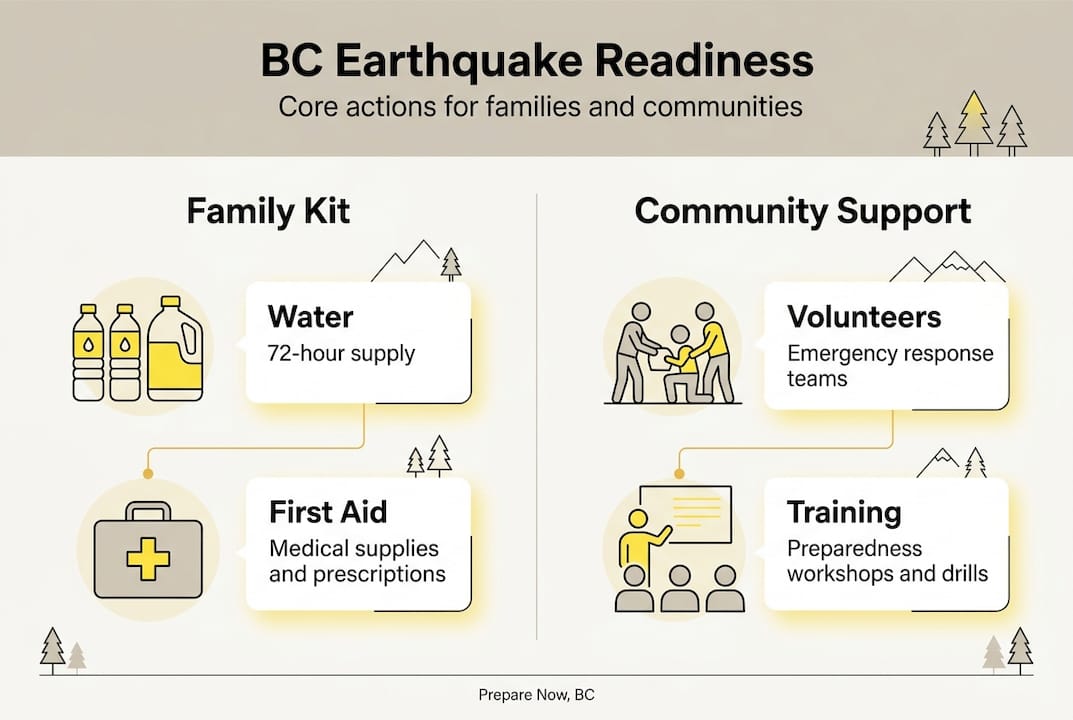
PreparedBC recommends that every household maintain a 72-hour emergency kit containing water, non-perishable food, first aid supplies, medications, flashlights, batteries, and important documents. The government emphasises self-sufficiency because emergency services will be overwhelmed immediately after a major earthquake, and it may take days before help reaches every neighbourhood. Families who prepare in advance reduce the burden on first responders and improve their own chances of staying safe and comfortable during the chaotic aftermath.
| Resource type | Target audience | Key features |
|---|---|---|
| Household Preparedness Guide | All BC families | Multilingual, step-by-step planning, kit checklists |
| Great BC ShakeOut | Schools, workplaces, community groups | Annual drill, coordinated response practice |
| School emergency guides | Parents and educators | Evacuation procedures, reunification plans |
| Kid-friendly kits | Children and families | Age-appropriate supplies, educational materials |
Explore the government-endorsed BC earthquake kits that meet provincial recommendations, and review the earthquake kit organisation guide for BC families to ensure your supplies are accessible and well-maintained.
Community preparedness programmes also train volunteers in emergency response skills such as first aid, search and rescue, and damage assessment. These programmes create networks of trained citizens who can assist neighbours and support professional responders when disasters overwhelm official resources. Many municipalities offer free or low-cost training sessions, and participation strengthens community resilience by building relationships and trust before emergencies occur.
Insurance coverage and risk assessment insights
The majority of homeowners in Metro Vancouver and Vancouver Island carry earthquake insurance coverage, but no provincial Disaster Financial Assistance programme exists for earthquake losses. This means that families without insurance will bear the full cost of repairing or rebuilding their homes after a major quake. Standard home insurance policies in BC typically include earthquake coverage as an optional endorsement, and most lenders require it for properties in high-risk areas.
Earthquake insurance comes with higher deductibles than other types of coverage, often ranging from 10% to 20% of the home’s insured value. This means that if your home is insured for $500,000 and your earthquake deductible is 15%, you will pay the first $75,000 of repair costs out of pocket before insurance coverage begins. These high deductibles reflect the catastrophic nature of earthquake risk and the potential for widespread simultaneous claims that could strain insurance markets.
Scientists estimate the risk of a major M9.0 Cascadia earthquake at 2% to 10% over the next 30 years, with potential impacts including 3,400 or more fatalities, 18,000 buildings destroyed, and economic losses exceeding $128 billion. This scenario represents the worst-case outcome, but even smaller earthquakes can cause significant damage and disruption. The 2001 Nisqually earthquake in Washington State, a magnitude 6.8 event, caused over $2 billion in damage and highlighted the vulnerability of older buildings and infrastructure.
| Insurance aspect | Details |
|---|---|
| Coverage availability | Most BC home policies offer earthquake endorsements |
| Deductibles | Typically 10% to 20% of insured home value |
| Government aid | No Disaster Financial Assistance for earthquake losses |
| Risk of M9.0 Cascadia quake | 2% to 10% probability in next 30 years |
| Potential impact | 3,400+ fatalities, 18,000 buildings destroyed, $128B+ losses |
“Earthquake insurance is a personal decision that depends on your financial situation, risk tolerance, and ability to absorb large out-of-pocket costs. Many families choose coverage to protect their most valuable asset, while others rely on savings and government-backed mortgage insurance to manage risk.”
The absence of government disaster financial assistance for earthquakes means that personal insurance and preparation are critical. Families should review their policies annually, understand their deductibles and coverage limits, and consider whether their current protection aligns with their financial capacity to rebuild. Some insurers offer lower deductibles for higher premiums, and comparing quotes from multiple providers can reveal significant differences in cost and coverage.
Learn about choosing the right earthquake emergency kits for BC families to complement your insurance strategy with practical supplies that help you survive and recover after a quake.
Insurance markets may face severe strain after a major earthquake, with some carriers potentially unable to pay all claims promptly. This reality underscores the importance of diversifying your risk management strategy by combining insurance with personal preparedness, financial reserves, and community connections that provide mutual support during recovery.
Earthquake preparedness solutions for BC families
Now that you understand the government’s role in earthquake readiness, it’s time to take action. Ready-to-go emergency kits tailored for BC families follow government guidelines for 72-hour self-sufficiency, providing water, food, first aid, and communication tools in one convenient package. Whether you need a basic earthquake kit for your household, group earthquake kits for larger families or community organisations, or the government-endorsed BC earthquake kit that meets provincial recommendations, you’ll find options that simplify compliance with PreparedBC standards.
Expert advice is included to help you choose the right kit for your family size, living situation, and specific needs. Kits are organised for quick access during emergencies, with clearly labelled supplies and instructions that guide you through the critical first 72 hours after a quake. By investing in a quality emergency kit today, you align with government preparedness initiatives and ensure your family can remain safe and comfortable while emergency services restore order and infrastructure.
Frequently asked questions
What role does the government play in earthquake readiness in BC?
The government leads infrastructure upgrades, promotes family preparedness through PreparedBC, operates the Earthquake Early Warning system, and enforces building codes that reduce earthquake damage. Emergency Management BC coordinates response efforts and provides multilingual guides, while the seismic retrofit programme strengthens schools to protect children. However, families must take personal responsibility for assembling emergency kits, creating communication plans, and practising earthquake drills. Review the earthquake preparedness checklist for BC residents to see how government recommendations translate into household actions.
How do earthquake early warning alerts work in British Columbia?
Earthquake early warning alerts detect the initial seismic waves and send automatic notifications to phones, televisions, and radios seconds before stronger shaking arrives. The system uses seismometers to monitor ground motion and algorithms to calculate expected intensity at your location. When you receive an alert, immediately Drop, Cover, and Hold On to protect yourself from falling objects and structural damage. The warning time varies based on your distance from the earthquake’s epicentre, ranging from a few seconds to tens of seconds.
What emergency supplies should families in BC prepare for earthquakes?
Families should maintain at least 72 hours of water (four litres per person per day), non-perishable food, first aid kits, prescription medications, flashlights, batteries, and communication tools such as battery-powered radios. Include important documents, cash, and supplies for infants, elderly family members, and pets. Store supplies in accessible locations throughout your home, vehicle, and workplace. Explore emergency supplies for earthquake preparedness in BC for detailed checklists and organisation tips.
Is earthquake damage covered by insurance or government aid in BC?
Most BC homeowners insurance policies offer earthquake coverage as an optional endorsement, typically with deductibles of 10% to 20% of the home’s insured value. No provincial Disaster Financial Assistance programme exists for earthquake losses, meaning families without insurance must pay all repair and rebuilding costs themselves. Review your policy annually to confirm coverage limits, understand deductibles, and ensure your protection aligns with your financial capacity to recover. Personal insurance and preparedness are essential because government aid will not cover property damage.